By Justin Head, Land Specialist, Whitetail Properties Real Estate — Missouri-licensed real estate attorney and former title company President & CEO
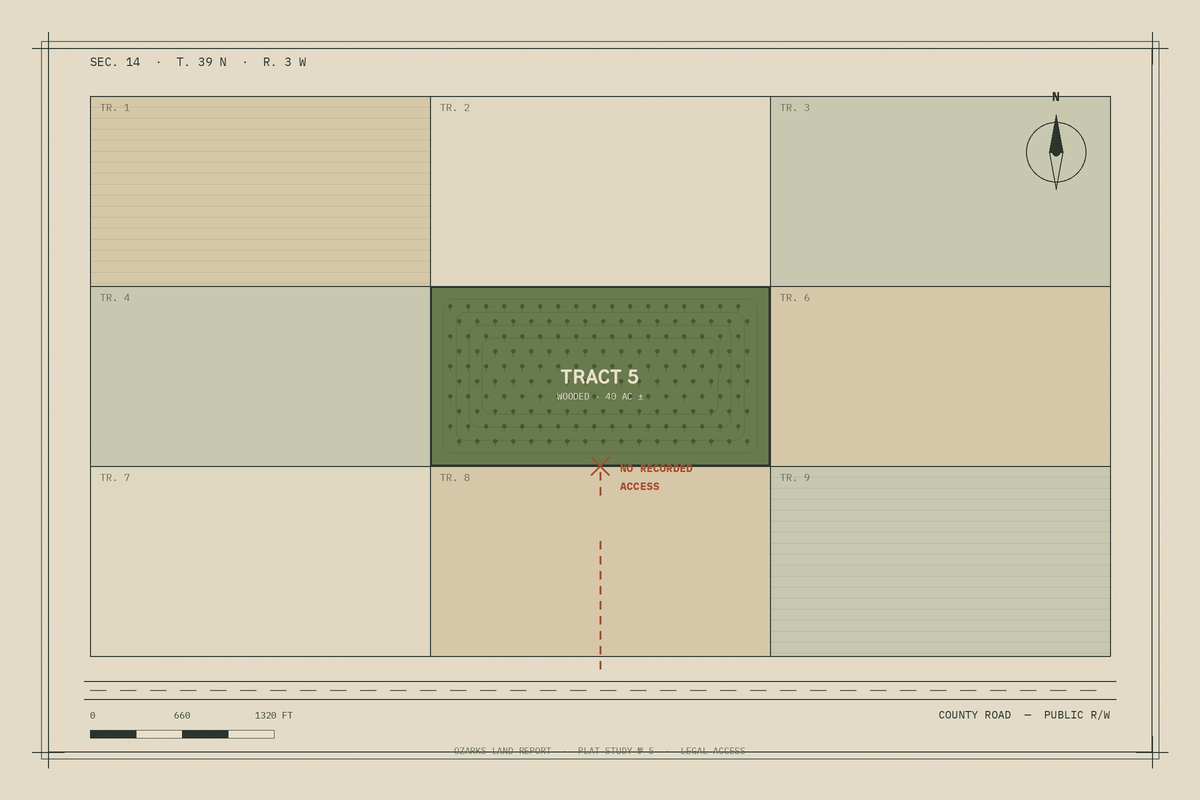
Short answer: A parcel is “landlocked” when it has no legal right of access to a public road — meaning the only way to reach it crosses someone else’s property and you have no recorded easement to do so. In the Missouri Ozarks, where many tracts border the Mark Twain National Forest or were carved out of larger family farms generations ago, landlocked and access-impaired parcels are more common than buyers expect. Before you buy rural land in Missouri, confirm legal access in writing — a gravel road you can drive today is not the same thing as a legal right to use it.
Buying a hunting tract, timber ground, or a recreational retreat in the Ozarks is one of the most rewarding purchases you can make. But access is the single issue that quietly sinks more rural land deals than any other — and it’s the one buyers are least equipped to spot on their own. Here’s how to think about it, what to check before you write an offer, and what your options are if a property turns out to be landlocked.
What does “landlocked” actually mean?
A landlocked parcel has no legal connection to a public road. You might be able to physically drive to it down a field road or a forest two-track, but if there is no recorded easement, dedicated road, or other legal right giving you permission to cross the land between your boundary and the nearest public road, your access exists only as long as your neighbor allows it.
That distinction — physical access versus legal access — is the heart of the issue:
- Physical access is whether a road, trail, or driveable route exists on the ground today.
- Legal access is whether you have an enforceable, recorded right to use that route, one that survives a sale, a fence-line dispute, or a new neighbor who decides to lock the gate.
A property can have one without the other. The dangerous case is the parcel with good physical access and no legal access — because everything looks fine right up until it isn’t.
Why access problems are so common in the Ozarks
Several things about land in Franklin, Gasconade, Crawford, Phelps, and Dent Counties make access worth scrutinizing more carefully here than in a typical suburban transaction:
- Old deeds. A lot of Ozarks land has been in the same family for decades, split and re-split among heirs with handshake understandings about who uses which road. Those understandings are often never recorded, so they don’t transfer to a buyer.
- National Forest boundaries. Properties bordering or surrounded by the Mark Twain National Forest sometimes rely on forest roads for access. Access across federal land is governed by separate rules and permits and cannot be assumed — it needs to be confirmed.
- Seasonal and shared roads. Gravel and dirt roads maintained informally by a handful of neighbors may not be public roads at all, even if they’ve been used “forever.”
- Subdivided tracts. When a large farm is divided and sold off in pieces, the back parcels can end up depending on an easement across the front parcels — and if that easement was never properly drafted and recorded, the back tract is landlocked.
How to check legal access before you buy
You don’t have to be a lawyer to do basic diligence, but you do need to look at the right documents and ask the right questions. Here is the practical order of operations.
1. Read the deed and look for an easement
Start with the seller’s vesting deed and any referenced easement documents. A deed that conveys the land “together with” a described right-of-way is a good sign. A deed that says nothing about access is a flag to dig further.
2. Order a title commitment and read Schedule B
When you go under contract, the title company issues a title commitment. Schedule B lists the easements, reservations, and exceptions that affect the property. This is where recorded access easements show up — and also where you’ll see if access is missing. Many buyers skim the commitment; on rural land, read Schedule B closely and ask the title company directly whether the parcel has recorded legal access to a public road.
3. Get a survey
A current boundary survey shows where the parcel actually sits relative to roads and neighboring tracts, and a surveyor can plot recorded easements. On larger or irregular Ozarks tracts, a survey is often the only way to know with confidence how the property connects — or doesn’t — to the public road system.
4. Check the county records and the plat
The county Recorder of Deeds and Assessor’s records can reveal recorded easements, road dedications, and how the surrounding parcels are configured. County road maps and plats show which nearby roads are public (county-maintained) versus private.
5. Ask whether the road is public or private
A road being on a map, or being gravel and graded, does not make it public. Confirm with the county whether the road you’d use for access is a county-maintained public road. If it’s private, you need a recorded easement to use it legally.
What if a property is landlocked?
A landlocked parcel isn’t necessarily a deal you should walk away from — sometimes these tracts sell at a discount and the access problem is solvable. But you need to understand the path before you buy, not after.
The cleanest solution is a recorded access easement negotiated with the neighbor who owns the land between your tract and the public road. This is a legal agreement, recorded against both properties, that gives you a permanent right of access. The time to negotiate it is before closing, ideally as a condition of your purchase.
Missouri law also provides a statutory remedy. Under Missouri’s private road / “way of necessity” statutes (Chapter 228, RSMo), an owner of landlocked property can petition the county to establish a private road across neighboring land when there is no other legal access. This is a real option, but it is a legal proceeding with costs, requirements, and no guaranteed timeline — view it as a backstop, not a substitute for confirming access up front.
Because every situation is different, anyone buying a landlocked or access-impaired parcel should have the specific facts reviewed by a Missouri real estate attorney before relying on any one solution.
A note on why this matters for value
Access doesn’t just affect whether you can reach your land — it affects what the land is worth and how easily you can sell it later. A tract with clean, recorded legal access is more valuable, easier to finance, and far easier to resell than an otherwise identical tract with a question mark over how you get to it. If you’re buying, confirming access protects your investment. If you’re selling, getting access documented properly before you list removes the single most common reason rural deals fall apart at the closing table.
Frequently asked questions
Is a parcel with a gravel road across it landlocked?
Not necessarily — it depends on whether you have a legal right to use that road, not just the physical road itself. If the road is private and you have no recorded easement, the parcel can still be legally landlocked even though you can drive on it today.
Does using a road for many years give me a permanent right to it?
Long use can sometimes create rights under doctrines like prescriptive easement, but these are fact-specific, hard to rely on, and frequently disputed. Never assume long-standing use equals a guaranteed legal right — confirm it in writing with a recorded easement.
Can I get a mortgage on landlocked land?
Many lenders will not finance a parcel without confirmed legal access, which is one reason access problems also limit your future buyer pool. This is part of why access affects resale value, not just usability.
How do I find out if the road to a property is public?
Check with the county — the Recorder of Deeds, Assessor, or county road department can tell you whether a road is county-maintained (public) or private. A title company and a surveyor can also help confirm.
What’s the difference between an easement and a public road?
A public road is maintained by and dedicated to the public, and anyone can use it. An easement is a private legal right for a specific parcel to cross specific land for access. Both can give you legal access; the key is that one of them must exist and be recorded.
One more access question shows up on these tracts: an old county roadbed the seller says nobody has used in decades. Whether it is still a public road, what that means for the gate and for your neighbor, and who owns the ground if the road is truly gone, is its own subject. Our article on Missouri road abandonment law walks through it.
Justin Head is a Missouri-licensed real estate attorney with 20 years in real estate law, a former title company President & CEO, and a Land Specialist with Whitetail Properties Real Estate serving Franklin, Gasconade, Crawford, Phelps, and Dent Counties. This article is general educational information, not legal advice; for guidance on a specific property, consult a Missouri attorney.
Thinking about buying or selling land in the Missouri Ozarks? Get a free, no-obligation land valuation or call Justin Head at 573.308.7376 or Ryan Record at 573.259.6360.
Related reading: Missouri Water Law: Who Owns the Creek, Who Can Float It, and What That Means for Your Land