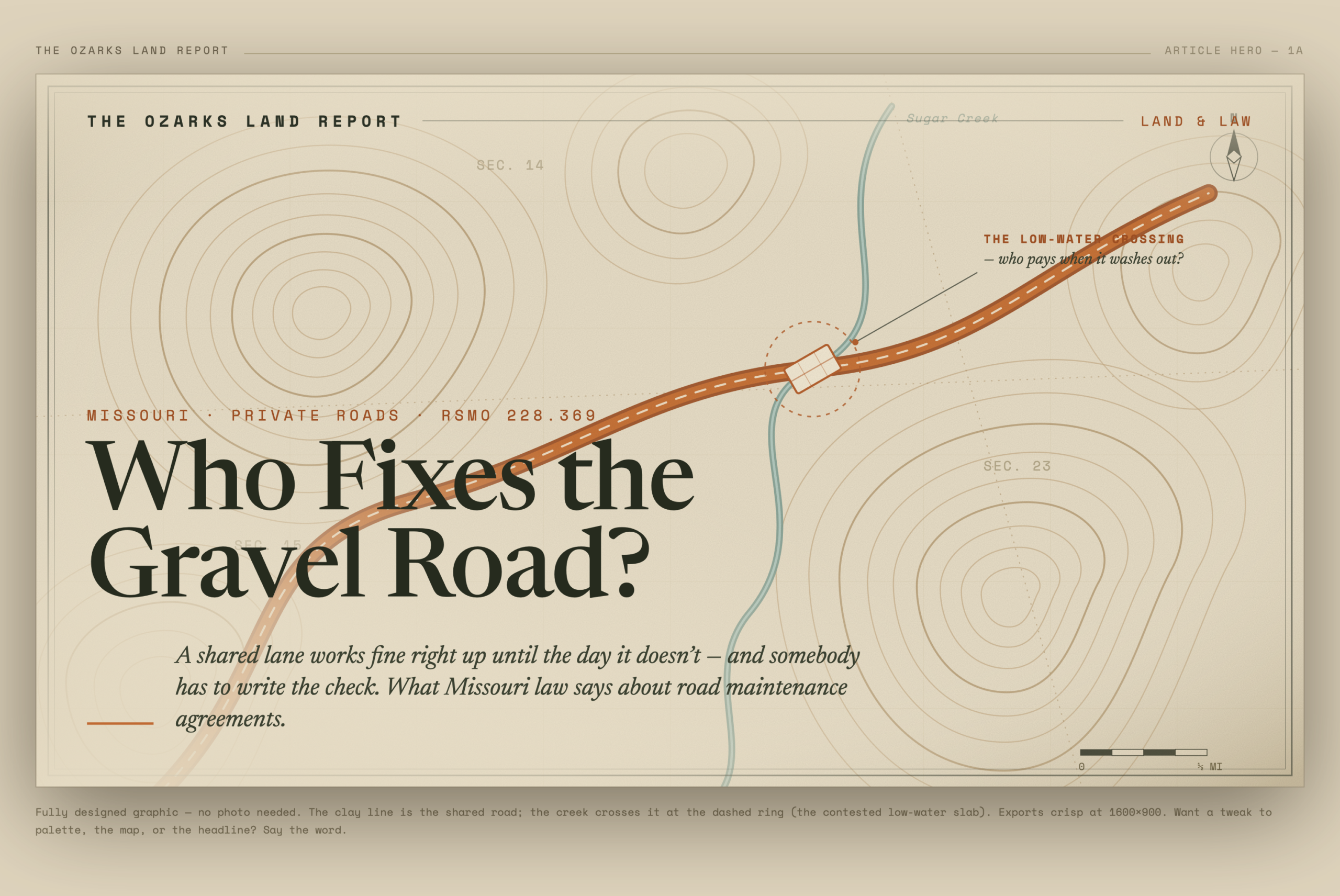
If you own rural land in Missouri, odds are good that you reach it over a road you don’t entirely own. A shared gravel lane, a private drive crossing a neighbor’s ground, a low-water slab over a creek, an easement that three or four families all rely on to get home. It works fine right up until the day it doesn’t, and somebody has to write a check to fix it.
That’s when I get the phone call: “The road’s washing out and my neighbor won’t pay a dime. Who’s actually responsible for this?” It’s one of the most common questions I hear, and the answer depends almost entirely on one thing: whether anybody ever put it in writing.
I’ve seen this one from more than one chair. I’ve advised landowners on it, and I’ve also served as a mediator on this exact scenario, sitting between neighbors trying to sort out who owes what for a shared road. So what follows isn’t just the law on paper; it’s what actually tends to happen when the gravel runs out and the goodwill runs thin.
One quick boundary before we start. This article is not about whether you have the legal right to use the road in the first place. That is a separate access and easement question. This article assumes the road is being used and focuses on who maintains it, who pays, and why the answer should be in writing.
When nothing is in writing
Start with the default. If there’s no written maintenance agreement, recorded covenant, or useful language in anybody’s deed, Missouri falls back on old common-law rules about easements. The general default is that the people who use and benefit from the road are expected to keep it usable. The owner of the ground under the road is not automatically responsible for maintaining it just because the road crosses his land, and he doesn’t have to improve it for everybody else’s benefit either.
That sounds tidy on paper. In practice it’s a mess. The common law tells you, in general terms, that the users bear the cost, but it doesn’t tell you how much each one pays, who hires the contractor, or what happens when one stubborn neighbor refuses to participate. Those gaps are exactly what turn a pothole into a lawsuit.
Missouri’s fix: asking a court to step in
In 2012 the legislature gave homeowners and certain easement holders a tool for this exact situation. It’s RSMo Section 228.369, and it does something that didn’t clearly exist before: it lets a court create a road maintenance plan when the neighbors can’t agree on one themselves.
Here’s how it works. When a private road serves more than one household, and the benefitted owners can’t agree in writing on a plan for maintaining, repairing, or improving it, any one of them can petition the circuit court for an order setting up a plan. The court can apportion the cost among everyone who benefits, and it has real flexibility in how. The statute lets the court divide the cost commensurate with each owner’s use and benefit, and spells out several methods it can use: equal shares, proportionate to assessed value, by front footage, or by usage and benefit. If the owners can’t even agree on who should oversee the work, the court can appoint disinterested commissioners to design the plan and name a supervisor to carry it out. Once a plan is set, it gets recorded with the county, and any benefitted homeowner or holder of an easement to use the private road can go to court to enforce it.
Courts have used this with some creativity. In Stieren v. Grothaus, 559 S.W.3d 70 (Mo. App. E.D. 2018), a Jefferson County case involving Sugar Mountain Road, the appellate court approved dividing a single road into two sections with a separate annual assessment for each. One family’s home sat on, and used, only the front stretch of the road; the court held they couldn’t be charged for the longer subdivision portion beyond their place that they never drove on. The point is that a judge isn’t stuck with a one-size-fits-all answer; the plan can be tailored to how the road is really used and who actually benefits from each part of it.
One caution: Chapter 228 is written around private roads serving residences and homeowners, so the statute may not fit every bare hunting tract, timber property, or farm lane with no residence on it. If your shared road serves recreational ground rather than houses, don’t assume the statutory fix is automatically available.
But the statute is not the first choice. The first choice is still a well-drafted agreement that prevents the fight before it starts.
The catch every landowner needs to understand
Now here’s the part that surprises people, and it’s the real reason I wanted to write this.
Section 228.369 is most useful when there is no recorded maintenance agreement or court order that actually covers the benefitted owners and the maintenance problem at issue. The statute itself points this direction, letting a court act “in the absence of a prior order or written agreement for the maintenance of the private road, including covenants contained in deeds or state or local permits.” So if there is already a recorded agreement or covenant that collectively covers all the benefitted owners, that document may control and may prevent the court from creating a new statutory maintenance plan.
It’s not quite all-or-nothing, though, and the nuance matters. In Maue v. Fiedler Acres Subdivision, 614 S.W.3d 601 (Mo. App. E.D. 2020), the court of appeals held that a prior agreement or covenant binding fewer than all the benefitted landowners does not automatically bar a Section 228.369 action. The key question is whether there’s a recorded agreement or covenant collectively affecting all the landowners who benefit from the private road. A side deal that covers only some of the neighbors is not the same as a document that covers everyone, and the court refused to read the statute in a way that would let a few owners shut the rest out of it.
That’s a good reason to have an agreement, and usually it is. But it cuts the other way too, and this is the trap. If your agreement is narrow or poorly drafted, it can limit or preclude the statutory fix while still leaving real expenses unassigned.
I’ll give you a live example. I recently looked at a recorded road maintenance agreement for a shared gravel road. It was signed by all the owners, properly recorded, looks official. But the operative language said the owners would split the cost of maintenance, “limited to graveling, blading and ditching of same, and maintenance of any culverts therein.” Four categories. That’s it. Graveling. Blading. Ditching. Culverts. Not bridges. Not low-water slabs. Not creek crossings. Not brush clearing. Not gates. Not storm cleanup.
So what happens when the bridge needs work, or the concrete slab over the creek washes out, or the brush along the road needs cutting back? None of those are graveling, blading, ditching, or culverts. At minimum, that creates a serious fight over whether the recorded agreement already controls the subject or whether the missing items can still be addressed through another legal route. Either way, the owners are back in the expensive uncertainty the agreement was supposed to prevent.
A narrow agreement, in other words, can sometimes be worse than no agreement at all.
What a good agreement should actually cover
The lesson isn’t “don’t sign an agreement.” It’s “if you’re going to have one, make it comprehensive.” When I help clients put one together, or review one before they sign it, I want it to address the whole picture, not just the easy gravel-and-grading part:
- Everything that can break. The road surface, yes, but also bridges, culverts, low-water slabs and creek crossings, drainage and ditching, brush and tree trimming, snow and ice removal, signage, and gates. If a structure is part of getting down the road, name it.
- How costs are split, and the method. Equal shares are simple but not always fair; usage-based or front-footage splits may fit better depending on the road.
- Who’s in charge. Name a person or a simple process for getting estimates, hiring the work, and collecting everyone’s share.
- What happens when someone won’t pay. Spell out interest, the right to collect, collection costs, and who covers attorney’s fees in a dispute.
- Emergency repairs. If a washout, fallen tree, failed culvert, or storm blocks access, the agreement should say who can authorize immediate work and how the cost gets collected afterward.
- Extraordinary damage. If one owner’s logging, construction, cattle operation, commercial use, renters, guests, or heavy equipment tears up the road, the agreement should say whether that owner pays more than the normal share.
- The maintenance standard. Does the road merely need to remain passable by ordinary vehicles, or is the goal year-round access for trailers, emergency vehicles, delivery trucks, farm equipment, and school buses?
- Future owners. Make it run with the land, bind successors and assigns, and get it recorded, so it binds whoever buys in next and shows up in a title search.
Those last few are not filler. When I’ve mediated these disputes, the emergency-repair question and the extraordinary-damage question are the two that blow up most often, because that’s where one neighbor feels stuck with a bill that somebody else’s choices created. Settle those on paper while everyone is still friendly and you head off the exact arguments I get hired to referee. A page or two of careful drafting up front is a fraction of the cost of one washed-out crossing and a neighbor who won’t share the bill.
A road runs both ways
One last thing, and it’s the part the statute can’t put in writing. Where Section 228.369 applies, it is there if you need it, but in my experience the courthouse is rarely the best place to settle these. When I’ve mediated road disputes, the thing that’s always in the room, whether anybody says it out loud or not, is that these neighbors still have to live next to each other when it’s over. The person you fight with over a culvert is the same person you’ll wave to every morning and call when your cattle get out.
That reality is usually what gets a deal done. Most of these disputes aren’t really about the money; they’re about feeling like someone else is getting a free ride. Once everyone can see the actual costs laid out and a fair way to split them, the heat tends to come out of it fast. A court order can force the issue, but a plan the neighbors built themselves is the one that still holds up five years down the road. If you’re in one of these, my honest advice is to try the table before the docket.
It’s a marketability problem too
For sellers, this is not just a neighbor problem. It is a marketability problem. A buyer may love the farm and still hesitate if the access depends on a shared gravel road, an aging creek crossing, and a vague agreement that does not say who pays when the expensive part breaks. Even when the legal access is there, vague maintenance paperwork can still create buyer hesitation, title questions, lender concern, or last-minute renegotiation. A clean, comprehensive maintenance agreement is one of the quiet things that makes rural ground easier to sell, and its absence is one of the quiet things that makes a buyer nervous at exactly the wrong moment.
The bottom line
Missouri usually gives rural owners two practical paths to a maintained private road: write a clear agreement, or, where the statute applies and there’s no written agreement or order covering the benefitted owners, ask a court to build a plan under Section 228.369. The mistake to avoid is the one in the middle, a thin agreement that’s just complete enough to limit the statutory fix but not complete enough to actually answer the questions that come up. If you share a road, dig out whatever governs it and read every word closely. The paperwork may be in a deed, covenant, recorded agreement, subdivision document, or even a state or local permit. The best time to fix a road maintenance agreement is when everyone is dry, calm, and still speaking — not after the creek rises and the only thing left to argue about is the bill.
One caution before you reach for the maintenance statutes. If the road was ever a county road rather than a private one, the question is different: whether that road has actually been abandoned, and who owns the roadbed if it has. That is covered in our article on Missouri road abandonment law.
Buying or selling ground that depends on a shared road? Request a free, no-obligation valuation, or get in touch — we look at the access paperwork, not just the acres.
This article is general information about Missouri law, not legal advice, and reading it doesn’t create an attorney-client relationship. Every road and every easement is a little different, so if you’ve got a specific situation, talk to a lawyer about the documents that actually apply to your property.