By Justin Head — Whitetail Properties Land Specialist & Attorney
Short answer: In Missouri, a properly placed purple mark on a tree or post can serve as the legal equivalent of a “No Trespassing” sign. Under Section 569.145 of the Revised Statutes of Missouri — the “purple paint law” — a landowner or lessee can post property with purple marks instead of, or in addition to, signs. Done correctly, those marks provide legal notice against trespass and can support a charge of trespass in the first degree: generally a Class B misdemeanor punishable by up to six months in jail and a fine of up to $1,000. If you see purple paint on a Missouri property line, treat it exactly like a posted sign and stay off the land unless you have permission.
Drive the back roads of the Missouri Ozarks long enough and you start noticing them — short purple stripes brushed onto fence posts and the trunks of trees along a property line. To a lot of people they look like trail markers or somebody’s idea of decoration. They are neither. In Missouri, that purple paint is a legal “keep out,” and it carries the same weight as a posted sign.
I get asked about it constantly — by landowners who want to protect their ground without nailing up signs that get shot full of holes or torn down, and by hunters and buyers who want to know whether they are allowed to step across that line. This is the plain-English answer, straight from the statute, with the practical side that only comes from actually walking and selling this ground. I am a Missouri-licensed attorney as well as a land agent, so I will give you the law precisely — and tell you how it actually plays out in the field across Franklin, Gasconade, Crawford, Phelps, and Dent Counties.
What the Missouri purple paint law actually is
Missouri’s purple paint law is Section 569.145 of the Revised Statutes of Missouri. The legislature first added it in 1993 and refined the details in later amendments, with the current version in force since 2017. The idea is straightforward: in addition to the traditional ways of posting land, an owner or lessee “may post the property by placing identifying purple marks on trees or posts around the area to be posted.”
That framing matters. Purple paint is not a separate, lesser kind of notice. The statute expressly provides that posting this way “shall be found to be reasonably likely to come to the attention of intruders” for purposes of Missouri’s trespass law. In plain English: a proper purple mark is legally equivalent to a “No Trespassing” sign. It does the same job — it just does not blow down, fade off, rust out, or get pulled off the fence and tossed in a ditch.
The exact rules: how a landowner has to mark the line
Here is where most online explanations get sloppy, and where the lawyer in me wants to be precise — because if you do not follow the specifications, your “posting” may not actually be valid. The statute gives landowners two approved methods.
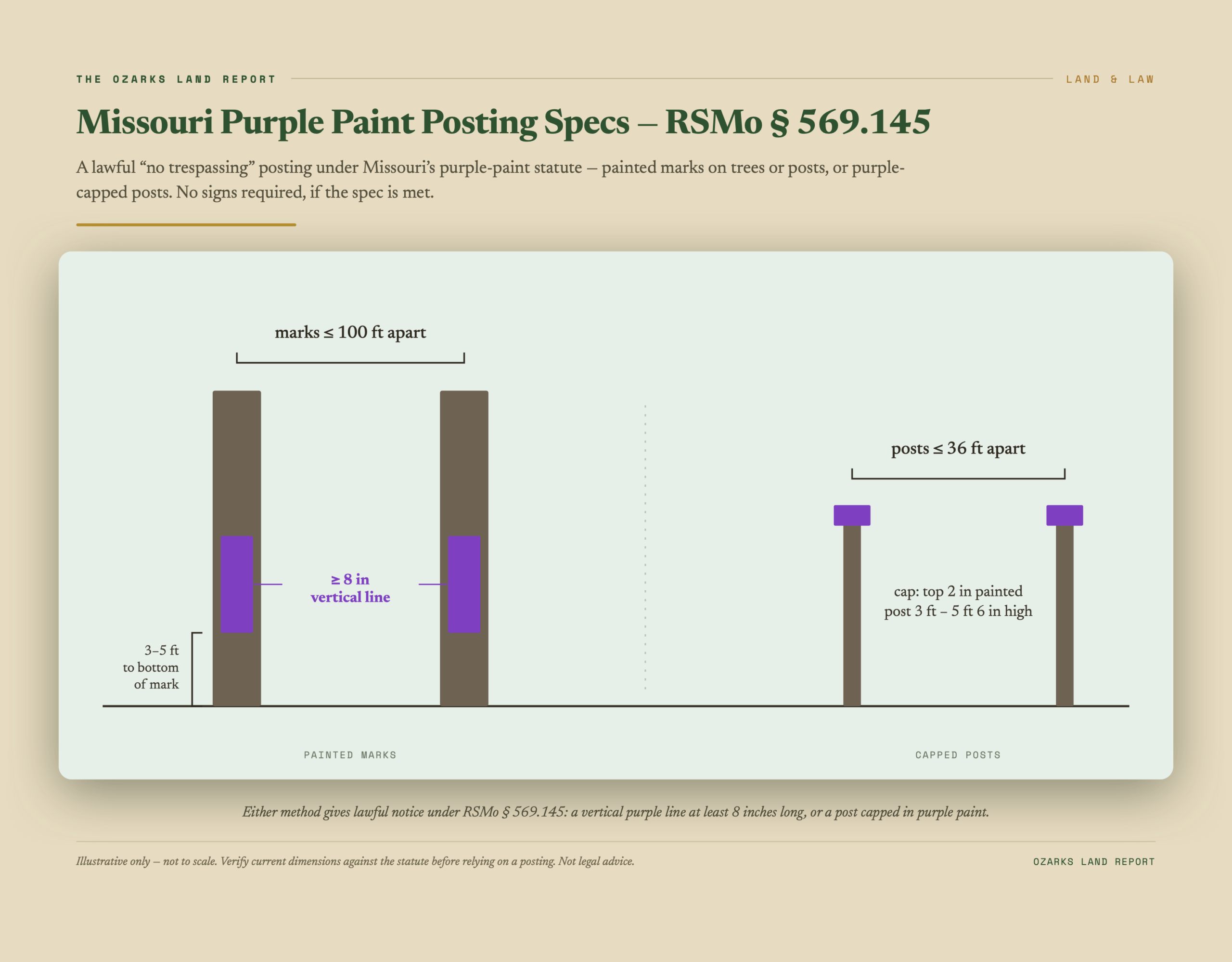
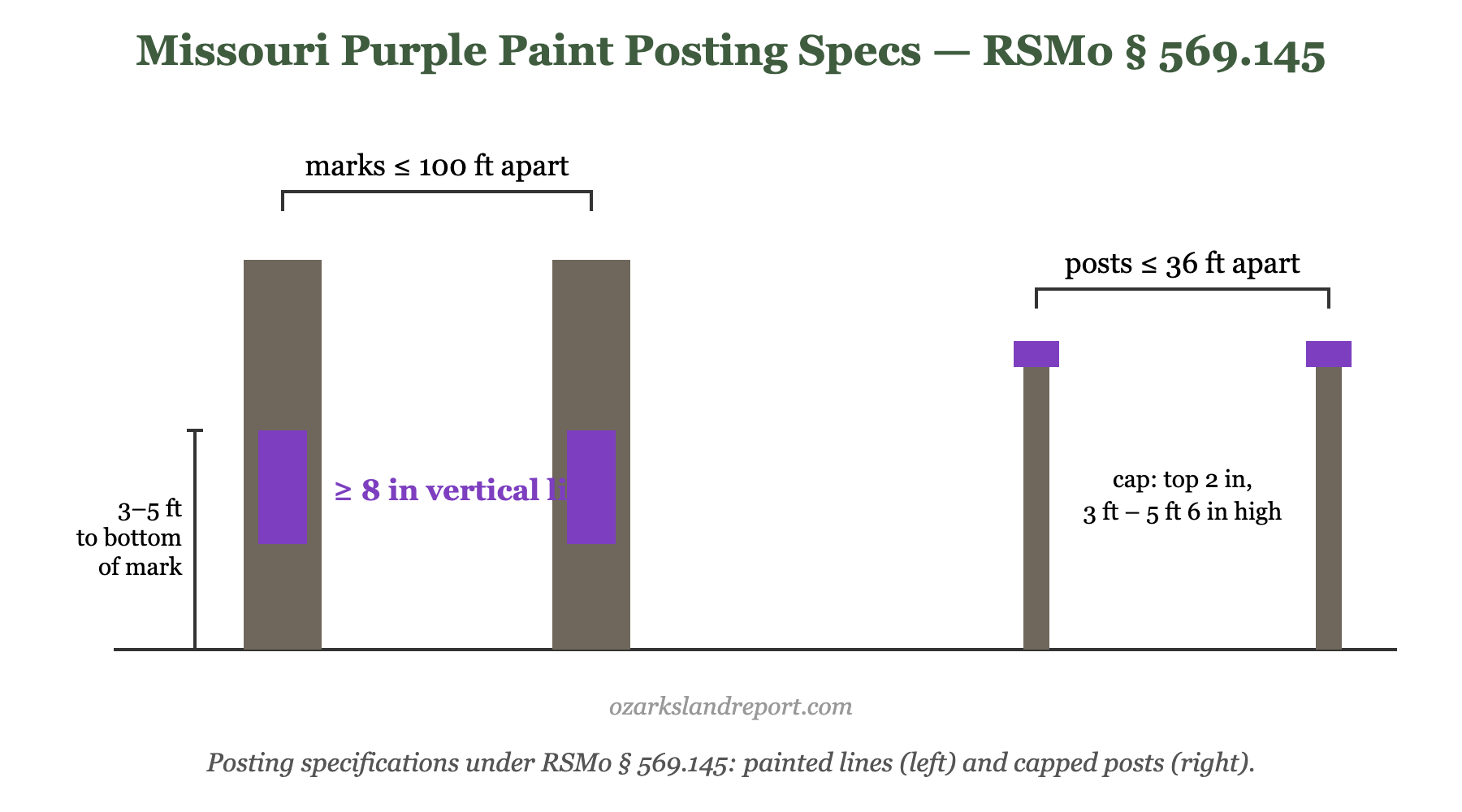
Method 1 — purple lines on trees or posts
- Each mark is a vertical purple line at least eight inches long. (The statute sets a minimum, not a maximum — longer is fine.)
- The bottom of the mark must sit no less than three feet and no more than five feet off the ground.
- Marks must be placed no more than 100 feet apart.
- Each mark must be readily visible to anyone approaching the property.
Method 2 — capped or marked posts
- A post capped or otherwise marked on at least its top two inches.
- The bottom of that cap or mark must be no less than three feet but no more than five feet six inches high.
- Those posts must be no more than 36 feet apart and, again, readily visible.
- One catch most people miss: if the mark is on a shared fence and is visible from both sides — effectively posting both sides of the fence — the statute requires agreement from all owners or lessees who share that fence.
A few details worth flagging. The marks go on trees or posts, not on buildings. The “readily visible to any person approaching” standard means the marks need to face outward toward where someone would come from, not inward. And purple is the only color the statute recognizes for this — green, orange, or red paint does not do the job under Missouri’s purple paint statute.
Why purple, and why it beats signs
The usual explanation for choosing purple over, say, red is twofold: purple stands out against bark and foliage because it is not a color that occurs much in nature, and, unlike red, it remains distinguishable to most people with the common red-green forms of color blindness. Whatever the reasoning, the practical advantage is obvious to anyone who owns rural ground. Signs get shot, stolen, blown down, and torn off. A purple mark brushed onto a hardwood does not. Several manufacturers now sell a latex “boundary marking” paint formulated for exactly this purpose — you will find it at farm and hardware stores around the state, and you can brush it on as a semi-paste or thin it to spray. It is cheaper than signs and lasts for years.
What crossing purple paint actually means (the part with teeth)
This is the question I get most, and it pays to understand the structure of Missouri trespass law, because purple paint changes which charge applies. Missouri has two degrees of criminal trespass.
- Trespass in the second degree (Section 569.150) covers simply entering someone’s land unlawfully. It is what the law calls an “absolute liability” offense — a prosecutor does not have to prove you knew or intended anything; entry is enough. But it is only an infraction, with a fine up to $400 and no jail time. This is the baseline that applies even to unmarked, unposted ground.
- Trespass in the first degree (Section 569.140) is the serious one. It applies when a person knowingly enters or remains on real property that is either fenced or enclosed in a way designed to exclude intruders, or as to which notice against trespass is given by actual communication (“get off my land”) or by posting “in a manner reasonably likely to come to the attention of intruders.” First-degree trespass is a Class B misdemeanor — up to six months in the county jail and a fine of up to $1,000.
Here is the connection: the purple paint statute expressly says that marking your land this way satisfies that “posting” element. So purple paint is what moves the offense up from a $400 infraction to a jailable misdemeanor. That is the whole point of posting — it puts a trespasser on notice and gives the charge real teeth.
One accuracy note, because I see it wrong almost everywhere — including on otherwise-reliable sites and printed handouts: the maximum fine for first-degree trespass is commonly listed as $500. That figure was correct under Missouri’s old criminal code. When the revised code took effect in 2017, the maximum fine for a Class B misdemeanor rose to $1,000. If a website, a sign, or a brochure tells you $500, it is quoting law that has been off the books for years.
And remember this is only the criminal side. Trespass is also a civil wrong, and clean, well-documented posting helps a landowner there too.
For landowners: how to post your land the right way
If you own ground here and you want to post it, do it correctly — sloppy posting is worse than no posting, because it gives you false confidence.
- Follow the spec exactly. Eight-inch minimum vertical lines, bottoms three to five feet up, no more than 100 feet apart, facing the direction people approach from. Cut corners on the spacing or height and you hand a defense lawyer an argument that the posting was never valid.
- Hit the corners, gates, and access points hardest. Those are where people actually enter and where a court will look first. Heavy, obvious marking at every logical entry point does more work than a flawless line through the back timber.
- Use real boundary paint. The latex semi-paste products made for this last for years on bark. Cheap hardware-store spray paint fades and runs.
- Do not paint a line you are not sure of. This is the lawyer talking: if your boundary is uncertain, paint creates a record of where you claimed it was. Marking the wrong tree — or your neighbor’s — can start the exact fight you were trying to avoid. If the line is in doubt, get it surveyed before you open the paint can.
- Mind the shared-fence rule. If your marks would post a fence your neighbor shares, the statute says you need their agreement first. Get it, ideally in writing.
- Keep it up. Paint is durable, but bark grows and weather works on it. Refresh your lines every few years, and there is nothing wrong with backing them up with signs at the main entrances — belt and suspenders.
One fence-law wrinkle worth knowing: the purple paint law does not require you to fence the land too. But if you or your neighbor run livestock along that line, Missouri’s separate fence statutes still apply on top of this. Posting your boundary and maintaining a lawful fence are two different obligations.
For hunters, buyers, and anyone in the woods: what purple means for you
If you are not the landowner, the rule is short: purple paint means no. Treat a purple stripe on a tree or post exactly like a “No Trespassing” sign, because legally that is what it is. Do not cross it — not to retrieve a deer, not to “just look,” not because the gate down the road happened to be open.
For hunters, the stakes are higher than a trespass ticket. Hunting on posted ground without permission is not only first-degree trespass; it can bring Missouri Department of Conservation violations on top of it, and wildlife violations can cost you fines and your hunting privileges. A blood trail that crosses onto purple-marked ground is a phone call to the neighbor, not a fence to climb. If a wounded deer or turkey crosses onto purple-marked land, the safe answer is to contact the landowner or a conservation agent rather than crossing without permission.
For buyers walking a tract with me, I point the purple out for two reasons. It shows you where the neighbors have drawn their lines, and it is a good prompt to confirm exactly where your own prospective boundary and access actually run before you ever rely on what is painted on a tree — the same boots-on-the-ground due diligence I walk through in our guide to checking legal access before you buy.
Common misconceptions
- Purple paint is not a “for sale” marker, a survey flag, or a utility or timber-cruise mark. Those use different colors and systems. Purple, on a boundary, means posted.
- You do not need both a fence and paint. Paint alone, done to spec, is valid notice. (Livestock and fence law are a separate question, as noted above.)
- It is Missouri’s rule, not a national standard. More than a dozen other states recognize some form of purple-paint posting, but the exact specifications differ. Do not assume the height or spacing you learned in another state applies here.
- Paint on a building does not count. The statute is specific — trees or posts.
- Purple paint does not prove ownership or establish a legal boundary. It is a posting method, not a survey, deed, fence agreement, or boundary-line adjudication. If where the line actually runs is in question, that is a survey-and-title problem, not a paint problem.
Why this matters in the Ozarks
Across the five counties we work — Franklin, Gasconade, Crawford, Phelps, and Dent — a lot of the best hunting tracts, timber ground, and recreational land sits in big, lightly traveled blocks where a posted sign might last one season before it is gone. Purple paint is how many of our landowners — including absentee owners managing a place from out of state — actually keep their lines marked, and it is why you see it on so many tracts out here. Whether you are protecting your own boundaries or learning to read someone else’s, knowing what that purple stripe means — and the law behind it — is part of being a competent landowner in this part of Missouri.
If you are buying or selling land in the eastern Ozarks and want a straight read on boundaries, access, posting, or any of the title and legal questions that come with rural ground, that is exactly what we do. Call Justin at (573) 308-7376 or Ryan at (573) 259-6360, or request a free land valuation at ozarkslandreport.com.
Frequently asked questions
Is purple paint legally the same as a “No Trespassing” sign in Missouri?
Yes. Under RSMo 569.145, properly placed purple marks are deemed posting “reasonably likely to come to the attention of intruders” for Missouri’s trespass law — the same legal notice a posted sign provides. Treat a purple stripe exactly like a sign.
How high and how far apart do purple marks have to be?
Line marks on trees or posts: vertical purple lines at least 8 inches long, with the bottom of the mark 3 to 5 feet off the ground, placed no more than 100 feet apart and readily visible. Capped posts: marked on at least the top 2 inches, cap bottom between 3 feet and 5 feet 6 inches high, posts no more than 36 feet apart.
What is the penalty for crossing purple paint in Missouri?
Knowingly entering properly posted land is trespass in the first degree — a Class B misdemeanor carrying up to six months in jail and a fine of up to $1,000 under Missouri’s revised criminal code (many sites still quote the outdated $500 figure). Entering unposted land is second-degree trespass, an infraction with a fine up to $400.
Does purple paint mean the same thing in other states?
More than a dozen states recognize some form of purple-paint posting, but the required heights, lengths, and spacing differ state to state. The specifications in this article are Missouri’s — do not assume rules you learned elsewhere apply here.
This article is general educational information about Missouri law as of its writing, not legal advice, and it does not create an attorney-client relationship. Statutes change, and the right answer depends on your specific facts and boundaries. Before relying on posting to protect your property — or before entering land you do not own — consult a Missouri attorney.
Justin Head is a land specialist with Whitetail Properties and a licensed Missouri attorney. He works with buyers and sellers of farms, hunting land, timber, and recreational property across Franklin, Gasconade, Crawford, Phelps, and Dent Counties, with a focus on the legal, practical, and market issues that shape rural land ownership in Missouri.
Related reading: Missouri Water Law: Who Owns the Creek, Who Can Float It, and What That Means for Your Land