Franklin · Gasconade · Crawford · Phelps · Dent Counties, Missouri
A no-frills fall food plot built for one job: deer in front of you on Halloween
Prefer a document? Download the print edition (PDF).
Decide what you want a food plot to do before you buy a single bag of seed. That sounds obvious, and I ignored it for years. I planted whatever bag had the biggest buck on the front, hunted over it, and wondered why the deer showed up in December instead of October.
A plot cannot do everything, so the job has to match the way you actually hunt and the ground you actually have. Are you an early bow hunter who wants something green and tender in September? A rut hunter who wants deer moving through in November? A parka and muzzleloader hunter who wants standing food in the cold? And what will your dirt grow without a fight? Answer those first. Then pick the job and plant for the job.
The job here is simple. I want deer standing in the plot in daylight during the last week of October and the first weeks of November, on ordinary Ozarks ground that has never grown much of anything. My son and I hunt that stretch together every year, and that is what this plot is built for. That is it. I am not trying to feed the herd through January, and I am not trying to protect a perennial stand. This is a kill plot, and around here we just call it the Halloween plot.
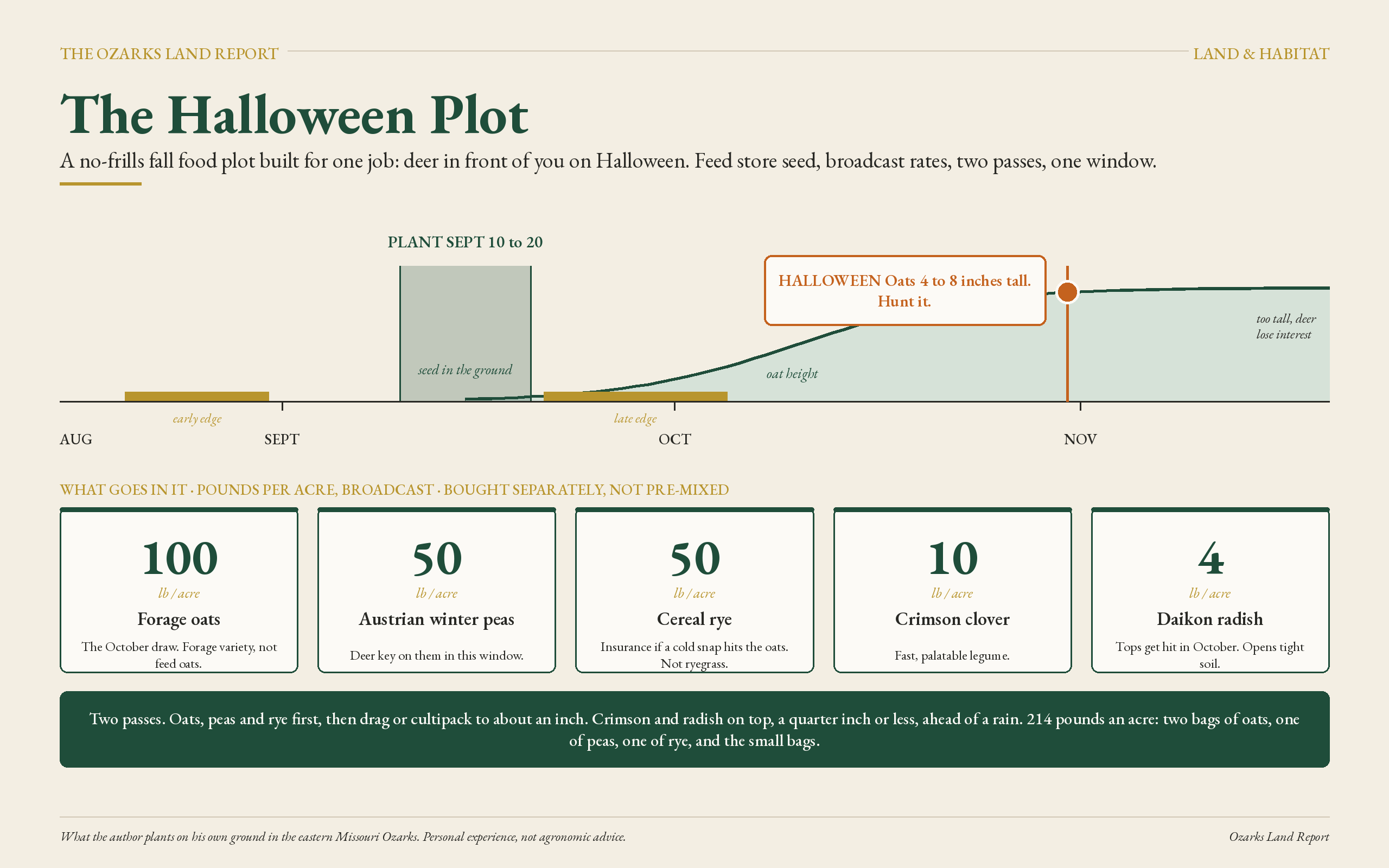
What goes in it
Everything below comes off the shelf at a local feed store. Buy each seed by the bag and keep the bags separate. Do not have them blended for you, and do not dump it all in the spreader together. The big seed and the small seed get planted at different depths, and the heavy peas and light oats separate in the hopper and come out uneven. Two passes takes ten extra minutes and fixes both problems.
Rates below are per acre, broadcast. These are the rates I use, not a recommendation from anyone with letters after their name.
Forage oats, 100 pounds. The main draw in October while it is young and tender. Buy a forage variety, not feed oats.
Austrian winter peas, 50 pounds. Deer key on them in this window. They can fade after hard freezes, which is fine, because so does the window.
Cereal rye, 50 pounds. Insurance. If an early cold snap knocks the oats back, the rye keeps the plot green. Make sure the bag says cereal rye. Ryegrass is a different plant and it is not what you want.
Crimson clover, 10 pounds. Comes up fast, gets grazed right alongside the oats, and adds a highly palatable legume to the mix.
Daikon radish, 4 pounds. The tops get hit in October before any frost. Cheap, and it opens up tight soil.
That is 214 pounds an acre. At the counter it is two bags of oats, one of peas, one of rye, and small bags of clover and radish.
When to plant it
Plant so the oats are four to eight inches tall on the day you want to hunt them. Too tall and deer lose interest. Too short and there is nothing there to hold them. For a Halloween peak in our part of Missouri, that means seed in the ground September 10 to 20. Go earlier in that range if September is running dry and later if it is wet and warm. Plant in late August, and the oats get rank and stemmy by mid-October and the peas take a beating before you are ever in a stand. Wait until October and the oats and rye still make it, but the peas, clover and radish run out of daylight, so skip the radish and lean on the oats.
Putting it in
Start with a clean, firm seedbed. Do not turn me in to the soil police, but I use a disc for this. The big seed needs to be covered, so this is not a throw-and-go plot, but it is close. If you run a drill instead of a spreader, adjust the rates down. The broadcast numbers are heavy on purpose.
First pass: broadcast the oats, peas and rye, then drag or cultipack so they end up about an inch to an inch and a half deep. If you are calibrating a spreader, calibrate on rye alone. The peas change how everything flows.
Second pass: broadcast the crimson clover and radish on top. They want a quarter inch of cover or none at all. Do it ahead of a rain and let the rain set them.
Yes, a soil test and some lime would make all of this work better. That is a different article. This one is for the guy with a spreader, a drag and a free Saturday in September.
The honest part
I have tried more fall blends than I can count and I have been sure about every one of them. This is where I have landed for now, and it has killed deer for us on ground that did not owe us anything. Ask me in two years and I will probably have changed my mind again. If you try it and it works, or if you find something better, I would like to hear about it.
If you are looking for ground to plant, or have ground to sell, in Franklin, Gasconade, Crawford, Phelps, or Dent County, that is what we do. Request a free land valuation or call.
Notice. Seeding rates, dates and methods here are what the author uses on his own ground in the eastern Missouri Ozarks and are shared as personal experience, not agronomic advice. Results vary with soil, weather and deer density. Your local MU Extension office can help with a soil test and rates for your ground.
Justin Head is a Missouri licensed attorney, a Missouri licensed real estate salesperson, and a Land Specialist with Whitetail Properties serving Franklin, Gasconade, Crawford, Phelps and Dent Counties. He spends more money on seed than he should.