Franklin · Gasconade · Crawford · Phelps · Dent Counties, Missouri
General educational information about Missouri law as of September 2026. Not legal advice about any specific home, tract, or title, and it does not create an attorney-client relationship. Statutes, the Department of Revenue’s rule, and its published instructions were verified against primary sources as of September 21, 2026. Forms and fees change; confirm the current submission package with the Department before filing.
Prefer a document? Download the print edition (PDF).
Short Answer
For an ordinary Missouri sale today, a manufactured home does not become part of the real estate because it has sat on the property for decades. Before conversion, the home is personal property under Missouri’s manufactured-home laws, usually with a certificate of title, and it must be handled separately from the land. Conversion requires four things: the home is permanently affixed to a foundation and connected to utilities; an affidavit of affixation is recorded with the county recorder; a certified copy of the recorded affidavit is filed with the Department of Revenue within 60 days; and the Department accepts the surrender of the title or certificate of origin, or completes the confirmation-of-conversion process.
Until then, a deed to the land does not convey the home, most loans that finance the home and land together are unavailable, and the title company will usually except the home from coverage. The state filing fees are modest. Resolving ownership, liens, or foundation problems can cost considerably more, and unresolved conversion problems can delay closing.
Three different questions
Sellers run three questions together that the law keeps apart. Has the home legally become real estate? Start with the recorded affidavit and the Department’s conversion record, then confirm that the home and its ownership satisfy the statutory requirements. How is it assessed for taxes? Tax classification is a separate question and does not establish that conversion is complete. Does it qualify for the buyer’s loan? That is a separate underwriting question that conversion alone does not answer. This article is about the first question, with a short word on the other two.
Why this comes up at the worst possible time
Many country homes on acreage in the eastern Ozarks are manufactured homes. A lot of them were set twenty or thirty years ago, skirted, decked, and lived in ever since. The family thinks of the home as part of the farm because it is. The law does not, unless someone did the paperwork.
The problem surfaces when the property goes under contract. The buyer applies for a loan. The lender orders title work. The title examiner finds no affidavit of affixation in the county records and asks whether the home has a certificate of title. Sometimes the seller produces one, still in the name of whoever bought the home, sometimes with a lender’s lien from a loan paid off years ago. Sometimes nobody can find it. Resolving ownership, obtaining releases, and completing the filings can delay closing. Start before the property goes under contract.
What “affixed” means under Missouri law
The rules live in two statutes that work together, RSMo 442.015 in the real property chapter and RSMo 700.111 in the manufactured housing chapter. Both took effect March 1, 2011. Section 442.015 also preserves rights that existed under prior law before August 28, 2010, so a home with an older ownership or lien history may need separate review; that provision does not excuse the current requirements for a conversion done today.
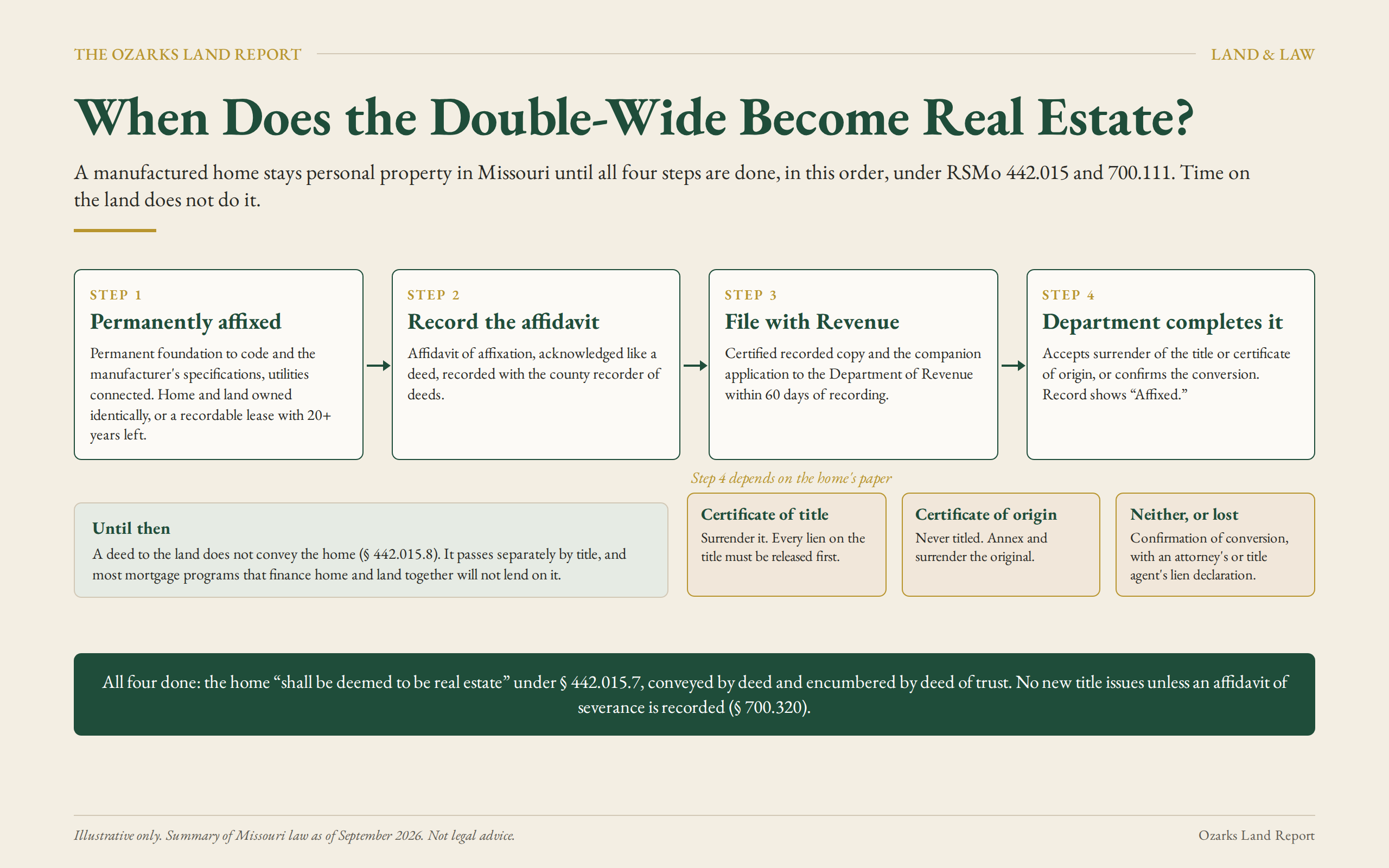
Section 442.015 sets the physical test. A manufactured home is “permanently affixed” when it is anchored to the real estate by attachment to a permanent foundation, built to applicable state and local building codes and the manufacturer’s specifications under the federal installation standards, and connected to residential utilities such as water, gas, electricity, or sewer or septic service. Skirting, a deck, and a well line are not a permanent foundation. Piers and anchoring installed to the standard can be.
The statute then sets the ownership test. The ownership interests in the home and in the land must be identical. There is one exception. If the homeowner does not own the land, the homeowner must hold it under a lease in recordable form with at least twenty years remaining after the affidavit of affixation is executed, and the landowner’s consent must be endorsed on or attached to the affidavit and acknowledged the way a deed is. Recording the lease is sensible practice; the statute requires recordable form. A child’s home on a parent’s farm can qualify this way, and so can any other long-term arrangement, but a lease written for twenty years a decade ago no longer does.
The affidavit of affixation
The affidavit is the document that does the work. It identifies the home, the land, the ownership, and any liens. The following summarizes its principal contents under 442.015; use the current form and the statute for the complete filing:
- The manufacturer, make, model, model year, dimensions, and serial number of the home, and whether it is new or used.
- A statement that the affiant owns the land, or holds the twenty-year lease with the landowner’s acknowledged consent attached.
- The street address and legal description of the land.
- The home’s paper trail: a certificate of title, with date and number, to be surrendered; or a manufacturer’s certificate of origin, annexed to the affidavit and surrendered; or a statement that the document cannot be found after diligent search, or that the home is covered by neither document, and that the owner will apply for a confirmation of conversion.
- Every lien on the home, with each lienholder’s name and address and the original principal amount, and a statement that each will be released, or proof that it has been.
- A statement that the home is or will be permanently affixed.
- The name and address of the person who will submit a certified copy to the Department of Revenue.
The affidavit is signed and acknowledged like a deed and recorded with the recorder of deeds in the county where the land sits. The recorder indexes it in the real estate records and returns a certified copy.
Complete the Department of Revenue filing
The sequence is record first, then file. The statute and the Department’s main manufactured-homes instructions agree: record the affidavit with the county recorder, then submit the certified recorded copy with the supporting documents to the Department. The filing must reach the Department within 60 days of the recording date, and when it does and is accepted, the statute treats the Department filing requirements as satisfied as of the recording date. The Department’s FAQ contains inconsistent wording about the sequence; follow the record-first process in the statute and resolve any conflicting instruction with the Department before you file. In practice, expect a late submission to require a freshly recorded affidavit.
Two form sets are in circulation. The Department’s rule, 12 CSR 10-23.475, last amended effective February 28, 2026, names the Affidavit of Affixation (Form 5312), the Affidavit of Severance (Form 5313), the Application for Surrender of Title or Manufacturer’s Certificate of Origin (Form 5315), and the Application for Confirmation of Conversion (Form 5314). The Department’s current public instructions identify a combined Manufactured Home Affixation or Severance form (Form 5312-5313) with an Application for Manufactured Home (Form 108-M), submitted at any Missouri license office or mailed to the Motor Vehicle Bureau, PO Box 100, Jefferson City, MO 65105-0100, with an $8.50 affixation fee and a $9.00 processing fee. Use the forms and instructions the Department currently publishes, linked in the sources below.
Which companion filing you make depends on the home’s paper. If the home has a certificate of title, you apply to surrender it with the original, and the Department will not accept the surrender until every lien perfected against the title has been released. If the home was never titled and is still covered by the manufacturer’s certificate of origin, you surrender that instead. If the home has neither, or the owner has searched diligently and cannot produce it, you apply for confirmation of conversion. That route requires the owner’s statement of any facts affecting the validity of the title and a declaration from a Missouri-licensed attorney or an agent of a title insurance company that the home is free of, or released from, all recorded security interests, liens, and encumbrances, with the same disclosure of known facts affecting title. The Department’s FAQ adds that an owner who does not have the title is not required to obtain a duplicate from a previous owner. What the confirmation does not do is create ownership. A lien search addresses recorded claims; it does not establish who owns the home. Ownership still has to be shown, by the chain of sale documents, by survivorship, or through an estate.
When processing is finished, the Department provides a written acknowledgment of compliance, which its instructions call a Certificate of Affixation and which the title company will want in the file, and marks the home’s record with the title type “Affixed.” Under RSMo 700.320, once an affidavit of affixation is recorded, no new title can issue on the home unless an affidavit of severance is recorded, so a missing title on a home converted years ago is normal, not a defect. Once the four steps are complete, 442.015 says the home “shall be deemed to be real estate,” conveyed by deed, encumbered by deed of trust, and governed by real estate law as if it had been built on site from lumber.
What happens if nobody does this
The statute is blunt about it. Under 442.015, no conveyance of land on which a manufactured home sits transfers any interest in the home unless an affidavit of affixation has been recorded, and not followed by an affidavit of severance. A general warranty deed of the farm, without the affidavit, conveys the dirt and leaves the home behind as personal property still governed by Chapter 700. Any agreement that tries to waive that rule is void as contrary to public policy.
For a seller, this means three things. The home has to be conveyed separately, by assignment of the certificate of title, which requires that the title exist, that lawful ownership be established, and that liens be released. A buyer paying cash may accept that. A buyer borrowing often cannot: most mortgage programs that finance the home and land together, including the conventional and government-backed programs most rural buyers use, require the home to be real property, although FHA’s Title I program does finance manufactured homes held as personal property. Conversion alone does not make a home loan-eligible; foundation, construction date, identification, and other underwriting requirements still apply. And title insurance coverage of the home varies by underwriter, so confirm the requirements with the closing agent early.
There is a tax angle. Under RSMo 137.115, a manufactured home used as a dwelling is assessed at the residential rate. A home on land the owner does not own is personal property for tax purposes; a home on land the owner owns may be treated as real property, and it goes on the real estate tax bill as an improvement when it has been deemed real estate under 442.015. A home still on a personal property statement is a clue that the conversion was never done. A home on the real estate bill is not proof that it was.
The lost title, the old lien, and the owner who died
The hard cases are the old ones, and they follow a pattern.
The certificate of title is missing. The confirmation of conversion route above was written for this. A lien search, a release of any lien that shows, the declaration of an attorney or an agent of a title insurance company, and the application.
The title shows a lien from a loan paid off long ago. The Department will not accept a surrender until that lien is released, and the affidavit itself has to state that liens will be released or prove that they have been. Obtaining an old lien release can take time, especially if the lender has merged or changed names. Start early.
The titled owner is dead. First determine whether the deceased owner’s interest passed outside probate. RSMo 700.630 lets a manufactured home’s certificate of ownership carry a transfer-on-death beneficiary, and a title held by joint owners with right of survivorship or by spouses as tenants by the entirety passes to the survivor. If there is a surviving owner with a right of survivorship, or a surviving, validly designated TOD beneficiary, the Department’s transfer procedures apply and no estate is needed for the home. If neither route applies, an attorney should review the ownership history and determine the estate procedure: a small estate affidavit under RSMo 473.097 where the estate qualifies; a determination of heirship under RSMo 473.663 where no administration was commenced within a year of death and no will was presented for probate within the time the statute allows; or a full administration. The person legally authorized to act for the estate, or the owner once established, then completes the transfer and conversion documents. The land and the home may have different ownership histories.
The pattern I see most often looks like this. A double-wide set in the 1990s sits on a tract the family is ready to sell. The title is still in the name of a parent who died years ago, with a lien from a loan paid off long before, and everyone assumed the home was affixed when it was set. Sometimes an earlier probate even vested an older home on the same land and missed this one. The cure on those facts is a lien release, the estate step that fits the family, and then the affidavit and the Department filing. A home that passed by survivorship or to a TOD beneficiary skips the probate step; one that did not does not.
Severance: taking a home off the land
The conversion runs both ways. If a home that has been affixed and recorded is later moved, 442.015 requires the person with an interest in the real estate to record an affidavit of severance, with the same identifying information, the book and page of the original affidavit of affixation, and a declaration by a Missouri attorney or an agent of a title insurance company that the home is free of recorded liens. The owner then applies to the Department for a new certificate of title, and the home goes back to being personal property.
What to pull before you list
- The deed and legal description of the land.
- The home’s manufacturer, model year, dimensions, and serial number, from the data plate under the kitchen sink or in a closet, or from the front crossmember of the frame.
- The certificate of title or certificate of origin, or a note that neither can be found.
- Lien information and any releases.
- A recorded affidavit of affixation, by book and page.
- The Department’s evidence of a completed conversion: its written acknowledgment, or a record showing the home as “Affixed.” The Department confirms status on written request for a small fee; title companies and dealers can check it through the Department’s record inquiry system.
Where that leaves you
| Title in your name, no liens | Confirm physical affixation and matching ownership; record the affidavit, submit the Department package, and obtain confirmation of completion. |
| Title missing | Confirmation of conversion, with the declaration of an attorney or an agent of a title insurance company. |
| Titled owner deceased | Survivorship or TOD first; otherwise the estate analysis above. |
| Home on land you do not own | Establish matching ownership, or a qualifying lease with at least twenty years remaining after execution of the affidavit and the landowner’s acknowledged consent. |
| Already converted | Verify the completed conversion and retain the supporting records, including the recorded affidavit and the Department’s acknowledgment; the absence of a title is expected. |
Common questions
Does the home’s age matter?
Not for the conversion. Missouri’s definition of a manufactured home in RSMo 700.010 turns on size and construction: a transportable structure on a permanent chassis that is eight body feet or more wide, or forty body feet or more long, or at least 320 square feet when erected on site, built to be used as a dwelling with the utilities connected. There is no build-date requirement in the definition. Age matters for financing. Homes built before the federal construction standards took effect in June 1976 are generally not eligible for the mainstream mortgage programs regardless of affixation, so a pre-1976 home can be converted and still be hard to finance.
We own the land and the home but the title is in my late father’s name. Do we need probate?
Not necessarily. First determine whether the deceased owner’s interest passed to a surviving owner with a right of survivorship or to a surviving, validly designated TOD beneficiary. If neither route applies, an attorney should review the ownership history and determine the necessary estate procedure. The land and the home may have different ownership histories. This is the most common surprise in these files.
Can we do the affidavit at closing?
Sometimes, but signing the affidavit is only one step. The closing agent must coordinate lawful ownership, any lien payoff and release, recording, the Department submission, and the lender’s requirements. Do not assume the entire conversion can be completed at the closing table. Ask the question the day you decide to sell, not the day the lender asks.
My home is on my parents’ land. Can it be affixed?
Only with a lease in recordable form that has at least twenty years remaining after the affidavit is executed, with your parents’ acknowledged consent attached, or by putting the land in your name. Otherwise the home stays personal property, which is often fine until someone wants to borrow against it.
What does the conversion cost?
The Department’s fees are under twenty dollars. The real cost is recording fees, a lien search, and, where a title is missing or an owner has died, the attorney’s or title agent’s declaration and any probate work. Budget the time more than the money.
Manufactured home questions sit next to their cousins. If the home came to the family through an estate, start with selling inherited land in Missouri. If the heirs cannot agree on selling at all, see whether one heir can force the sale of a family farm. And if the question is where the line runs rather than what sits on it, start with Missouri fence law.
The first thing I do on a listing with a manufactured home is check the county records for an affidavit of affixation and the Department of Revenue’s record for the home’s status. If the records do not show a completed conversion, we identify the missing documents and any ownership issues before they become a closing problem. If you own a country home on acreage in Franklin, Gasconade, Crawford, Phelps, or Dent County and are not sure which side of the line your home is on, call or email and I will tell you what the records show. Request a free land valuation or call 573.308.7376.
Scope. This article covers manufactured homes on privately owned land in Missouri and the state law process for treating them as real estate. It does not cover manufactured home rental communities, dealer sales, sales tax on new units, or the federal installation standards in detail.
Currency. Verified against the Revised Statutes of Missouri, 12 CSR 10-23.475 as amended effective February 28, 2026, and the Missouri Department of Revenue’s manufactured homes page, FAQ, and Form 5312-5313 on September 21, 2026. Confirm the current form package at dor.mo.gov or a license office before filing.
Sources. RSMo 442.015; RSMo 700.111; RSMo 700.010; 700.320; 700.630; 137.115; 473.097; 473.663; 12 CSR 10-23.475; Department of Revenue, Manufactured Homes; Manufactured Homes FAQ; Form 5312-5313; Form 108-M.
Notice. Justin Head is a Missouri-licensed attorney and a licensed real estate salesperson with Whitetail Properties Real Estate, LLC. This article is educational and is not legal advice or an attorney-client relationship. Facts matter; talk to a Missouri attorney about your situation before relying on anything here.
Justin Head is a Missouri-licensed attorney with Hansen, Stierberger, Downard, Schroeder & Head LLC in Union, Missouri, and a Missouri-licensed real estate salesperson and Land Specialist with Whitetail Properties serving Franklin, Gasconade, Crawford, Phelps, and Dent Counties. This article is published in that dual capacity.