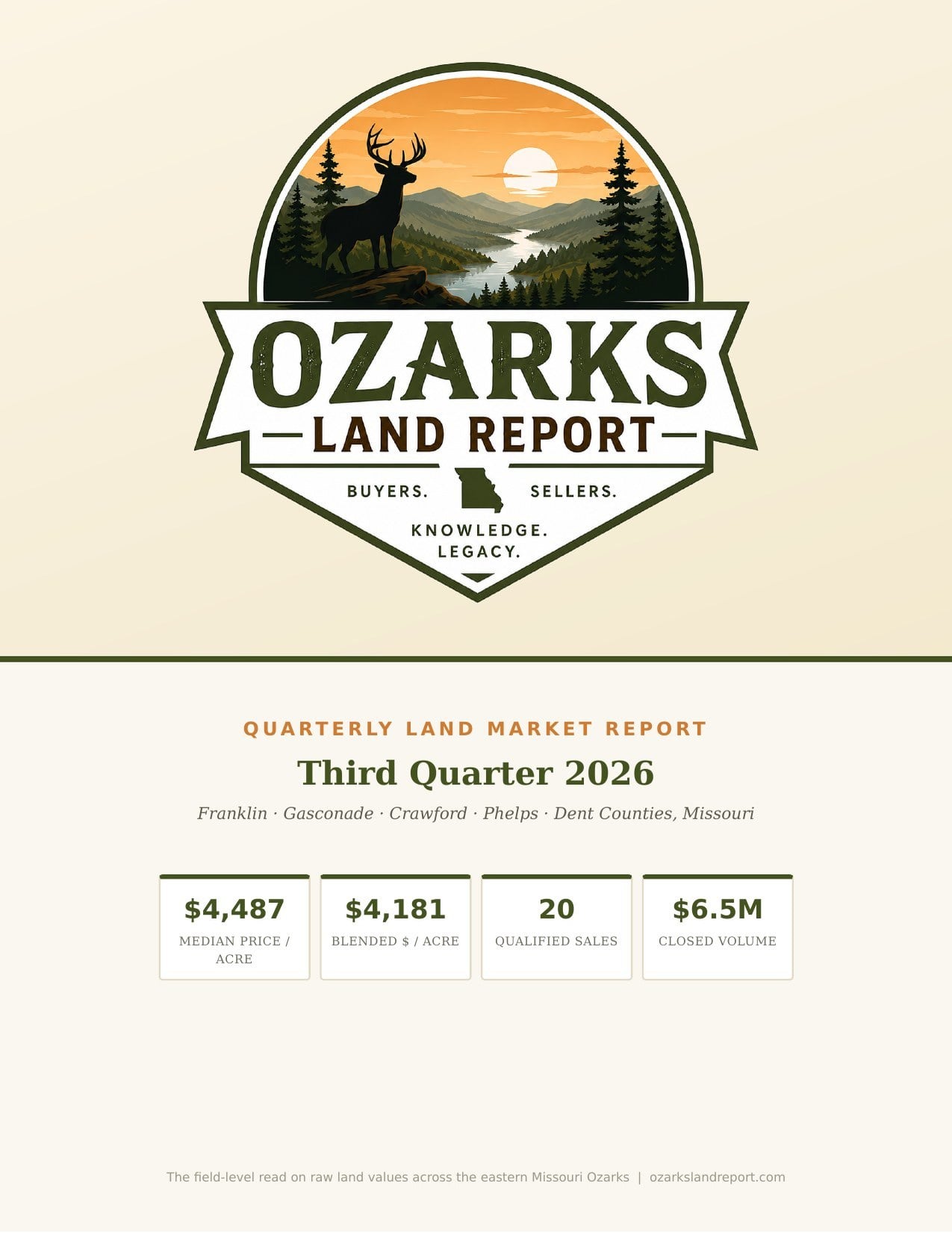
The third quarter of 2026 was the quarter the cost of money turned back up. The Federal Reserve raised its target range to 3.75–4.00% on September 16, its first increase since 2023; the 10-year Treasury ended the quarter near 5.3%, its highest level in more than two decades; and Freddie Mac’s 30-year mortgage average crossed 7%. Stocks spent the summer catching their breath after a 14.9% second quarter, with the S&P 500 up 2.0% on a price basis. The dirt, as usual, kept its own counsel.
Across our five-county footprint, qualified bare-land closings of 30 acres or more traded at a median of $4,487 per acre, a blended $4,181 per acre across 1,554.6 acres, and $6.50 million in total volume over 20 qualifying sales. That is the same number of closings as the second quarter and a median about 5% lower, and every county in the footprint recorded at least one closing.
Every qualified sale, the charts, and full methodology & sources.
What we measure, and what we leave out
The number that matters most here is simple: what is bare ground actually trading for? This dataset includes only third-quarter closed MLS sales in the Farm and Land & Lots categories of 30 acres or larger, screened to listings reporting zero bedrooms and zero bathrooms (a blank bedroom or bathroom field treated as zero), the same objective screen behind our Bare Dirt Report series, and drawn from the same row-level datasets. Screening out the residential premium isolates the price of the dirt itself, as nearly as the MLS record allows. These figures describe qualifying transactions reported in MARIS under that screen; they are not a census of every transfer of land in the five counties. We lead with the median rather than the $5,001 unweighted average, because a few high-priced tracts can pull the average upward and misrepresent what a typical recreational or grazing buyer experiences.
Local values by county
| County | Sales | Closed Volume | Acres | Blended $/Acre |
|---|---|---|---|---|
| Franklin | 3 | $1,128,450 | 159.7 | $7,067 |
| Gasconade | 5 | $1,466,395 | 293.9 | $4,990 |
| Crawford | 5 | $2,056,385 | 664.4 | $3,095 |
| Phelps | 4 | $1,175,422 | 277.7 | $4,233 |
| Dent | 3 | $673,000 | 158.9 | $4,235 |
| Total | 20 | $6,499,652 | 1,554.6 | $4,181 |
All five footprint counties recorded a qualifying closing this quarter, but sample sizes remain small; treat county figures as directional. Franklin and Dent each rest on three sales, so read those blends as samples rather than levels. Crawford’s blend is pulled down by a single 416-acre block near Bourbon that closed at $2,900 per acre, the size discount at work rather than county weakness.
The size story is the one buyers ask about most, and this quarter drew it plainly: the 30–50 acre band blended $6,224 per acre, the 50–100 band $4,187, and the three tracts over 100 acres $3,232. The rule of thumb holds: pay up per acre for a buildable 30–50, expect a discount per acre when you buy size.
The forces behind the price
Capital markets and rates
Q3 was a flat quarter for stocks and a hard one for bonds. The S&P 500 gained 2.0% on a price basis (7,499 on June 30 to 7,652 on September 30), the Nasdaq Composite 2.5%, and the Dow lost 2.7%, with September a down month for the S&P and the Dow as Treasury yields climbed. The Federal Reserve raised the funds rate a quarter point to 3.75–4.00% on September 16 on a unanimous vote, calling inflation “elevated,” and its median projection now has the rate near 4.1% at the end of both 2026 and 2027. The 10-year Treasury, the benchmark for farm and land loans, rose from about 4.46% on June 30 to about 5.3% at quarter end, and the 30-year mortgage averaged 7.03% on September 24 against 6.30% a year earlier. Financing is more expensive than it was in spring; a buyer pre-approved in June should re-run the numbers before writing an offer.
Farmland: a plateau, stated plainly
The Chicago Fed’s August 2026 AgLetter reported Seventh-District farmland values unchanged from a year earlier, with “good” farmland flat quarter over quarter as well; in inflation-adjusted terms that was a 3.7% decline, the largest real drop since 2016. Only 5% of surveyed lenders expected values to rise in the third quarter. Missouri’s own numbers were firmer: USDA’s 2026 Land Values summary put Missouri farm real estate at $5,200 per acre (+4.0%), cropland at $5,310 (+3.1%), and pasture at $2,850 (+3.6%); farm real estate and cropland outpaced the national averages, and pasture ran just under the national 4.2%. The speculative froth is gone, lenders are watching repayment more closely, and Missouri pasture is still appreciating.
Cattle: the engine under Ozarks grass
At the Joplin Regional Stockyards, the September 28 sale moved 9,521 head, with 500–549 pound steers averaging about $429 per hundredweight ($410–$445), 600-pound steers near $391, and 700-pound steers in the low $350s. Feeder steers sold $7 higher to $10 lower than the prior week, with the gains on seven-weights, while heifers were steady to $15 lower. A calf check at these levels makes every acre of productive grass more valuable to hold and more expensive to buy, and it keeps a floor under Ozarks pasture demand even as borrowing costs rise.
Timber: oak anchors woodland value
The most current published read is the Missouri Department of Conservation’s Timber Price Trends for April–June 2026 (the July–September update had not been released at press time). Oak sawlog stumpage in the Southern region averaged about $246 per MBF (thousand board feet) for mixed oak on roughly 7,400 MBF reported (International 1/4-inch scale), with the red-oak group near $131 and the white-oak group near $82 on thin volume. White oak still commands its specialty premium: white oak stave logs, the bourbon-barrel trade, averaged about $1,588 per MBF on the Doyle scale, reported from MDC’s Northern region. A managed oak stand is real latent value that never shows up on a tax card.
What it means for you
If you’re selling, the bid remains strongest for well-located, accessible 30–50 acre tracts with frontage, water, a building site, or a marketable oak stand; that tier blended $6,224 per acre this quarter. With financing costlier than it was in June, the buyer pool thins at the margin. Price to the comparable, not the outlier, and expect more scrutiny of access and utilities.
If you’re buying, size still buys the biggest discount in the market: the three 100-plus acre closings blended at roughly half the per-acre price of the 30–50 acre tracts. A 7% mortgage and a 10-year above 5% mean every offer should be underwritten at today’s rate, not spring’s. The clearest value plays remain large grazing and recreational tracts where strong cattle prices and standing timber help carry the ground.
Our base case into Q4 is a steady, fundamentally supported Ozarks market: fewer marginal buyers at higher rates, a median that holds in the mid-$4,000s, and no crack in the foundation. We’ll be watching the Fed’s October and December meetings and whether the 10-year holds above 5%, the Chicago Fed’s November AgLetter, MDC’s July–September oak stumpage release, and the fall feeder-cattle run at Joplin.
Curious what your own ground is worth? Request a free, no-obligation valuation, or get in touch. You can also download the full report (PDF): every qualified sale, the charts, and full methodology & sources.
Prepared by Justin Head, Whitetail Properties Land Specialist / Missouri Attorney. 573.308.7376 · justin.head@whitetailproperties.com
This report is compiled from sources believed reliable and is provided for informational purposes only. It is not investment, legal, tax, or financial advice. Land values vary widely by location, access, improvements, and timing; figures reflect a limited quarterly sample and should not be relied upon as an appraisal.
Sources & Methodology
This report is built from Multiple Listing Service (MARIS) closed-sale records for the third quarter of 2026, limited to the Farm and Land & Lots categories at 30 acres or larger, screened to listings reporting zero bedrooms and zero bathrooms, with blank bedroom or bathroom fields treated as zero. This screen is intended to isolate bare-land pricing but cannot guarantee that every tract was free of improvements. Figures reflect 20 qualifying sales across Franklin, Gasconade, Crawford, Phelps, and Dent Counties; all five footprint counties recorded at least one qualifying sale. Macro figures: Federal Reserve FOMC statement of September 16, 2026; FRED (S&P 500, DGS10); Freddie Mac Primary Mortgage Market Survey, September 24, 2026; Federal Reserve Bank of Chicago AgLetter, August 2026; USDA NASS Land Values 2026 Summary; USDA AMS Market News, Joplin Regional Stockyards, September 28, 2026; Missouri Department of Conservation, Timber Price Trends, April–June 2026. Compiled by Justin Head and Ryan Record, Ozarks Land Report / Whitetail Properties Real Estate. Data current as of Q3 2026 (July 1 – September 30, 2026).