Franklin · Gasconade · Crawford · Phelps · Dent Counties, Missouri
General educational information about Missouri law as of August 2026. Not legal advice about any specific parcel, certificate, sale, or dispute, and it does not create an attorney-client relationship.
Prefer a document? Download the print edition (PDF).
Short Answer
A Missouri tax sale certificate of purchase gives the purchaser a statutory lien, not ownership of the land. The owner ordinarily has at least one year to redeem. If redemption occurs, the purchaser is repaid through the collector according to Section 140.340. Only if the property remains unredeemed, and the purchaser satisfies the separate deed requirements, can the purchaser acquire title.
Every August, on the fourth Monday, county collectors across Missouri sell land for delinquent taxes. This year that is Monday, August 24, 2026. In the Ozarks counties the crowd is usually small and the parcels are usually rough. Somebody bids a few hundred dollars on forty acres and walks out holding a piece of paper that feels like a deed.
It is not one, at least not yet. It is a lien with deadlines attached, and the deadlines are where the money is made or lost. That is nothing against the bidder; Chapter 140 does not explain itself, and it has surprised plenty of careful people.
Chapter 140 of the Revised Statutes of Missouri, the Jones-Munger Act, governs these sales. It is not a hostile statute, but it is unforgiving about timing, and many of the most common ways a tax sale purchaser loses money are self-inflicted. What follows is the shape of the thing for anyone thinking about bidding.
Do you own the property after a Missouri tax sale?
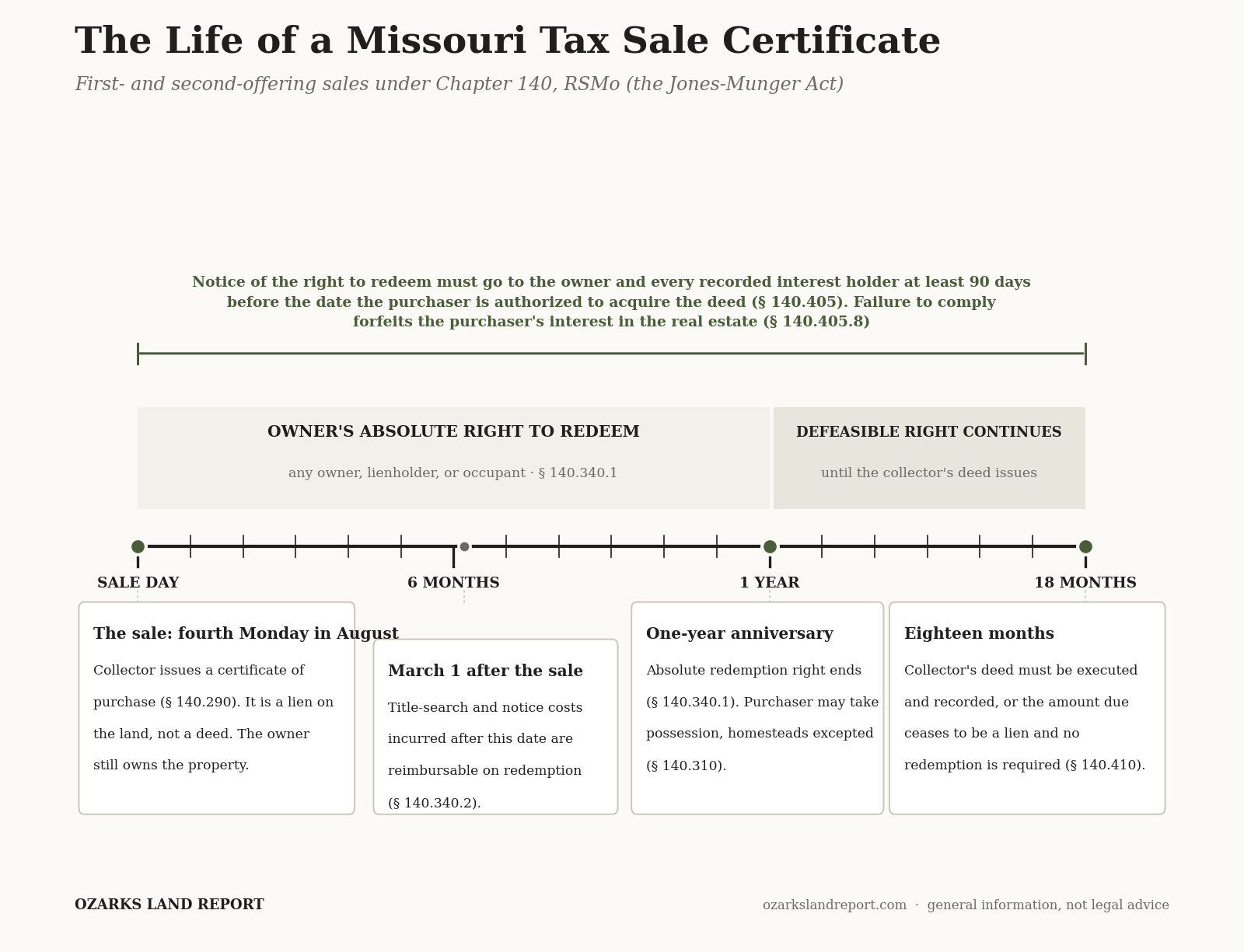
No. The collector issues a certificate of purchase under Section 140.290. The State Tax Commission’s July 2019 informational Chapter 140 manual puts it plainly: the certificate creates only a lien on the property, and it is the collector’s deed that transfers title.
Until that deed issues, the owner still owns the land. After one year, Section 140.310 may give the purchaser possession rights, subject to the statute’s homestead exception and to the owner’s ability to retain possession by assigning rents or agreeing to pay them. Taking possession before the deed issues is usually a bad idea. Under Section 140.320, a purchaser who takes possession after the first year but before the deed must pay the taxes assessed during that occupancy, and failing to do so, or committing waste on the tract, forfeits all rights acquired by the certificate as to that tract. The prudent course is to leave the ground alone until the collector’s deed is in hand.
How long does the owner have to redeem?
Under Section 140.340.1 the owner, any lienholder, or an occupant has an absolute right to redeem for one year after the sale, and a defeasible right to redeem after that, running until the purchaser actually acquires the deed.
There is one long tail worth knowing about. Under Section 140.350, minors and incapacitated or disabled persons as defined in chapter 475 may redeem land belonging to them within five years of the date of the last payment of taxes on the real estate, whether that last payment was made by the protected person, a predecessor in interest, or a representative. Where the record owner is a minor or under guardianship, the certificate carries redemption risk long after the ordinary one-year period ends.
Redemption is common. When it occurs, the purchaser is repaid through the collector. Section 140.340.2 sets out the components: the full purchase money named in the certificate, the costs of the sale, the cost to record the certificate and the fee to record its release, the reasonable and customary cost of the title search, the postage for the required notices, any subsequent taxes paid by the purchaser with interest at eight percent, and interest at the rate stated in the certificate, capped at ten percent annually.
Economically, then, a tax sale certificate resembles a capped-return statutory lien investment carrying real forfeiture risk. It is not a conventional loan. Failure to satisfy Chapter 140 can wipe out the purchaser’s interest entirely.
What happens to the overbid?
The minimum bid is the taxes, interest, penalty, and costs. Anything above that is surplus, and Section 140.340.2 says no interest is owed on the amount paid in excess of the delinquent taxes plus the collector’s costs of sale.
That is worth reading twice before a bidding war starts. If the taxes are $300 and you bid $4,000, then $3,700 of your money sits with the county earning nothing for a year or more. On redemption you do get it back, because it is part of the purchase money named in the certificate, but you earn no return on it. Where a deed issues instead, Section 140.230 governs surplus funds and directs them to former lienholders of record and then to the former owner, with escheat to the county school fund after three years if not distributed or called for as part of a redemption or a collector’s deed issuance. That last phrase has not been construed in any decision we have located, so a purchaser should not count on recovering surplus outside a redemption.
Can a Missouri tax sale purchaser lose the entire investment?
Yes, five ways, and these are the ones that actually cost people money.
Missing a required recipient or otherwise failing to comply with Section 140.405. The section requires a title search from a licensed attorney or title company and written notice to the owner of record and every holder of a publicly recorded unreleased deed of trust, mortgage, lease, lien, judgment, or other claim. Notice goes by both first class and certified mail, return receipt requested. Subsection 8 is the penalty clause: failure to comply results in the purchaser’s loss of all interest in the real estate.
Stopping after mailed notice fails. Constitutional due process rides on top of the statute. Section 140.405 prescribes the mailing and follow-up requirements, but where a purchaser knows the attempted notice was unsuccessful, due process may require additional reasonable steps. The Missouri Supreme Court said so in Schlereth v. Hardy, and the United States Supreme Court said the same in Jones v. Flowers. Returned or unclaimed mail is a signal to do more, not a box to check.
Letting a later tax go delinquent. Section 140.440 requires the certificate holder to pay taxes accruing after the certificate issued, and says any purchaser who suffers a subsequent tax to become delinquent forfeits all liens on the land. Missouri real estate taxes go delinquent January 1. Buy a certificate in August, forget the December bill, and you can forfeit your position without anyone telling you.
Taking possession and then neglecting it. Section 140.320, described above, forfeits all rights under the certificate as to any tract taken into possession where the purchaser fails to pay taxes assessed during the occupancy or commits waste.
Missing eighteen months. Section 140.410 requires the purchaser to pay all subsequent taxes and cause the deed to be executed and recorded within eighteen months from the date of sale. Miss it and the amount due you ceases to be a lien. Section 140.340.1 closes the circle: once that lien expires, no redemption is required at all. The owner then owes you nothing and keeps the ground. House Bill 613 shortened this window from two years in 2015, and purchasers working from older material still get caught by it.
When must the purchaser send the ninety-day notice?
This is the part practitioners still argue about, and it is worth understanding before you plan a purchase.
Section 140.405.2 requires notice at least ninety days before the date the purchaser is authorized to acquire the deed. In 2012 the Missouri Supreme Court decided Harpagon MO, LLC v. Bosch and Sneil, LLC v. Tybe Learning Center, Inc. on the same day, holding that a first or second offering purchaser is authorized to acquire the deed exactly one year after the sale, so notice had to go at least ninety days before the one-year anniversary. Both opinions construed the statute as it read at the time.
In 2015, House Bill 613 added subsection 9, which defines the phrase “authorized to acquire the deed” as the date chosen by the tax sale purchaser that is more than the minimum redemption period, provided the purchaser has met the other statutory conditions.
The State Tax Commission’s July 2019 informational Tax Sale Procedure Manual states that subsection 9 was passed to clarify the ninety-day notice requirement, that the amendment implies a purchaser may choose a date after the one-year anniversary of the tax sale in first and second offerings to acquire the deed, and that the amendment did not eliminate the requirement that notice be given at least ninety days before the date the purchaser acquires the deed. Under Section 140.410, the deed must in any event be obtained and recorded within eighteen months of the sale. The manual describes itself as informational; it is not binding law.
As of August 2026, no reported Missouri appellate decision has addressed the timing of the ninety-day notice under the statute as amended, and readings differ among collectors and practitioners. The deadline that applies to a particular certificate is a question for the purchaser’s own attorney.
Which costs are reimbursable, and why March 1 matters
Section 140.340.2 contains a provision that surprises people. For first and second offering sales, costs incurred in providing notice of redemption rights are not reimbursable unless they are incurred after March first following the purchase of the certificate.
Order your title search in September, right after the August sale, and you may have bought it for yourself. Order it after March 1 and it becomes a redemption component. The work is the same. The timing decides who pays for it.
What does the collector’s deed actually give you?
If no one redeems and you have done everything right, Section 140.420 directs the collector to execute a deed vesting an absolute estate in fee simple, subject to claims for unpaid taxes, and foreclosing inferior recorded interests and equities of redemption.
That is real title, but it is not yet marketable title in the eyes of most underwriters. Expect to quiet title before a title company will insure it. Section 140.590 generally imposes a three-year limitations period for actions challenging a recorded collector’s deed, subject to statutory exceptions and disability tolling, and Section 140.600 eliminates the need for an actual pre-suit tender, although the petition must offer to reimburse the purchaser for taxes paid with interest. Budget for the quiet-title action. Merely holding the property for three years does not guarantee that a title underwriter will insure it; Section 140.590’s limitations period is subject to statutory exceptions and disability tolling, and Section 140.350 can extend redemption rights for minors and incapacitated or disabled persons well beyond three years.
What changes on August 28, 2026
Senate Bill 973, signed this year, takes effect August 28, 2026, four days after this year’s sale. It amends the bidder eligibility provisions of Section 140.190, expands the authority of land banks, and eases the path for counties to pursue judicial foreclosure in place of Chapter 140 auction sales. Closest to home for buyers, it amends Section 140.250 so that a purchaser at a sale held after the third offering may elect, by notice to the collector before the deed issues, to proceed under the third-offering notice and redemption procedure rather than take an immediate deed. A purchaser concerned about the marketability of an immediate post-third-offering deed now has an express statutory option to use the notice-and-redemption procedure. The bill does not amend Sections 140.340, 140.405, or 140.410, and it does not alter the first- and second-offering redemption, notice, or deed-timing rules discussed in this guide.
Before you bid
Know which offering you are at. First- and second-offering sales carry an absolute one-year right of redemption, followed by a defeasible right that continues until the purchaser acquires the deed. Third-offering sales carry the separate ninety-day redemption procedure described in Sections 140.250 and 140.405, while post-third-offering sales generally have no redemption period. Know that you cannot bid if you are delinquent on taxes on other property; Section 140.190 enforces this with a signed affidavit at the sale, and a false affidavit can invalidate the purchase. Read the legal description in the advertisement, because a description too imperfect to identify the land with reasonable certainty can void the sale under Section 140.530. And put the eighteen-month date and every following December tax bill on a calendar the day you get home.
Done carefully, buying certificates is a modest, secured, capped-rate way to put money to work in a county you know. Done casually, it is an easy way to pay a stranger’s tax bill and keep nothing for the trouble.
Scope. This article addresses sales conducted under Missouri Chapter 140. Different procedures may apply in jurisdictions governed by Chapter 141 or other special statutory schemes.
Currency. This article reflects Missouri law as of August 19, 2026. Senate Bill 973 (2026) takes effect August 28, 2026; it amends Sections 140.190 and 140.250 along with land bank authority and county judicial foreclosure options, and does not alter Sections 140.340, 140.405, or 140.410. The governing law may depend on the date and type of sale, so purchasers should confirm the statutory version applicable to the particular transaction.
Sources. Chapter 140, RSMo; House Bill 613 (2015); Senate Bill 973 (2026); Harpagon MO, LLC v. Bosch, 370 S.W.3d 579 (Mo. banc 2012); Sneil, LLC v. Tybe Learning Center, Inc., 370 S.W.3d 562 (Mo. banc 2012); Schlereth v. Hardy, 280 S.W.3d 47 (Mo. banc 2009); Jones v. Flowers, 547 U.S. 220 (2006); State Tax Commission of Missouri, Chapter 140 Tax Sale Procedure Manual (July 2019).
Notice. This article is general information about Missouri law and is not legal advice. It does not create an attorney-client relationship. Tax sale purchases turn on facts and deadlines specific to each parcel and county, and anyone considering one should consult an attorney about their own situation. Justin Head is a Missouri licensed attorney and a land specialist with Whitetail Properties serving Franklin, Gasconade, Crawford, Phelps, and Dent Counties.