Franklin · Gasconade · Crawford · Phelps · Dent Counties, Missouri
General educational information about Missouri and federal law as of August 2026. Not legal advice about any specific pond, dam, creek, tract, or dispute, and it does not create an attorney-client relationship. Prefer a document? Download the print edition (PDF).
Short Answer
Probably yes, and the state dam-safety program almost certainly does not apply to you. Missouri’s dam-safety law reaches only dams 35 feet or greater in height, and a dam that reaches that threshold may still qualify for the statutory agricultural exemption when used primarily for irrigation, livestock watering, or commercial fish rearing and sale. Nearly every farm pond in the Ozarks falls outside that program entirely. But “no dam permit” is not the same thing as “no rules,” and landowners get that backwards constantly. The authorization that actually catches most creek dams is federal, not state: damming a flowing creek puts fill into a streambed, and if that streambed is a water of the United States, you need Clean Water Act authorization from the Army Corps of Engineers unless the discharge qualifies for an exemption. The Clean Water Act does contain a real farm and stock pond exemption, and a pond built to serve an established farming operation can fall inside it. What the exemption does not cover is bringing new ground into a new use, and which side of that line you are on is the Corps’ call, not yours. Separately from any permit, Missouri common law does not much care whether you had permission: if your impoundment backs water onto the neighbor above you or turns loose on the neighbor below you, Missouri’s oldest line of water cases says you are liable however carefully the obstruction was made. The dam is the easy part. The water it moves is the expensive part.
Every land agent in the Ozarks has had this conversation. Somebody buys 120 acres with a wet-weather draw running through the middle of it, walks the bottom, and says the same sentence I have heard a hundred times: there’s a perfect pond site right there. And there usually is. The Ozarks is full of them, narrow hollows with a solid clay bench and a watershed that will hold water.
Then comes the second sentence, which is always a question, and always the same one. Can I just build it?
I work both sides of this, as a land agent who sells this ground and as a licensed Missouri attorney, so let me give you the real answer rather than the coffee-shop one. The coffee-shop answer is “it’s your land, do what you want.” The lawyer answer is “it depends,” which is useless. The honest answer is more interesting than either: for most Missouri landowners, the state will not stop you, the federal government might, and neither one of them determines whether you get sued. Those are three separate questions, and I have watched people who nailed the first two get wrecked by the third.
Here is the whole framework, with the citations, and with the places where Missouri law is genuinely unsettled marked as unsettled, because the honest answer is more useful than a confident wrong one.
In this guide
- Does Missouri regulate my dam? The 35-foot line
- The agricultural exemption is narrower than everyone thinks
- The authorization that actually applies: Clean Water Act Section 404
- The farm pond exemption, and where it actually stops
- The species layer: hellbenders, mussels, and extra scrutiny
- Swampbuster: the federal trap with no construction permit
- The permits people forget: land disturbance, floodplain, county
- Do I have the right to hold the water at all?
- Fish passage: the statute nobody has heard of
- What goes in the pond: stocking rules
- What happens if the water goes where it should not
- If the dam fails
- Ponds on the property line, fences, and the neighbor
- Who is liable when somebody gets hurt at the pond
- What all of this looks like in our five counties
- Ponds when you are buying or selling
- Frequently asked questions
Which Rules Apply to My Pond?
Eleven triggers cover almost every pond project in this part of the state. Find yours, then read the section that goes with it.
| If this is true | Who cares | Likely requirement | First thing to do |
|---|---|---|---|
| Dam will be 35 feet or greater in height, measured from the lowest downstream toe to the crest | Missouri DNR, Dam and Reservoir Safety Program | Construction permit, engineered plans sealed by a professional engineer | Call DNR and get a written measurement determination before design |
| Reservoir will cover 15 acres or more but the dam is short | Missouri DNR | Almost certainly nothing. Height, not surface area, is the operative trigger | Confirm the dam height in writing |
| Dam is tall and the pond is for irrigation, livestock watering, or commercial fish rearing and sale | Dam and Reservoir Safety Council | Agricultural exemption, which must be applied for and approved | Apply early. There is no decision deadline |
| Dam places fill in a creek that is a water of the United States | U.S. Army Corps of Engineers, St. Louis District | Section 404 authorization, or a determination that an exemption applies | Request an approved jurisdictional determination |
| Pond serves an established farming operation | Corps | The Section 404(f)(1)(C) farm and stock pond exemption may apply | Ask the Corps in writing. Do not self-certify |
| Farm pond on a jurisdictional non-perennial feature, half acre or less | Corps | Nationwide Permit 40, pre-construction notification always required | File the PCN |
| Dam site is on a stream carrying listed species (hellbenders, mussels) | Corps and U.S. Fish & Wildlife Service | ESA review must finish before work starts (General Condition 18) | Run the FWS Missouri determination key in IPaC |
| Any wetland sits in the footprint and you take USDA program money | USDA NRCS and FSA | Swampbuster: converting it can forfeit farm program benefits | File AD-1026 and get a certified wetland determination before you dig |
| Project disturbs one acre or more | Missouri DNR, Water Protection Program | Land disturbance (construction stormwater) permit | Add up dam, borrow area, and spillway together |
| Any part of the work sits in a mapped flood hazard area | Your county or city floodplain administrator | Floodplain development permit, and no-rise engineering if in a floodway | Check the FEMA map for the parcel |
| Pond touches or crosses a boundary line, or a neighbor uses it | Nobody, until there is a dispute | Recorded easement or written agreement | Pull the deeds before you dig |
Who to call before you move dirt
- Missouri DNR, Dam and Reservoir Safety Program, Rolla: 573-368-2175, toll free 800-361-4827, mowaters@dnr.mo.gov
- U.S. Army Corps of Engineers, St. Louis District Regulatory Division: (314) 331-8575, MVS-Regulatory@usace.army.mil
- Your county or municipal floodplain administrator, through the county clerk or the Missouri State Emergency Management Agency floodplain program
- Missouri DNR Water Protection Program, for land disturbance: 573-751-1300
- Your local NRCS field office, for design help, conservation practice standards, and the wetland determination that keeps you square with USDA
- Your county Soil and Water Conservation District, for cost-share money that can pay a real share of an impoundment practice
Every one of those calls is free, and the NRCS and SWCD calls are the ones most likely to save you money: Missouri’s parks, soils, and water sales tax cost-share can fund qualifying structures with NRCS engineering behind them, and taking the money runs the wetland and cultural-resource screens for you automatically.
Does Missouri Regulate My Dam? The 35-Foot Line
Start here, because this is the question everybody asks first and it has a clean answer.
Missouri’s Dam and Reservoir Safety Law lives at Sections 236.400 through 236.500 of the Revised Statutes, administered by the Department of Natural Resources through the Dam and Reservoir Safety Council. The definition of a regulated “dam” is at Section 236.400(5), and the operative sentence is the second one:
“Sections 236.400 to 236.500 shall not apply to any dam which is not or will not be in excess of thirty-five feet in height or to any dam or reservoir licensed and operated under the Federal Power Act.”
Thirty-five feet. That is the line, and the numbers behind it tell you how few structures sit above it: SEMA counts more than 5,000 dams in Missouri, and the state-regulated set runs on the order of 700. Your pond is almost certainly in the first group.
Treat the trigger as 35 feet or greater. I want to flag a wording conflict once and then move on, because it matters only if you are designing within inches of the line. The first sentence of Section 236.400(5) defines a dam as one “thirty-five feet or more in height.” The second sentence, quoted above, excludes anything “not or will not be in excess of thirty-five feet.” Those two do not say the same thing about a structure measuring exactly 35.0 feet. DNR administers the program on the “35 feet or greater” reading, and that is the number you should design and plan against. Nobody builds an earthen dam to a tolerance that makes the difference measurable anyway, and being right about a fraction of a foot is not worth an enforcement letter.
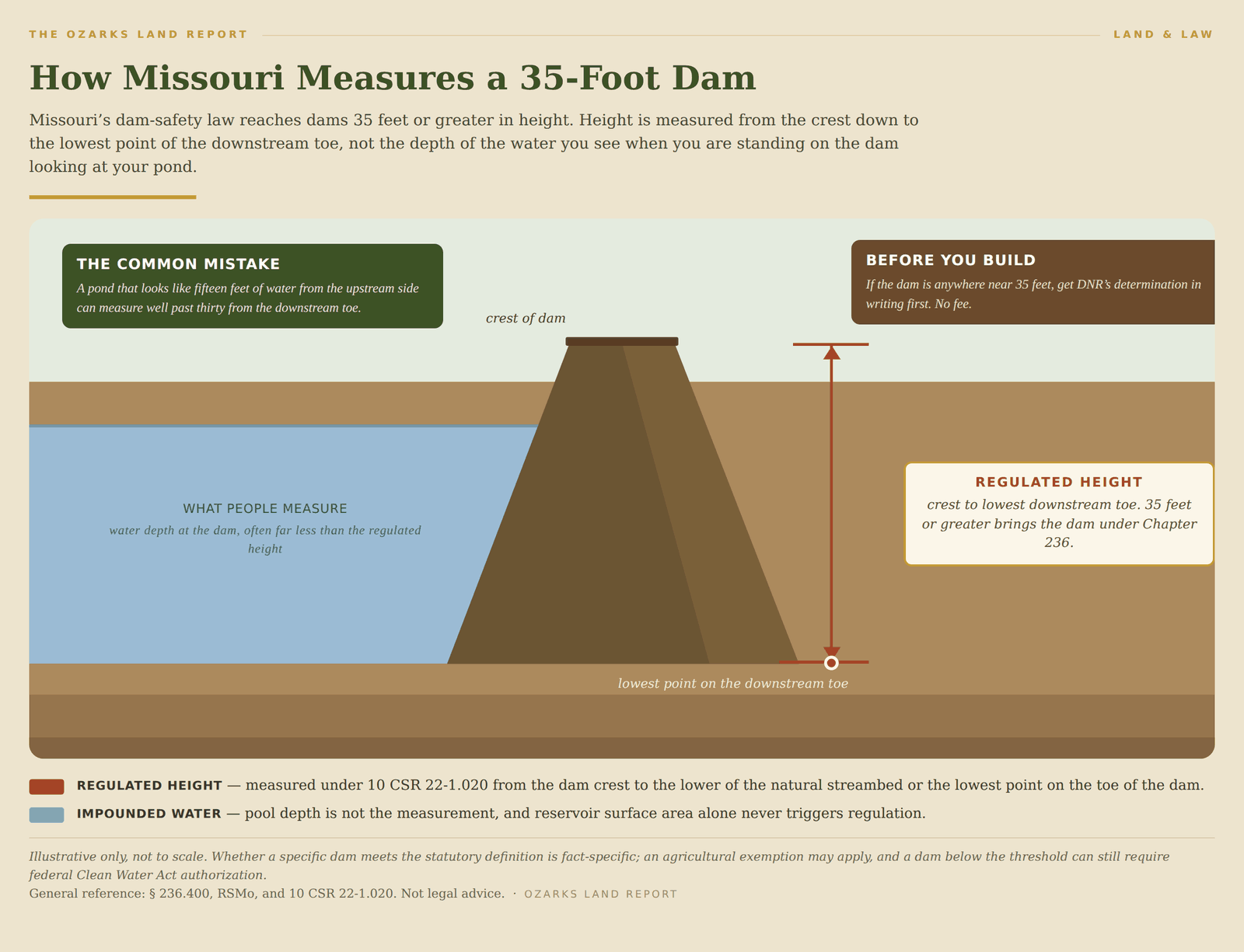
Which leads to the rule I would give any client: if the dam is anywhere near 35 feet, get DNR’s determination in writing before construction. Not a phone call you remember, a document you keep. It costs nothing; Missouri dam safety permits carry no fee at all, and it is the cheapest piece of paper in the entire project.
Two more wrinkles inside the definition are worth your time.
The 15-acre prong is a red herring. The first sentence of Section 236.400(5) sweeps in any impoundment with a surface area of fifteen or more acres at water storage elevation. People read that and panic about a big shallow lake. Do not. The second sentence overrides it. A 200-acre lake behind a 20-foot dam is not a state-regulated dam under Chapter 236. Height is the only trigger that actually fires.
Height is not measured the way you think it is. This is the trap. Under the DNR rule at 10 CSR 22-1.020, height of dam means the difference between the dam crest elevation and the lower of either the natural streambed or the lowest point on the toe of the dam. Not the water depth. Not the height of the face you see when you are standing on the dam looking at your pond. You measure from the bottom of the downstream toe, out at the far edge of the fill, up to the top. In steep Ozark hollows those two numbers diverge badly. I have seen dams that look like fifteen feet of pond from the upstream side and measure well past thirty from the downstream toe. This is the single most common way a landowner ends up regulated without knowing it.
If you do land above the line, you need a construction permit under Section 236.435, applied for with plans bearing the seal of an experienced professional engineer registered in Missouri (the statute also accepts an engineer employed by a qualified engineering division of a state or federal agency regularly engaged in dam construction), and the council has 45 days to act. Willful violation is a misdemeanor under Section 236.500, with each day a separate offense.
The Agricultural Exemption Is Narrower Than Everyone Thinks
Here is where I disagree with most of what is written about Missouri pond law online, and where I think landowners are being told something comforting and wrong.
Section 236.435(6) exempts agricultural dams from the entire program regardless of height:
“A landowner who now owns or proposes to construct an agricultural dam or reservoir which will be used primarily for agricultural purposes will be exempt from all provisions of sections 236.400 to 236.500.”
Everybody stops reading there. The word “agricultural” sounds broad, and if the pond is on a farm, people assume they are covered. But “agricultural dam” is a defined term, and the definition at Section 236.400(1) is a closed three-item list:
“‘Agricultural dam’, any dam constructed to impound water for use in irrigation, livestock watering, or commercial fish rearing and sale.”
Irrigation. Livestock watering. Commercial fish rearing and sale. That is the whole list. Read what is not on it: recreation. Personal fishing. Waterfowl and wildlife habitat. Duck hunting impoundments. Fire protection. Erosion control. Aesthetics. A 40-foot dam built on a working cattle farm to create a bass lake is not obviously an agricultural dam under that definition, because a bass lake you fish yourself is not irrigation, not livestock watering, and not commercial fish rearing and sale.
That matters most for the exact project the market is building right now. The high-dollar recreational tract with a big managed lake is the single most common large-dam project in this part of the state, and it is the project least likely to fit inside the exemption’s actual words.
Three more practical points on the exemption:
- It is not self-executing. DNR is explicit that the exemption “must be applied for and approved by the Dam and Reservoir Safety Council,” and that if the request is denied, a construction, registration, or safety permit will be required. The regulations go further: 10 CSR 22-2.010 tells owners of agricultural dams 35 feet and higher to notify the council that they are relying on the exemption. It is also the one approval with no published decision deadline, so build time into your schedule.
- It can be lost. Section 236.435(6) provides that if the council determines the dam “is no longer used primarily for agricultural services, it shall become subject to the provisions of sections 236.400 to 236.500.” Convert the stock tank to the centerpiece of a hunting lodge and you may have converted your regulatory status with it.
- Losing it can reach backwards. Under 10 CSR 22-2.010, where an agricultural dam constructed after the law’s effective date later becomes subject to regulation, the owner has to produce evidence, before a registration permit will issue, that the dam met the construction permit criteria in effect at the time it was originally built. Nobody engineers a stock pond to spillway design standards. That is a bad letter to get twenty years later.
A separate, partial exemption sits at Section 236.435(7) for dams designed and monitored by qualified engineers for soil and water conservation, irrigation, or wildlife purposes, but note that one still requires plans to be filed with the chief engineer before construction.
The Authorization That Actually Applies: Clean Water Act Section 404
Now the part that catches people, because it has nothing to do with how tall your dam is.
Building an earthen dam across a creek means putting fill material into a streambed. If that streambed is a “water of the United States,” that discharge requires authorization under Section 404 of the Clean Water Act from the Army Corps of Engineers. There is no height threshold. A six-foot dam across a jurisdictional creek needs authorization; a thirty-four-foot dam on a hillside catching only sheet flow may not.
Which Corps district covers us: all five of our counties, Franklin, Gasconade, Crawford, Phelps, and Dent, sit in the St. Louis District. Regulatory Division, 1222 Spruce Street, St. Louis, (314) 331-8575.
Whether your draw is jurisdictional is the whole ballgame. After Sackett v. EPA, 598 U.S. 651 (2023), federal jurisdiction reaches “relatively permanent, standing or continuously flowing bodies of water.” In rough practice:
- A perennial creek, flowing year round, is almost certainly jurisdictional.
- An ephemeral draw that runs only in direct response to rain or snowmelt is generally outside federal jurisdiction after Sackett.
- An intermittent stream, the seasonal or spring-fed channel that is most of the Ozarks, is the contested middle, decided on facts.
That middle category is not an academic problem here. Our drainages are karst. We have losing streams that go dry in August and run bank-full in March, springs that surface and disappear, and channels whose flow regime is not what it looks like on the day you walk it. Do not classify your own creek by eye. Ask the St. Louis District for an approved jurisdictional determination, which is generally good for five years (the Corps can revisit one sooner when the governing law changes, as it did after Sackett).
One precision point, because people over-read this document: an approved jurisdictional determination decides whether the aquatic features on your place are waters of the United States. It does not, by itself, decide whether your activity is exempt, or which permit authorizes the work. Those are separate questions asked in a separate conversation with the same office. The AJD tells you whether you are in the federal system at all. It does not tell you how you get out.
One currency note, because it changed recently and a lot of published guidance is stale: the 2021 nationwide permits expired March 14, 2026. The 2026 nationwide permits took effect March 15, 2026 and run through March 15, 2031. If you are reading an article that cites the 2021 NWPs, it is out of date. Also worth watching: EPA and the Army proposed a revised “waters of the United States” definition in November 2025 that, among other things, would put ephemeral features formally outside jurisdiction. As of this writing, that proposal had not been finalized. In Missouri, the January 2023 rule, as amended, is enjoined; EPA and the Army are instead interpreting “waters of the United States” under the pre-2015 regulatory regime consistent with Sackett until further notice. Confirm the current regime before relying on it.
The nationwide permit written for this exact project is NWP 40, Agricultural Activities, and you should read its farm-pond sentence carefully:
“This NWP also authorizes the construction of farm ponds in non-tidal waters of the United States, excluding perennial streams, provided the farm pond is used solely for agricultural purposes.”
Excluding perennial streams. So NWP 40 may cover a farm pond on a jurisdictional feature that is not a perennial stream, up to a half-acre of loss, with a pre-construction notification always required. It cannot cover damming a year-round creek. For that you are looking at NWP 18 (minor discharges, capped at 25 cubic yards and a tenth of an acre), NWP 29 or 39 if the pond is part of a residential or commercial development, or an individual permit if you exceed the caps.
Keep the logic in order, because this is where people tangle themselves up. A nationwide permit is an authorization to discharge into waters of the United States. If your draw is genuinely not jurisdictional, you do not need NWP 40 or any other Section 404 authorization, because there is nothing federal to authorize. You reach for a nationwide permit when the feature is jurisdictional and you need a route through. Jurisdiction first, exemption second, permit third.
And if the draw is not jurisdictional, is there a state fill permit waiting behind the federal one? No. Missouri has no state dredge-and-fill program, and DNR’s Section 401 role only attaches when there is a federal permit to certify. Some states built state fill programs after Sackett; Missouri has not. Missouri’s Clean Water Law definition of “waters of the state” at Section 644.016 even expressly excludes waters “entirely confined and located completely upon lands owned, leased or otherwise controlled by a single person,” which is the classic one-owner farm pond. The one state hook that survives everywhere: DNR’s general water-pollution authority under Section 644.051 still reaches sediment leaving your construction site for somebody else’s water, which is one more reason the land disturbance permit below is not optional paperwork.
One more federal hook on one specific river. The Meramec is on the St. Louis District’s Rivers and Harbors Act Section 10 list as navigable from its mouth to mile 49.0 at Pacific, which is eastern Franklin County frontage. On that reach, structures and work in the river need Corps authorization under Section 10 regardless of anything Sackett did, and an actual dam across a navigable water implicates Section 9 of the same act. The Gasconade and the Bourbeuse do not appear on the district’s Section 10 list, which is worth stating affirmatively, with the footnote that navigability is ultimately a factual question and the lists are not exhaustive.
On the state side, Section 401 water quality certification through Missouri DNR runs with the federal permit. Missouri issues blanket general and specific conditions alongside each nationwide permit cycle, and the current set is dated March 14, 2026. In the prior cycle the pond-relevant nationwide permits were certified on general conditions, meaning a project meeting those conditions was certified without individual DNR review. Pull the 2026 conditions rather than assuming they carried forward unchanged. If individual certification is required, the applicant must request a pre-filing meeting at least 30 days before submitting the certification request (a federal requirement under 40 CFR 121.4 that DNR can waive or shorten). The fee is $150 for a certification project that requires a Finding of No Significant Impact but not an Environmental Impact Statement, and $1,500 for a project that requires an Environmental Impact Statement.
The Farm Pond Exemption, and Where It Actually Stops
This is the most misunderstood provision in the whole area, and it gets misunderstood in both directions. Some people treat it as a blanket pass. Others, including a fair amount of what is written online, treat it as a dead letter. Neither is right.
The Clean Water Act contains an express exemption for farm ponds at 33 U.S.C. Section 1344(f)(1)(C), with a close parallel at 33 CFR 323.4(a)(3) (the regulation adds one gloss: maintenance, but not construction, of drainage ditches), covering discharges:
“for the purpose of construction or maintenance of farm or stock ponds or irrigation ditches, or the maintenance of drainage ditches.”
That is real and it is self-executing, meaning no application and no Corps sign-off. It is also conditional. Section 1344(f)(2), the recapture provision, pulls an otherwise-exempt discharge back under permitting:
“Any discharge of dredged or fill material into the navigable waters incidental to any activity having as its purpose bringing an area of the navigable waters into a use to which it was not previously subject, where the flow or circulation of navigable waters may be impaired or the reach of such waters be reduced, shall be required to have a permit under this section.”
Now, the natural first read of that is grim: a dam converts flowing stream to standing water and reduces the reach of the stream by design, so recapture would seem to swallow every pond ever built. That read is wrong, and a federal court of appeals has said why.
In Coon ex rel. Coon v. Willet Dairy, L.P., 536 F.3d 171 (2d Cir. 2008), the court confronted exactly this argument and rejected it:
“a party needs a permit only when it is starting a new farming operation, not when it is building a new pond to support an existing farming operation.”
The court’s reasoning is the part worth keeping:
“Given that Section 1344(f)(1)(C) provides a permit exemption for the construction of a stock pond … that section would be rendered meaningless by an interpretation of the recapture provision that required permits for all new uses, including new ponds.”
That is the correct structural point. Congress wrote a pond exemption on purpose. An interpretation under which building a pond always triggers recapture would read the exemption out of the statute, and courts do not read statutes that way.
So where does the line actually fall? On whether you are supporting an operation that already exists or bringing new ground into a new use. A stock pond added to a working cattle farm sits comfortably on the exempt side. Clearing and impounding a wooded hollow to launch something the place has never done is where recapture lives. Two cautions on that:
- Coon is a Second Circuit decision. Missouri is in the Eighth. It is persuasive authority here, not binding, and I have not found an Eighth Circuit case squarely on the pond-recapture question. Do not treat it as settled law in Missouri.
- The call belongs to the Corps district, not to you on your tailgate. Whether your operation is “established,” and whether this pond “supports” it, are fact questions the St. Louis District answers. Get it in writing.
And here is the practical safety net that makes the whole analysis less frightening than it sounds: if the exemption does not reach your project, NWP 40 may still authorize it. The 2026 nationwide permit expressly covers qualifying farm ponds in non-tidal waters excluding perennial streams. Failing the exemption is not the end of the road. It is a different road, with a pre-construction notification on it.
Missouri’s own Department of Conservation puts the bottom line plainly in the Missouri Pond Handbook: “Conversion of streams or wetlands to construct a pond may be against the law. Check with the U.S. Army Corps of Engineers for more details.”
If MDC is telling you to call the Corps, call the Corps.
One more federal layer: the Missouri regional conditions
Nationwide permits do not arrive in Missouri unmodified. The Corps adds regional conditions for the state, and the 2026 Missouri regional conditions came out with the current permit package. This is where a landowner finds obligations that appear nowhere in the nationwide permit itself, and in our five counties they bite harder than almost anywhere else in Missouri.
Two of them matter for a pond project.
Seasonal spawning closures (Regional Condition 2). You may not perform regulated work, including discharging fill, in waters on the Missouri Combined Stream Spawning List during that water’s closure period. Our streams are all over that list, and they do not share a single window:
| Stream | Closure period | Counties in our five-county area |
|---|---|---|
| Meramec River, mouth to MO-19 | 15 March to 15 June | Franklin, Crawford, Dent |
| Meramec River, Scott’s Ford Access upstream to MO-8 | 15 Nov. to 15 Feb. | Crawford, Phelps |
| Bourbeuse River | 15 March to 15 June | Franklin, Crawford, Gasconade, Phelps |
| Gasconade River | 15 March to 15 June | Gasconade, Phelps |
| Huzzah Creek | 15 March to 15 June | Crawford |
| Courtois Creek | 15 March to 15 June | Crawford |
| Current River | 15 March to 15 June | Dent |
| Big Piney River | 15 March to 15 June | Phelps |
| Little Piney Creek | 15 Nov. to 15 Feb. | Phelps |
| Dry Fork, mouth to MO-8 | 15 Nov. to 15 Feb. | Crawford, Phelps |
| Blue Springs Creek | 15 Nov. to 15 Feb. | Crawford |
| Spring Creek | 15 Nov. to 15 Feb. | Phelps |
Several of these streams are listed in additional counties outside our footprint; the column above shows only the five counties this report covers.
Look at what that table does to a construction schedule. The Meramec carries two opposite closure windows on two different reaches of the same river. Work the lower river and you lose the spring. Work the reach above Scott’s Ford and you lose the winter instead. Get that backwards and you have scheduled your dozer into the one season you were prohibited from working. We have made this point before about who owns the creek and who can float it: on the Meramec, the answer depends on which reach you are standing in. It turns out that is just as true of federal permit conditions as it is of Elder v. Delcour.
The coldwater and spring-influenced streams cluster in the November to February group, which is the schedule-killer nobody anticipates, because most people assume winter is the safe time to move dirt in a creek.
Priority watersheds (Regional Condition 4). A pre-construction notification is required for any regulated activity in a listed priority watershed. In our five-county footprint, the relevant listed watersheds include the Meramec, the Bourbeuse, the Gasconade, the Current, the Big Piney, Huzzah Creek, Courtois Creek, and Dry Fork.
Do not reduce that to whether your pond touches the named stream. A watershed is an area, not a line on the map, and the Corps’ spatial data controls the determination if it conflicts with the published table. A pond a mile off the creek can sit inside the mapped boundary. Ask the Corps to confirm whether the project lies within the priority-watershed boundary.
Read that together with NWP 40, which already requires a PCN for every farm pond it authorizes, and the practical answer for this part of the state is that you should assume you are notifying the Corps. The version where you quietly proceed under a nationwide permit without telling anybody is mostly theoretical here.
The two conditions do not offer the same relief, and the difference matters. Regional Condition 2 permits a narrow district-engineer waiver where the applicant demonstrates an imminent threat to public health, safety, or property, and requesting that waiver requires a PCN. The Corps consults the U.S. Fish and Wildlife Service and the Missouri Department of Conservation before granting one, which tells you how often “I want to pour concrete in April” clears the bar. Regional Condition 4 contains no parallel waiver. It requires a PCN for any regulated activity in a listed priority watershed, full stop.
Pull the current Missouri regional conditions document for your specific stream and reach before you design around any nationwide permit, because the conditions are reissued with each permit cycle.
The Species Layer: Hellbenders, Mussels, and Why Our Streams Get Extra Scrutiny
The regional conditions above are not arbitrary, and understanding why they land on our streams explains one more layer that can reach your project directly: the Endangered Species Act.
This is specific to our five counties in a way most Missouri pond articles never have to deal with. The eastern hellbender’s Missouri population was federally listed as endangered in 2021, and it lives in the Gasconade, Big Piney, and Meramec basins, which is to say the rivers draining Phelps, Dent, Crawford, Gasconade, and Franklin counties. The Ozark hellbender, endangered since 2011 with designated critical habitat, occupies the Current River, which rises in Dent County. And in April 2026 the Fish and Wildlife Service finalized critical habitat for four freshwater mussels (the rule was proposed in December 2024); three of them, the sheepnose, snuffbox, and spectaclecase, carry designated units in the Meramec basin, the sheepnose unit expressly includes the Bourbeuse, and the spectaclecase units reach the Gasconade and the Big Piney as well. The Bourbeuse is one of the most mussel-rich streams in Missouri.
The mechanics: nationwide permit General Condition 18 bars a non-federal permittee from beginning work where a listed species might be affected until ESA review is complete. A pre-construction notification on one of these streams runs through screening against the Fish and Wildlife Service’s Missouri endangered species determination key in IPaC, the agency’s online project-review tool. For an in-channel dam on a hellbender or mussel stream, that can mean consultation time, added conditions, or a hard no.
Two practical points. First, IPaC is self-service: you can run your own project footprint through the Missouri determination key before you ever call the Corps, and walk into the conversation knowing what will surface. Second, this layer does not depend on permits at all if you skip them: an unpermitted dam that takes hellbenders is an independent violation of Section 9 of the ESA, and both hellbenders are also state-endangered under the Wildlife Code. While you are in the PCN process, know that General Condition 20 does the same job for historic properties: river terraces and spring sites in the Ozarks are archaeologically dense, and if excavation turns up burials, Missouri’s unmarked human burial statute at Sections 194.400 to 194.410 stops the job until it is resolved.
Swampbuster: The Federal Trap With No Construction Permit
Here is the layer that operates with no construction permit and no jobsite approval, and it is the one I see missed most often on working farms: USDA conservation compliance, known as Swampbuster.
Under 16 U.S.C. Section 3821, a producer who converts a wetland to enable or enhance agricultural production may become ineligible for most of the menu of USDA benefits, and a pond project can trigger the rule if it drains, fills, levels, clears, or otherwise converts a wetland for that purpose. The reach includes FSA commodity and ARC/PLC payments, disaster and livestock programs like LFP and ELAP, conservation programs like EQIP and CRP, FSA farm loans, and, since the 2014 Farm Bill relinked it, the federal crop insurance premium subsidy. The statute carries its own relief valves, minimal-effect determinations, good-faith relief, and mitigation among them, so conversion is not automatic ineligibility. For a cattle or hay operation in these five counties that takes drought or disaster money, it is real exposure all the same.
Three things make this trap different from everything else in this article. First, it is completely independent of Clean Water Act jurisdiction: Sackett did not touch it, because Swampbuster is a condition on federal spending, not a regulation of your land. A wet spot the Corps has no jurisdiction over can still be a wetland for USDA purposes. Second, Swampbuster is not administered through a construction permit or any jobsite approval; compliance rides on benefit eligibility, reviewed through wetland determinations, certifications, and spot checks, which can surface years after the dozer left. Third, it was just tested in court and stands: in CTM Holdings v. USDA, a federal district court in May 2025 granted summary judgment against a constitutional challenge, first on threshold grounds, no reviewable final agency action and no standing, and alternatively on the merits as a valid spending-power condition, and no appeal was filed. One district court’s ruling does not settle the question nationally, but the statute remains in force everywhere.
The practical move costs you nothing: before building in or near any wet area, file Form AD-1026 with FSA and ask NRCS for a certified wetland determination on the site. If the footprint is clean, you build with paper in hand. If it is not, you find out before the benefits are gone rather than after.
The Permits People Forget
Even when the dam is under 35 feet and the Corps says the draw is not jurisdictional, three more things can bite.
Land disturbance. Missouri DNR requires a land disturbance (construction stormwater) permit for activities disturbing one or more acres, or less than an acre if part of a larger common plan. A dam, its borrow area, and an emergency spillway clear one acre more easily than people expect.
Floodplain. If any part of the work sits in a mapped special flood hazard area, you need a floodplain development permit, and it is issued by your local floodplain administrator, not by FEMA and not by the State Emergency Management Agency. A pond dam is “development” under 44 CFR 59.1, which reaches “any man-made change to improved or unimproved real estate,” specifically including filling and grading. If the site is inside a regulatory floodway, the community generally cannot permit an encroachment without engineering showing no rise in base flood elevation. Many small Ozark headwater draws are unmapped or approximate Zone A, but the administrator makes that call, not you.
County. Most rural Missouri counties have no pond permit at all. County planning and zoning under Chapter 64 generally has to be adopted by a vote of the people, and many counties never have. Where it does exist, Chapter 64 carries agricultural exemptions running in parallel through the several county-classification subchapters. The second and third class county provision at Section 64.620 is representative: the zoning section “shall not apply to the incorporated portions of the counties, or to the raising of crops, livestock, orchards, or forestry, or to seasonal or temporary impoundments used for rice farming or flood irrigation.” Which subchapter governs depends on your county’s classification, so read the one that actually applies rather than the one that turns up first in a search. Franklin County, a first class county, has planning and zoning and a building department; the other four are thinner. Call the county clerk for the specific parcel rather than assuming, and remember that even a county with no zoning at all still has a floodplain administrator if it participates in the National Flood Insurance Program.
And if you plan to borrow gravel out of the creek for the dam or spillway, that is its own separate regime through DNR’s Land Reclamation Program and a Corps general permit, with a personal-use exemption that has real limits attached, and note that under the 2026 Missouri conditions the mining nationwide permit requires individual state water quality certification rather than riding the blanket one.
Do I Have the Right to Hold the Water at All?
Permits and water rights are different questions, and Missouri’s dam statute says so out loud. Section 236.485:
“The provisions of sections 236.400 to 236.500 do not grant or diminish any right to that water entering, discharged from or impounded by a dam or contained in a reservoir.”
A state dam permit is an engineering approval. It confers no right to the water and takes none away. So what does?
Missouri is a riparian state operating on reasonable use. Every landowner whose ground touches a water source has a right to reasonable use of it, measured against everyone else’s equal right. The Missouri case most often cited for reasonable use as applied to watercourses is Ripka v. Wansing, 589 S.W.2d 333 (Mo. App. S.D. 1979), where the court said Missouri “appears to have adopted the reasonable use theory” and applied the Restatement (Second) of Torts Section 850A factors: the purpose of the use, its suitability to the watercourse, its economic and social value, the extent of the harm, and the practicality of avoiding that harm.
The doctrinal point people miss is this: Missouri is not a natural flow state. Your downstream neighbor does not own a right to receive the creek exactly as God delivered it. He owns a right to make his own reasonable use, and his complaint has to be that your use is unreasonable. Detaining water behind a dam, standing alone, is not a tort in Missouri.
And you do not have to take reasonable use on faith as doctrine, because the Missouri Supreme Court has applied it to exactly this fight. In Bollinger v. Henry, 375 S.W.2d 161 (Mo. 1964), the owners of an old water mill on Big Whitewater Creek sued to enjoin a neighboring owner from pumping irrigation water out of the millrace where it crossed his land. The Court refused the absolute injunction: riparian rights include the natural flow of the stream “except as affected by reasonable use by other proprietors,” reasonable use includes a limited right to irrigate, and what is reasonable is a question of fact turning on the volume of the stream, the season, and the needs of the other users. The mill ran one day out of seven; six days out of seven the water flowed past unused, and the Court held it was error to enjoin the irrigator from taking any water at any time. That is the shape of the doctrine in practice: the question is never “did you touch the flow,” it is “did your use leave room for theirs.”
There is also an old and largely historical piece of Chapter 236, Sections 236.010 through 236.280, the mill dam and ad quod damnum article, under which a proprietor could petition the circuit court to erect a dam across a nonnavigable watercourse and have a sheriff’s jury value the resulting overflow damage. It is written for “mills, electric power and light works, or other machinery.” It is not the authority a farmer uses to build a stock pond, and I would not have a client rely on it (when a litigant tried to wield Chapter 236 against the mill dam in Bollinger, the Supreme Court brushed the argument aside in a sentence). But one line in it is worth remembering because it captures a principle that runs through everything below. Section 236.210:
“The inquest of the jury, or the order and permission of the court founded thereupon, shall not bar any prosecution or action for injuries caused by the erections herein contemplated, except such as were actually foreseen and estimated by the jury.”
Even a court order permitting your dam did not immunize you for damage nobody valued in advance. Permission is not a shield. Hold that thought.
Fish Passage: The Statute Nobody Has Heard Of
Two Missouri statutes create duties around dams that essentially no landowner knows about, and I include them because they are on the books and they carry criminal penalties.
Section 236.230 makes it a misdemeanor, and declares a public nuisance abatable as such, to erect or maintain any dam or obstruction “in or across any of the waters of this state, unless said waters be wholly upon his own premises,” without an apron or chute at least fifteen feet wide and low enough for the free passage of fish over it each way whenever the stream is swollen beyond its ordinary size. Each day is a distinct offense.
Read the carve-out, because it is doing all the work: unless said waters be wholly upon his own premises. A pond on an ephemeral draw that begins and ends inside one ownership is outside the statute. A dam across a creek that enters your place from the neighbor above and leaves toward the neighbor below is not.
Section 252.150 imposes a parallel duty on “any person owning, operating or using any dam existing or which may hereafter be constructed across any river, stream or creek in this state” to erect and maintain a fishway or other device the Conservation Commission deems necessary “to enable fish to have free passage up and down said waters at all times,” on penalty of a $100 to $300 misdemeanor. The section has its own escape hatch worth knowing: where the dam’s height or character makes a fish ladder impractical or unnecessary, the statute lets the owner maintain a fish hatchery instead. Section 252.200 separately makes it unlawful to place a “fish dam or other obstruction” that obstructs free passage of fish.
Are these enforced against farm ponds? In my experience, essentially never. Do they exist, and would a motivated neighbor’s lawyer find them? Yes. That is a different risk profile than “no rules apply.”
One more: if you intend to pump to fill or top off the pond, check the Major Water User registration statutes, Sections 256.400 and 256.410. The trigger is having a source and equipment “necessary to withdraw or divert one hundred thousand gallons or more per day,” which is about 70 gallons per minute, and DNR reads the test as capacity, not actual use, aggregated across all your wells and intakes. A single six-inch irrigation pump clears that bar. Note the trigger is withdrawal or diversion equipment, so a pond that simply fills by gravity off its own watershed is not what the statute is describing. And if the fill plan involves drilling a well, the well itself must be put down by a Missouri-permitted driller to the state well construction code, with the certification filed with DNR.
What Goes in the Pond: Stocking Rules
The dam is DNR’s and the Corps’ business. What swims behind it is the Conservation Commission’s, and the Wildlife Code has more to say about your pond than most owners expect.
Missouri regulates stocking by list: only species on MDC’s Approved Aquatic Species List may be bought, transported, possessed, and stocked in a private impoundment without a permit. The ordinary pond suite is all there: largemouth bass, bluegill, channel catfish, redear, fathead minnows, and grass carp. The condition is paperwork rather than a permit: buy from a lawful commercial source and keep the dated statement or receipt the Wildlife Code requires (sellers keep theirs for three years). Species not on the list, and prohibited species, need separate analysis or written approval before they touch your water. Contrary to a common assumption, Missouri does not impose a statewide triploid-only rule for grass carp; what MDC does tell you is to keep them from escaping, starting with a mesh screen across the spillway, because grass carp that reach a flowing river can reproduce. Fish shipped in from out of state bring their own layer, a certificate of veterinary inspection and an entry permit through the Missouri Department of Agriculture under 2 CSR 30-2.010. Releasing fish to streams or any public water is prohibited without authorization, and current MDC guidance points pond owners to commercial hatcheries rather than state stocking.
Two permit exemptions can matter to the owner. A Missouri resident whose land wholly encloses the water, and members of that resident’s immediate household, may fish there without a permit, and MDC separately states that no fishing permit is required on privately stocked waters; have guests confirm which exemption covers the particular pond. And if the weed control plan is chemical rather than biological, the label is necessary but not always the whole answer: a restricted-use product requires the appropriate Missouri applicator license, and pesticide discharges to waters of the state may need coverage under DNR’s pesticide general permit, MO-G870000. An isolated one-owner pond and a pond sitting on a flow-through stream are different cases, so check both the licensing and the discharge rules before treating.
What Happens If the Water Goes Where It Should Not
This is the section I would read twice, because it is where the money is and it is the part no permit protects you from.
Missouri has one of the older and harsher lines of authority in the country on obstructing a watercourse. Kelso v. C.B.K. Agronomics, Inc., 510 S.W.2d 709 (Mo. App. 1974), involved a structure across the Little Osage River that at some stages acted like a dam, backing water four to five feet above normal onto upstream ground. The rule the court stated:
“[A]ny obstruction of the flow of water in a natural water course, resulting in injury to another person, furnishes such person a right of action, however careful the obstruction may have been made.”
However careful. And in Amish v. Walnut Creek Development, Inc., 631 S.W.2d 866 (Mo. App. W.D. 1982), which is the closest Missouri case to our facts, a developer dammed Walnut Creek to make a lake and the lake overflowed in storms, damaging owners above and below:
“It is the impounding of the waters to such an extent that an overflow occurs and a trespass results … which fixes liability. Whether the impounding of the waters is intentional or accidental, whether the overflow is caused by negligence or without negligence, the agency obstructing the flow and causing the overflow of the waters of a natural watercourse to the damage of adjacent property owners is liable for its misfeasance in an action of trespass.”
Intentional or accidental. Negligence or without negligence. That is about as close to strict liability as tort law gets, and it applies whether the water backs up onto the neighbor above you or turns loose down on the neighbor below you.
And before you reach for the obvious defense, the Missouri Supreme Court has already priced it. In Kennedy v. Union Electric Co. of Missouri, 358 Mo. 504, 216 S.W.2d 756 (1948), a dam operator argued that a 1943 flood was an act of God, so the plaintiffs whose building flooded should recover nothing, or at most an apportioned share. The Court’s rule: where a natural flood would have caused part of the damage anyway, the obstruction owner is liable only for the additional damage his obstruction caused. But where no anticipatable flood had ever reached the plaintiff’s property, and the water got there because the dam was in the river, the dam caused all of it and there is nothing to apportion. “It rained hard” is not a defense to a Missouri flooding claim; at best it is an argument about how much of the bill is yours, and only if the rain alone would have reached the plaintiff without your help.
Now, a different rule governs diffuse surface water, meaning runoff that has not yet reached a defined channel. In Heins Implement Co. v. Missouri Highway and Transportation Commission, 859 S.W.2d 681 (Mo. banc 1993), the Supreme Court threw out the old modified common enemy doctrine and adopted reasonable use: each possessor may make reasonable use of his land even if the flow of surface water is altered and some harm results, but incurs liability when the interference is unreasonable, weighed by balancing the gravity of the harm against the utility of the conduct.
That distinction is outcome-determinative, and it is the first fight in nearly every one of these cases. Watercourse obstruction looks strict. Surface water is a balancing test. Which body of law applies turns on a threshold fact: was there a natural watercourse there or not?
That threshold question is exactly what Klokkenga v. Carolan, 200 S.W.3d 144 (Mo. App. W.D. 2006), turns on, and it is the case to know here. Missouri courts cite it alongside Heins for the proposition that reasonableness is a fact question weighing the gravity of the harm against the utility of the conduct. Its practical lesson for a landowner is that whether your neighbor’s lawyer gets to argue the strict obstruction cases depends on whether he can prove a natural watercourse existed where you built. A defined channel with a bed and banks is one case. A swale that carries water after a rain is a different and much better case for you.
Missouri has never squarely reconciled the two lines for an impoundment that floods a neighbor. Expect the defense to argue Heins. Expect the plaintiff to argue Kelso and Amish. Both arguments are live, and I am telling you that as a genuinely unsettled question rather than pretending the answer is clean.
Two more things you should know before you grade anything.
Punitive damages can reach the jury. Atkinson v. Corson, 289 S.W.3d 269 (Mo. App. W.D. 2009), is a boundary-drainage dispute that arose out of pond construction: a landowner smoothed a drainage ditch while building a pond, the neighbor answered with a berm along the boundary, and a jury found a reasonable-use violation. On the cross-appeal the Court of Appeals held the punitive damages claim was submissible and that the trial court erred in directing a verdict against it, and remanded for a new trial on punitives. To be precise about what that does and does not mean: no punitive award was affirmed. The holding is that a landowner who reroutes water at a neighbor’s expense can face a punitive claim that a jury is allowed to hear. For planning purposes that is enough.
The clock is strange. Trespass to real estate and nuisance both carry a five-year limitation under Section 516.120. But whether the nuisance is permanent or temporary changes both the damages measure and when the clock starts. Stevinson v. Deffenbaugh Industries, Inc., 870 S.W.2d 851 (Mo. App. W.D. 1993): a nuisance is temporary if it can be abated, permanent if abatement is impracticable or impossible. For a permanent nuisance the period “runs immediately upon creation” and bars all claims, present and future, once it lapses, with damages measured by the before-and-after market value. For a temporary nuisance the period “runs anew from the accrual of injury from every successive invasion,” with damages measured by lost rental or usable value.
And here is the counterintuitive part from Kelso: the permanence of the structure is not the test. A temporary structure can cause permanent injury and a permanent structure can cause only transient damage. What matters is the nature of the injury. If your dam permanently converted the neighbor’s bottom to marsh, that is likely a permanent nuisance, all damages recovered once, clock started when the damage first became ascertainable. If it backs up only in high water and he farms it in normal years, that is likely temporary, and he gets a fresh cause of action every time it happens. Forever.
If the Dam Fails
I want to be careful here, because this is a place where I would rather tell you the honest state of the law than a tidy answer.
I could not find a Missouri appellate decision squarely deciding the standard of liability for a dam failure. Not one. What Missouri has is adjacent: the Amish trespass formulation, which reaches impounded water that escapes and does damage regardless of negligence; the Kennedy act-of-God apportionment rule for dam-caused flooding, which is about operation rather than structural collapse; and the Heins liability framework, which lists “abnormally dangerous activity” as one route to liability alongside intentional-and-unreasonable and negligent conduct. Whether Missouri would apply strict liability to a reservoir as an abnormally dangerous activity, in the Rylands v. Fletcher tradition, is an open question on the authority I can find. I would not represent to anyone that Missouri has adopted that rule, and I would not represent that it has rejected it.
What I can tell you with confidence is what a state permit does and does not do for you, because the legislature was explicit. Section 236.475 immunizes the Dam and Reservoir Safety Council, the chief engineer, staff, and state consultants against dam-failure claims premised on the fact of state approval, absent willful and wanton misconduct. It immunizes the state. It conspicuously does not immunize the owner, and it does not say a permit satisfies the owner’s duty of care. The statute’s existence presupposes that dam-failure liability still runs against somebody, and that somebody is the person who owns the dam.
Which produces an irony worth sitting with. Almost every pond in these five counties is under 35 feet and therefore outside Chapter 236 entirely. That means no state permit, no state inspection, and no regulatory standard whose satisfaction could even arguably substitute for common-law care. Your exposure is pure common law with nothing to point at. The Association of State Dam Safety Officials puts the general principle well: compliance with standards does not absolve an owner of liability, but it does establish a minimum standard of care. If you build to no standard at all, you have handed the other side that argument.
Three more things the owner of a bigger dam should know. If your dam is regulated, DNR requires a maintained emergency action plan, with notification rosters and the downstream inundation zone documented; DNR publishes a template. Second, watch hazard creep: Missouri’s environmental classification of a regulated dam is driven by the count of inhabitable structures downstream in the breach zone, so somebody else building houses below you can reclassify your dam upward and retroactively tighten the spillway, inspection, and permit-renewal obligations you bargained for. Third, no Missouri statute requires dam liability insurance, and ordinary farm and CGL policies can exclude or sublimit dam-failure liability; an hour with your insurance agent reading the water-damage exclusions is part of the project.
Practical translation, and this is opinion from experience rather than a legal conclusion: build it to NRCS Conservation Practice Standard 378 whether or not anyone makes you, and let your county SWCD cost-share help pay for it if the practice qualifies. Size the spillway for a real event. Keep the trees off the dam. Write down the inspections. If it ever goes to a jury, the file you kept is worth more than the permit you did not need.
Ponds on the Property Line, Fences, and the Neighbor
Three separate problems here, and the first one is the one that surprises attorneys, let alone landowners.
There are no riparian rights in an artificial pond. The Missouri Supreme Court addressed it directly in Incline Village Board of Trustees v. Edler, 592 S.W.3d 334 (Mo. banc 2019). A subdivision lake had been created by damming a creek. Lot owners whose ground abutted the lake built a dock. Their deed excepted the lake. They lost, and the dock came out. Riparian rights do not ordinarily attach to artificial bodies of water, and rights in one must “originate in grant, contract, or prescription.” The Court also declined to adopt a “permanent becomes natural” exception, noting that jurisdictions recognizing one require more than permanence, they require lengthy undisputed reliance on the use.
The practical rule for you: abutting a man-made pond gets you nothing. Not a swim. Not a boat. Not a bucket. What gets you something is owning the bed under it or holding a written easement. If your neighbor’s cattle have watered at the pond on your side of the line for thirty years, that is not a water-rights question. It is a prescriptive easement question, and the elements under Homan v. Hutchison, 817 S.W.2d 944 (Mo. App. W.D. 1991), are continuous and uninterrupted use for ten years, adverse, under claim of right, with notice to the owner.
Before you panic about the neighbor’s cattle, though, note the element that decides most of these cases: adversity, and how the use began. Long use by itself proves nothing. If the watering started because your grandfather told his neighbor it was fine, that use is permissive, and permissive use does not ripen into a prescriptive easement no matter how many decades it runs. It has to become adverse, and the owner has to have notice of that change. Which cuts both ways. If you are the one who has been watering at the neighbor’s pond on a handshake, you probably have less than you think. If you are the owner, the handshake is your defense, and it is worth knowing whether one exists before the argument starts.
There is one important exception, and it is the reason splits matter more than water. In Greisinger v. Klinhardt, 321 Mo. 186, 9 S.W.2d 978 (1928), a club dammed Stout’s Creek and made a 175-acre lake; the tract was later divided and the lower owners tried to drain it. The court enjoined them. Rights in an artificial water body “may be by grant, contract, express or implied, or by prescription,” and owners who create a water system jointly may establish reciprocal easements in it so that one cannot destroy it without the others’ consent. Incline Village read Greisinger narrowly, as an implied-easement case arising on division of commonly-owned property, not as a general rule. Which is exactly the point: if a pond was built while the ground was in one ownership and the tracts were later split and sold with reference to the pond, the answer is very different than if the pond simply happens to lie across a line between two chains of title that never met. And Bollinger v. Henry, the millrace case from the water-rights section above, supplies the third pattern: where owners of different parcels carry water across their lands in one artificial channel without ever defining their interests, the Supreme Court measures their reciprocal rights as if they were riparian owners on a natural stream. Grant, severance, or shared channel: the rights follow the paper and the history, not the shoreline.
What about a pond straddling the boundary? Each owner owns the soil under the water to the line; nothing about water changes that. Beyond that, I will be straight with you: Missouri has no reported decision squarely adopting either the common-use rule (any bed owner may use the entire surface) or the divided-use rule (each owner confined to the water over his own bed) for a boundary pond between tracts that were never commonly owned. Other states have picked sides. Missouri has not. The defensible prediction from Greisinger, Bollinger, and Incline Village is that the answer turns on chain of title, not on the water. Pull the deeds. And if you are creating that situation on purpose by splitting a tract, do not leave it to implication: write an express easement covering surface use, bank access, dam maintenance, cost sharing, and livestock watering, and record it.
Fences. All five of our counties operate under Missouri’s general fence law, Sections 272.010 through 272.136, rather than the local option law, which applies only in the minority of Missouri counties that adopted it by vote. County adoption changes, so confirm with the county clerk for any specific transaction. Under the general law a lawful fence is defined at Section 272.020, and division fences are allocated by the right-hand rule at Section 272.060: give the adjoining owner written notice, then each builds the portion on his right as the owners face the fence line while standing at the center of the common line on their own property. Critically, under the general law only a neighbor who has livestock using the fence can be made to contribute; Section 272.132 says a neighbor with no stock cannot be compelled to pay, though that changes if he later runs stock against it.
Now the part nobody tells you: Chapter 272 says nothing about water. I have been through the chapter. There is no provision on streams, ponds, watercourses, or water gaps. No statute requires a fence across a pond, excuses one, or allocates the gap. Missouri Farm Bureau’s practical position is that the water gap belongs to whoever owns the fence segment it sits in, which is sensible and which I would follow, but it is guidance on maintenance responsibility, not authority.
Because the statute is silent, put it in writing, and note that the chapter gives you two distinct tools for that:
- Section 272.134 lets adjoining owners agree that no fence is needed at all. Useful where a pond, a bluff, or a wet bottom makes fencing pointless.
- Section 272.060(2) is the recordation mechanism for an agreement that departs from the statute’s own allocation. Agreements inconsistent with the right-hand rule must be in writing, signed, and recorded with the recorder of deeds.
An unrecorded handshake about a water gap survives exactly as long as both neighbors do.
Who Is Liable When Somebody Gets Hurt at the Pond
Two doctrines, and one of them contains a trap for farm owners specifically that I have not seen discussed anywhere.
Missouri’s Recreational Use Act, Sections 537.345 through 537.348, is generally the landowner’s friend. Section 537.346.1:
“Except as provided in sections 537.345 to 537.348, and section 537.351, an owner of land owes no duty of care to any person who enters on the land without charge to keep his or her land safe for recreational use or to give any general or specific warning with respect to any natural or artificial condition, structure, or personal property thereon.”
“Land” is defined to include water and structures, so a pond and a dam are covered by category. Note, though, that unlike many states’ versions, Missouri’s statute never actually names ponds, lakes, or dams. They come in through “land and water” and “any natural or artificial condition, structure.” Fishing is expressly listed as a recreational use, which is the strongest textual hook.
Now read Section 537.348, which lists what the Act does not protect, and read subsection (3)(b) together with the definition immediately following it:
“(3) Injuries occurring on or in: … (b) Any residential area. ‘Residential area’ as used in this section means land used for residential purposes in an area in which housing predominates, as opposed to industrial and commercial areas, and any land used for farming or agricultural purposes.”
Read that again. The Act’s protection does not extend to injuries occurring on land used for farming or agricultural purposes. Which is most of the ground I sell, and most of the ground with ponds on it.
The subsections of Section 537.348(3) are independent exceptions. Swimming pool, residential area, noncovered land: each stands on its own, and an injury falling into any one of them is outside the Act’s protection. So the agricultural language in (3)(b) is not in tension with anything, and it does not need to be read against the “noncovered land” definition in (3)(c), which is doing a narrower job of clarifying that a farm is not a commercial or industrial operation. The agricultural exception simply is what it says.
That is a bigger deal than a drafting quirk would be. The “residential area” definition was rewritten wholesale in 2021, by House Bill 369. The pre-2021 definition, the one on the books for nearly forty years, read “a tract of land of one acre or less predominately used for residential purposes, or a tract of land of any size used for multifamily residential services,” language that could never have touched a farm. The 2021 rewrite deleted that and named “any land used for farming or agricultural purposes” outright. It means the statute Missouri landowners have relied on for forty years to encourage letting people hunt and fish on their ground may not reach the very land most likely to be hunted and fished. Two consequences:
- Older Recreational Use Act cases do not account for it. Lonergan v. May, decided in 2001, applied the Act to Union Electric’s Lake of the Ozarks and analyzed the “noncovered land” exception, holding the lake was used primarily for recreational rather than commercial purposes. Useful for seeing how the Act’s exceptions are argued. It predates the 2021 amendment entirely, and it involved no farm or agricultural ground at all. Read pre-2021 authority with that in mind. (For the flavor of how courts read the old definition, the Fields opinion discussed below quotes it verbatim while analyzing a 1998 drowning.)
- Do not let anyone tell you the Act clearly immunizes your farm pond. On the current text it may well not, and I have not found a Missouri case construing the agricultural exception since it was added.
The favorable half: “swimming pool” is narrowly defined as one “intended and adapted for swimming and held out as a swimming pool,” so a farm pond does not fall into that exception.
One more clause in the Act that matters more for dams than for most land: Section 537.348(1) strips protection for malicious or grossly negligent failure to guard or warn against a dangerous condition the owner knew or should have known about, and, separately, for negligent failure to guard or warn against an ultrahazardous condition. Ordinary negligence is enough when the condition is ultrahazardous. Nobody has held a farm dam ultrahazardous in Missouri, but if you have read the dam-failure section above, you can see the argument waiting.
Attractive nuisance and drowning. Missouri adopted Restatement of Torts Section 339 in Anderson v. Cahill, 485 S.W.2d 76 (Mo. 1972), which eliminated the old allurement element, meaning a child no longer has to have been lured onto the land by the hazard itself. That did not change the outcome for ponds, and Missouri courts have said so repeatedly since.
The governing idea is open and obvious danger. In Finn v. Newsam, 709 S.W.2d 889, 892 (Mo. App. W.D. 1986), a seven-year-old drowned in an ice-covered pond on unimproved acreage next to a mobile home park. Summary judgment for the landowner was affirmed, and the court was blunt about the state of the law:
“the pool and pond cases still state the law and a landowner is not now … required to ‘child proof’ his premises against an obvious danger.”
The principle behind it, repeated in the Missouri cases:
“There are many dangers, such as those of fire and water, or of falling from a height, which under ordinary conditions may reasonably be expected to be fully understood and appreciated by any child of an age to be allowed at large.”
So the ordinary danger of drowning in an ordinary pond is generally open and obvious in Missouri, and generally not actionable. There are three exceptions, and each of them has a case behind it.
Very young children. The phrase doing the work above is “a child of an age to be allowed at large.” A child too young for that is a different case. In Fields v. Henrich, 208 S.W.3d 353 (Mo. App. W.D. 2006), a two-year-old wandered into an unfenced aeration pond and later died. The court:
“Only two years old, Michael could not be expected to fully understand and appreciate the danger of the aeration pond on Defendants’ property, as could perhaps another child old enough to be permitted to roam at large.”
The landowners still won, and why they won is the practical lesson. Liability in that situation requires that the owner “knew or had reason to know that children too young to appreciate the danger of the pond were likely to trespass,” and the plaintiffs could not show it: the property was in a residential area, but no toddlers lived there, the youngest child in the neighborhood was nine, and the only children in the immediate area were teenagers.
So the question is not simply whether your pond is near houses. It is whether small children are actually around and you know it. A pond backing up to a subdivision with young families, a daycare, a campground, or a road toddlers play along is a materially different risk than the same pond in a neighborhood of teenagers. Restatement Section 339 comment j, which Missouri follows, illustrates the point exactly: no liability for a ten-year-old who drowns in a small artificial pond, but liability for a three-year-old who drowns in a goldfish pond adjoining a nursery whose two- to five-year-olds the owner knows are in the habit of coming near it.
Age cuts your way with older children. Miller v. River Hills Development, 831 S.W.2d 756 (Mo. App. E.D. 1992), is not a pond case, it involved a fourteen-year-old who crawled under a fence and fell into an abandoned mine shaft, but the court’s framing is the standard one: “What might constitute an attractive nuisance to a seven year old child would be immaterial as applied to a fourteen year old high school student.”
Concealed or distracting conditions. This is the real exposure. Comment j preserves liability where “the condition is so hidden as not to be readily visible, or a distracting influence … makes it likely that the child will not discover or appreciate it,” and Missouri has applied it. In Crawford v. Pacific Western Mobile Estates, Inc., 548 S.W.2d 216 (Mo. App. 1977), a six-year-old drowned in an uncovered settlement tank and the landowner was liable, because distracting factors kept the child from appreciating the danger: the effluent was dark and murky so the true depth was hidden, a ball floated on the surface, and a wooden and metal bridge stretched across the tank. Compare Bichsel v. Blumhost, 429 S.W.2d 301 (Mo. App. 1968), where a child drowned in an uncovered well and the plaintiffs recovered on a trap or pitfall theory after expressly disclaiming attractive nuisance. Same idea, different label.
Put those together and the practical line is clear enough to act on. Open water is not your liability problem. What you added to it is, and who you know is nearby. An unmarked drop-off where a shelf falls away, an uncovered standpipe, a submerged intake, murky water hiding real depth, a rotting dock, a failing spillway structure: those are concealed or distracting conditions, and none of them are protected by “a pond is not an attractive nuisance.”
No Missouri statute requires you to fence, sign, light, or otherwise safeguard a private pond. But note the interaction: where the Recreational Use Act otherwise applies, Section 537.346 relieves you of the statutory duty to warn of conditions on the land, while Section 537.348(1) preserves liability for malicious or grossly negligent failure to guard or warn against a dangerous condition you knew or should have known about, and for ordinary negligence as to an ultrahazardous one. Read that alongside the agricultural exception above, which may take farm ground outside the Act altogether. Signage is a risk-management decision, not a compliance one. Once you know about a hazard, the calculus changes either way.
What All of This Looks Like in Our Five Counties
All five counties are in the Corps’ St. Louis District for regulatory purposes, and all five operate under Missouri’s general fence law. Those two facts cover most of what is county-specific.
Franklin County. The most developed of the five and the one most likely to have a layer of local process on top of the state and federal picture: Franklin County has planning and zoning and a building department. It is also the county where a pond is most likely to sit near residential development, which matters twice over, once because downstream housing is what drives dam hazard classification, and once because the Amish fact pattern, a developer’s lake overflowing onto residential neighbors, is a Franklin-type problem. And on the county’s eastern edge the Meramec below Pacific is a Section 10 navigable water, where in-river work answers to the Corps under the Rivers and Harbors Act no matter what happens to Clean Water Act jurisdiction.
Gasconade County. Uplands draining to the Gasconade, with Big Berger and Frene Creeks. Working farm ground where the agricultural exemption question is most likely to be real rather than theoretical, and where the Section 236.400(1) definition, irrigation and livestock watering, actually fits. Farms here taking USDA program money should read the Swampbuster section twice before touching a wet bottom.
Crawford County. Spring-fed tributary country, the Huzzah and the Courtois. Spring branches and losing streams make the perennial-versus-intermittent jurisdictional call genuinely hard here, and that call decides whether NWP 40’s farm-pond clause is even available to you. Note the split spawning windows: the upper Meramec reach and Dry Fork close in winter, the Huzzah and Courtois in spring.
Phelps County. Cold, clear, and trout-influenced: the Little Piney is a Blue Ribbon trout stream, with Mill Creek and Spring Creek nearby. Impoundment on or near a coldwater fishery is the highest-scrutiny version of this project in our footprint, the fish-passage statutes at Sections 252.150 and 252.200 are least theoretical here, and the coldwater streams carry the November-to-February closure window that wrecks winter construction schedules.
Dent County. Meramec headwaters and the Current rising at Montauk. Upper Meramec reaches lose flow and go dry seasonally, which is exactly the fact pattern where a landowner assumes “it’s just a dry draw” and where an approved jurisdictional determination earns its keep. The Current is Ozark hellbender water, which adds the species layer to any in-channel work. Dent is also where Elder v. Delcour, 269 S.W.2d 17 (Mo. banc 1954), arose, and it is worth remembering that on a floatable stream you have a public passage problem layered on top of everything in this article.
Whatever county you are in: if any part of the work touches a mapped flood hazard area, find your county floodplain administrator before you find your dozer operator.
Ponds When You Are Buying or Selling
Water is the best amenity on an Ozark tract and the one most likely to be sold on assumption. A few questions I want answered before a contract, not after.
- Who built the dam, when, and to what standard? If there is no engineering, no as-built, and no inspection history, price the unknown.
- Does the pond straddle a line, and what does the chain of title say? Incline Village means adjacency confers nothing. If the pond crosses a boundary or the buyer needs access to water on another tract, find the recorded easement or create one.
- Is there an unrecorded arrangement running with this pond? Neighbor’s cattle watering, a shared water line, a gate somebody has used for a decade. Ten years of adverse use may support a prescriptive-easement claim, but permissive use does not become prescriptive merely because it continues for ten years. Find out how it started, and whoever the buyer is, that history comes with the place.
- Was the dam built across a creek, and was it permitted? An unpermitted fill in a jurisdictional water does not cure itself with time. Ask, and ask for the paper.
- Has it ever backed water onto anybody? The five-year clock and the permanent-versus-temporary question in Stevinson mean an old flooding complaint may be dead, alive, or renewing every wet spring.
- Where does the water go when the spillway runs? Walk the downstream route. Look at what is below it now, and think about what could be built below it later, since downstream development is what drives hazard classification.
Pond and dam due diligence checklist
- Confirm the dam’s height measured from the lowest downstream toe to the crest, not the water depth
- Determine whether the impounded feature is perennial, intermittent, or ephemeral, and get an approved jurisdictional determination if it matters
- Ask for Corps authorization and any Section 401 certification for any dam built across a creek
- Confirm whether an agricultural exemption was ever applied for and approved, and whether the current use still fits the statutory definition
- Ask whether any wetland determination exists on the tract, and whether the seller participates in USDA programs whose compliance history transfers with the operation
- Check the mapped flood hazard status of the dam and the impoundment
- Pull the deeds where a pond touches or crosses a boundary; look for express easements, reservations, lake indentures, and, on river-bottom ground, levee or drainage district assessments
- Look for prescriptive-use facts: livestock watering, water lines, worn access, docks
- Review the downstream route and what is built below the dam
- Get any fence and water gap arrangement at the pond in writing and recorded
The Bottom Line
If you want to build a pond in the Missouri Ozarks, you probably can, and the state dam-safety program probably has nothing to say about it. Keep the five questions separate and you will not get hurt:
One, is my dam 35 feet or greater in height? Measured from the lowest downstream toe to the crest. Almost certainly no. If it is close, get DNR’s determination in writing.
Two, am I putting fill in a creek the federal government claims? That is the question that actually catches people, it has no height threshold, and the honest answer for an Ozark draw usually requires an approved jurisdictional determination rather than a look at the ground.
Three, is there a wetland in the footprint while I take USDA money? Swampbuster runs on its own track, with no construction permit or jobsite approval, and it can surface through a wetland determination, a certification, or a spot check years later. The practical safeguard is a free certified wetland determination before the dozer starts.
Four, do I have a right to hold this water? Riparian reasonable use, not natural flow. Detention alone is not a tort, and Bollinger says the measure is whether your use leaves room for everyone else’s.
Five, where does this water go that it did not go before? This is the one that costs money. Missouri’s obstruction cases attach liability “however careful the obstruction may have been made,” punitive damages are available, heavy rain is at best an apportionment argument under Kennedy, and no permit anybody can issue you changes that.
The goal is not to win the argument with your neighbor after the water rises. It is to understand where the water goes before you close the gap in the dam.
Frequently Asked Questions
Do I need a permit to build a pond in Missouri?
Often no state dam permit, but that is not the whole question. Missouri’s Dam and Reservoir Safety Law generally reaches dams 35 feet or greater in height, unless the dam qualifies for the agricultural exemption or is licensed and operated under the Federal Power Act, so most farm ponds fall entirely outside it. Separate authorization may still be required from the Army Corps of Engineers under Clean Water Act Section 404 if the pond dams a water of the United States, plus a Missouri land disturbance permit if you disturb an acre or more, and a local floodplain development permit if you are in a mapped flood hazard area. If you take USDA program money, converting a wetland to build the pond can forfeit those benefits under Swampbuster even where no permit was required.
Can I legally dam a creek on my own property in Missouri?
As a riparian owner you generally have the right to make reasonable use of the water, and detaining flow behind a dam is not by itself a tort in Missouri. Whether you may physically place fill in the channel is a separate federal question under Section 404. And if the impoundment causes water to overflow onto anyone else’s ground, upstream or downstream, Missouri’s obstruction-of-a-watercourse cases impose liability “however careful the obstruction may have been made.”
How tall can a dam be in Missouri without a permit?
Treat the trigger as 35 feet or greater, which is how Missouri DNR administers Section 236.400(5). Height is measured under DNR’s rule from the dam crest down to the lower of the natural streambed or the lowest point on the toe of the dam, so a dam can measure much taller than the water face suggests. If your design is near the line, get the Dam and Reservoir Safety Program’s determination in writing before you build. There is no fee for Missouri dam safety permits.
How big can a pond be in Missouri without a permit?
Surface area does not trigger Missouri’s dam-safety program. The statute’s 15-acre surface-area language is overridden by the height exclusion, so a 200-acre lake behind a 20-foot dam is not regulated under Missouri’s Chapter 236 dam-safety program. Height, measured from the lowest downstream toe to the crest, is the only trigger that fires. Federal Section 404 authorization is a separate question that turns on what you dam, not how big the pond is, and the half-acre and one-acre thresholds that matter are NWP 40’s loss cap and DNR’s land-disturbance trigger.
Are farm ponds exempt from Missouri dam law?
Only in a narrower sense than most people assume. Section 236.435(6) exempts dams used primarily for agricultural purposes, but “agricultural dam” is defined at Section 236.400(1) as one impounding water for irrigation, livestock watering, or commercial fish rearing and sale. Recreation, personal fishing, and wildlife or waterfowl impoundments are not on that list. The exemption also must be applied for and approved by the Dam and Reservoir Safety Council, and it can be lost if the use changes.
Can you build a pond on a wetland in Missouri?
Two separate problems. Filling a jurisdictional wetland requires Section 404 authorization from the Corps, and the farm pond exemption and NWP 40 have to be analyzed against the specific site. Independently, if you participate in USDA programs, converting a wetland to make agricultural production possible can forfeit your farm program benefits, crop insurance premium subsidy included, under Swampbuster, and that rule survived its recent court test. Before building in or near a wet area, file Form AD-1026 and get an NRCS certified wetland determination. It is free, and it is the difference between building with paper in hand and finding out afterward.
Am I liable if my pond floods my neighbor?
Very possibly, and Missouri’s rule is unusually unforgiving. Kelso v. C.B.K. Agronomics states that any obstruction of a natural watercourse causing injury gives a right of action “however careful the obstruction may have been made,” and Amish v. Walnut Creek Development applies liability “whether the impounding of the waters is intentional or accidental, whether the overflow is caused by negligence or without negligence.” Heavy rain is not a way out: under Kennedy v. Union Electric, an act of God matters only where the natural flood would have caused the damage anyway, and then only to apportion it. A different, balancing standard from Heins Implement governs diffuse surface water, and which body of law applies is the threshold fight. Punitive damages have been allowed in Missouri pond and drainage cases.
Who owns a pond that sits on the property line?
Each owner owns the ground under the water to the boundary line. Beyond that, Missouri has no reported decision adopting either the common-use rule or the divided-use rule for a boundary pond between tracts that were never in common ownership, so the answer turns on the chain of title rather than on the water. Where a pond was built while the land was in one ownership and the tracts were later sold with reference to it, Greisinger v. Klinhardt supports reciprocal easements, and Bollinger v. Henry measures shared artificial channels as if the owners were riparians on a natural stream. Where there is no common origin, Incline Village is clear that abutting an artificial pond by itself confers nothing.
Do I have to fence my pond in Missouri?
No Missouri statute requires a private landowner to fence, post, or sign a pond. Missouri’s fence law, Chapter 272, says nothing at all about water, streams, ponds, or water gaps, which is why a boundary fence at a pond should be handled by a written agreement, either under Section 272.134 for an agreement that no fence is needed or recorded under Section 272.060(2) where the agreement departs from the statute’s allocation. On liability, Missouri treats the ordinary danger of an ordinary pond as open and obvious, but a concealed artificial hazard around it can still support a trap or pitfall claim, and a very young child who cannot appreciate the danger is a separate question.
Is a pond an attractive nuisance in Missouri?
Generally no. Missouri courts have consistently treated the danger of drowning in an open pond as one that a child old enough to be allowed at large may be expected to understand, and Finn v. Newsam states that a landowner is not required to “child-proof” his premises against the obvious danger. Two exceptions matter. First, children too young to appreciate the danger, but only where the owner knew or had reason to know such children were likely to trespass, which is how Fields v. Henrich was decided. Second, conditions “so hidden as not to be readily visible” or a distracting influence, which is how the landowner lost in Crawford v. Pacific Western Mobile Estates. A drop-off, a submerged intake, murky water hiding true depth, or an uncovered standpipe is a different case from open water.
Does the Recreational Use Act protect me if someone drowns in my pond?
Less than you would hope. Section 537.346 relieves a landowner of the duty to keep land safe for uncharged recreational use or to warn of conditions, and a pond and dam are covered by category as “land and water” and “structures.” But Section 537.348(3) sets out independent exceptions, and (3)(b) withholds the Act’s protection for injuries occurring in a “residential area,” a term rewritten in 2021 to include “any land used for farming or agricultural purposes.” That language replaced a forty-year-old definition that could never have touched a farm, pre-2021 case law does not account for it, and a farm owner should not assume the Act covers their pond. The Act also never protects malicious or grossly negligent failure to guard or warn, and it preserves ordinary-negligence liability for ultrahazardous conditions.
Official Resources Worth Checking
Statutes and regulations
- Missouri Dam and Reservoir Safety Law, Sections 236.400 to 236.500, RSMo, and 10 CSR 22
- Missouri’s 35-foot dam definition, Section 236.400, RSMo
- The agricultural dam exemption, Section 236.435, RSMo
- Water rights preserved, Section 236.485, RSMo
- Fish passage duties, Sections 252.150 and 252.200, RSMo
- Major Water User registration, Sections 256.400 to 256.410, RSMo
- Missouri fence law, Chapter 272, RSMo, and MU Extension G810
- Recreational Use Act, Sections 537.345 to 537.348, RSMo (residential-area definition rewritten by H.B. 369, 2021)
- Clean Water Act Section 404(f) exemptions and recapture, 33 U.S.C. Section 1344(f), and 33 CFR 323.4
- Swampbuster wetland conservation compliance, 16 U.S.C. Section 3821
- Interstate aquaculture entry requirements, 2 CSR 30-2.010
- Rivers and Harbors Act Sections 9 and 10, 33 U.S.C. Sections 401 and 403, and the St. Louis District Section 10 waters list
Agencies and permits
- Missouri DNR Dam and Reservoir Safety Program, 573-368-2175, and PUB1351, Frequently Asked Dam and Reservoir Questions
- Missouri DNR Section 401 Water Quality Certification and the 2026 general and specific conditions
- U.S. Army Corps of Engineers, St. Louis District Regulatory Division, (314) 331-8575, and the Regulatory Request System for jurisdictional determinations
- 2026 Nationwide Permits, effective March 15, 2026 through March 15, 2031, especially NWP 40 (Agricultural Activities)
- 2026 Missouri Regional Conditions, including the Combined Stream Spawning List closure periods and the priority watershed table
- U.S. Fish and Wildlife Service IPaC and the Missouri endangered species determination key
- USDA NRCS certified wetland determinations and FSA Form AD-1026
- EPA, current implementation of “waters of the United States”
- Missouri Department of Conservation, Missouri Pond Handbook and the Approved Aquatic Species List
- NRCS Conservation Practice Standard 378 (Pond) and 402 (Dam); your local NRCS field office and county SWCD cost-share
- Missouri SEMA floodplain management program, and your county floodplain administrator
Cases referenced
- Elder v. Delcour, 269 S.W.2d 17 (Mo. banc 1954), public float rights
- Heins Implement Co. v. Missouri Highway & Transportation Commission, 859 S.W.2d 681 (Mo. banc 1993), reasonable use for surface water
- Kelso v. C.B.K. Agronomics, Inc., 510 S.W.2d 709 (Mo. App. 1974), and Amish v. Walnut Creek Development, Inc., 631 S.W.2d 866 (Mo. App. W.D. 1982), obstruction of a watercourse
- Kennedy v. Union Electric Co. of Missouri, 358 Mo. 504, 216 S.W.2d 756 (1948), act of God and apportionment in dam flooding
- Bollinger v. Henry, 375 S.W.2d 161 (Mo. 1964), reasonable use applied between water users; shared artificial channels
- Klokkenga v. Carolan, 200 S.W.3d 144 (Mo. App. W.D. 2006), and Atkinson v. Corson, 289 S.W.3d 269 (Mo. App. W.D. 2009), reasonableness and punitive damages
- Stevinson v. Deffenbaugh Industries, Inc., 870 S.W.2d 851 (Mo. App. W.D. 1993), permanent versus temporary nuisance
- Incline Village Board of Trustees v. Edler, 592 S.W.3d 334 (Mo. banc 2019), and Greisinger v. Klinhardt, 321 Mo. 186, 9 S.W.2d 978 (1928), rights in artificial water bodies
- Finn v. Newsam, 709 S.W.2d 889 (Mo. App. W.D. 1986); Fields v. Henrich, 208 S.W.3d 353 (Mo. App. W.D. 2006); Crawford v. Pacific Western Mobile Estates, Inc., 548 S.W.2d 216 (Mo. App. 1977); Miller v. River Hills Development, 831 S.W.2d 756 (Mo. App. E.D. 1992); Bichsel v. Blumhost, 429 S.W.2d 301 (Mo. App. 1968), children and water hazards
- Lonergan v. May, 53 S.W.3d 122 (Mo. App. W.D. 2001), Recreational Use Act
- Coon ex rel. Coon v. Willet Dairy, L.P., 536 F.3d 171 (2d Cir. 2008), Section 404(f) farm pond exemption and recapture
- Sackett v. EPA, 598 U.S. 651 (2023), scope of federal jurisdiction
- CTM Holdings, LLC v. USDA (N.D. Iowa 2025), summary judgment entered against the constitutional challenge; no appeal filed
If you are buying or selling land with a pond, a lake, or a creek that somebody wants to dam in Franklin, Gasconade, Crawford, Phelps, or Dent County and want a straight read on what the water means for value, permits, boundaries, and liability, that is squarely what we do, as landowners on this ground ourselves and with the legal background to back it up. Call Justin at (573) 308-7376 or Ryan at (573) 259-6360, or request a free land valuation.
About This Guide
About Justin Head
Written by Justin Head, a Missouri-licensed attorney and Land Specialist with Whitetail Properties Real Estate, with approximately twenty years of real estate law and title experience. He works on both the legal and transactional sides of rural land in Franklin, Gasconade, Crawford, Phelps, and Dent Counties and owns land in the region himself. Read Justin’s full bio →
How this guide is built. Substantive legal statements above are supported by primary sources: the Revised Statutes of Missouri, the Code of State Regulations, the United States Code and Code of Federal Regulations, Federal Register documents, agency materials, and reported judicial decisions cited throughout the guide.
Update policy. Federal wetlands jurisdiction, the nationwide permits and their Missouri regional conditions, the Section 401 certification conditions, and protected-species designations change on their own schedules. This guide is re-reviewed and the date below updated when material changes occur.
Last legally reviewed: August 15, 2026. Check this date before relying on anything time-sensitive above. The canonical, continuously updated version of this guide is published at ozarkslandreport.com/journal/missouri-pond-dam-law.
This article is general educational information about Missouri and federal law as of its writing, not legal advice, and it does not create an attorney-client relationship. Pond and dam questions are unusually fact-dependent: whether a particular draw is a jurisdictional water, whether a particular dam meets the statutory height definition, whether a particular impoundment fits the agricultural exemption, whether a particular wet area is a wetland for USDA purposes, and who bears liability for a particular flooding event all turn on their own facts and can change with new decisions and new rules. Federal wetlands jurisdiction and nationwide permit conditions have both changed recently and further changes were pending as of this writing. Before building, enlarging, altering, or removing a dam, or before relying on any exemption described here, consult a Missouri attorney, contact the Missouri Department of Natural Resources Dam and Reservoir Safety Program, and request a jurisdictional determination from the U.S. Army Corps of Engineers St. Louis District.