Franklin · Gasconade · Crawford · Phelps · Dent Counties, Missouri
General educational information about Missouri law as of August 2026. Not legal advice about any specific fence, boundary, tract, or dispute, and it does not create an attorney-client relationship.
Prefer a document? Download the print edition (PDF).
Short Answer
Missouri runs two fence laws at the same time, and the one that governs your farm depends on nothing but the county it sits in. Franklin, Gasconade, Crawford, Phelps, and Dent are all general fence law counties. Under the general law the obligation follows the livestock: if you do not run stock against the fence, you generally cannot be forced to build or pay for a division fence. Where both neighbors run stock, they divide it under the statutory right-hand rule in Section 272.060. And the fence is not always the property line. An old fence in the wrong place can ripen into a real claim to the ground on the other side of it, which is why fence questions derail more land closings than almost anything else we see.
Two systems, one state. That single fact explains most of the confusion about fences out here. Advice that is exactly right in Harrison County can be flat wrong in Crawford County, and most of what you find online never says which set of rules it is describing. Add the oldest misunderstanding in rural real estate, the belief that the fence line is the property line, and fence questions produce more neighbor disputes, more surprise survey results, more clouded titles, and more derailed land sales than nearly anything else we see. Here is how it actually works, county by county, and what it means when you buy or sell ground.
Which fence law applies in Franklin, Gasconade, Crawford, Phelps, and Dent counties?
The general fence law applies in all five. Missouri’s default statewide rules, Sections 272.010 to 272.136, RSMo, govern here as they do in most of the state. The alternative system, the local option fence law at Sections 272.210 to 272.370, has been adopted by county vote in nineteen counties, nearly all in northern and western Missouri: Bates, Cedar, Clinton, Daviess, Gentry, Grundy, Harrison, Knox, Linn, Macon, Mercer, Newton, Putnam, St. Clair, Schuyler, Scotland, Shelby, Sullivan, and Worth. None of the eastern Ozarks counties we cover are on that list.
No state agency keeps an official roster of which counties have opted in. Adoption happens by election under Section 272.370, and the list above follows University of Missouri Extension’s count as of September 2022, which the Extension itself frames as the counties “thought to have adopted” the local option. If you own ground elsewhere in the state, the county clerk is the place to confirm current status. For our footprint, the general law is the rulebook, and everything below assumes it.
Who has to pay for the fence between neighbors?
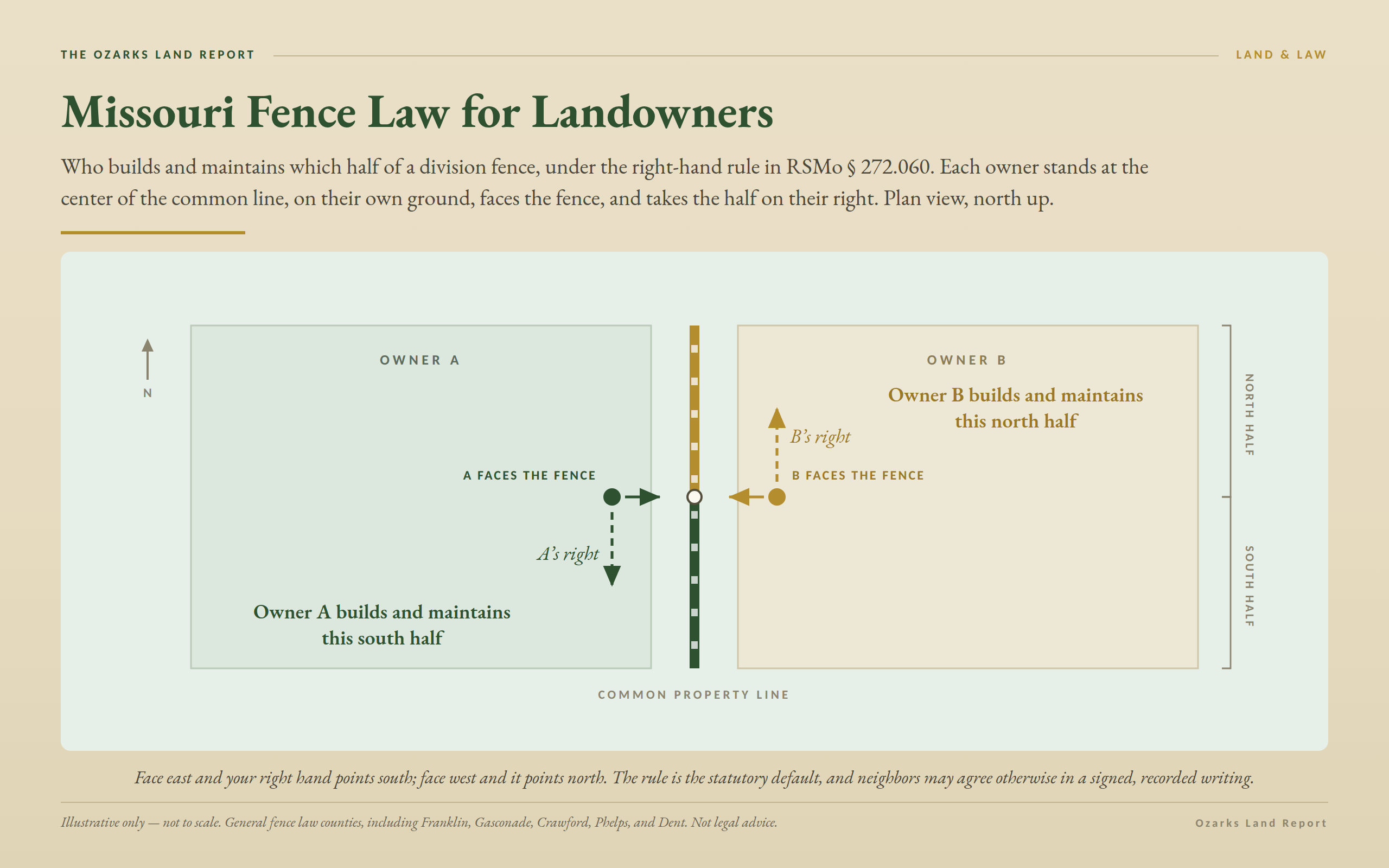
Under the general fence law, the answer turns on livestock. If you don’t run livestock against the fence, you generally can’t be forced to build or pay for a division fence at all. The burden of fencing livestock in belongs to the person who owns the livestock. When both neighbors run stock, they share the division fence, and the traditional arrangement is the “right-hand rule”: stand at the center of your common line, on your own ground, facing the fence, and the half to your right is yours to build and maintain.
That right-hand rule is not merely rural custom. It is Missouri’s statutory default under Section 272.060, which puts it in nearly those words. The process begins with written notice of the proposed construction or repair. Neighbors may agree to a different division, but the statute requires an agreement inconsistent with the right-hand rule to be in writing, signed by the agreeing parties, and recorded in the office of the recorder of deeds, and it then binds the makers, their heirs and assigns.
One wrinkle is worth knowing before you buy a bare tract next to a cattle operation: the exemption for owners with no livestock is not necessarily permanent. Section 272.132 provides that where one of two adjoining owners does not need a fence, the owner who does need it may build the entire fence and report the total cost to the associate circuit judge, who authorizes the cost to be recorded on each deed. If the adjoining owner later places livestock against that fence, the owner who built it is to be reimbursed one-half of the construction cost share, determined as provided in Section 272.060. Two cautions. The trigger is placing livestock against the fence, not merely owning cattle somewhere on the place. And this provision dates to 2001 and has almost no interpreting case law, so treat the statutory paperwork as essential and the remedy as untested rather than routine.
This is one of the sharpest practical differences from the local option counties. There, Section 272.235 provides that if either of two adjoining landowners needs a fence, both are obligated to build and maintain it, unless they agree that no fence is needed between their property. If you hunt-lease ground up north or buy a farm outside our area, don’t assume the rules you know travel with you.
What counts as a “lawful fence” in Missouri?
Under the general law, a lawful fence is not defined by measurements alone. Section 272.020 makes a fence of posts and wire or boards at least four feet high a lawful fence when it is mutually agreed upon by the adjoining landowners or decided upon by the associate circuit court of the county. Physically, all posts must be set firmly in the ground not more than twelve feet apart, with wire or boards securely fastened to the posts and placed at proper distances apart to resist horses, cattle, and other similar livestock. That first half is worth pausing on: a fence you build alone, exactly to spec, is not automatically a lawful fence under the general law. The agreement, or the court’s determination, is part of the definition.
The definition matters, but maintaining a lawful fence is not an automatic defense. Under Section 272.030, when livestock break over or through a lawful fence and trespass on a neighbor, the owner is liable for the resulting damage if the owner was negligent. That negligence requirement came into the statute by amendment effective in 2016, and a fair amount of older fence-law writing still circulating online describes the harsher rule it replaced. Responsibility may also turn on which neighbor was assigned the portion of the division fence the animals came through. Regular inspections, prompt repairs, and dated photographs are how you prove reasonable care when a dispute arrives later.
The part that costs people real money: the fence is not always the property line
Now the centerpiece, because this is where fence law stops being a neighbor topic and starts being a land-transaction topic. Fences in the Ozarks were built by practical people over the last century: along the easiest ground to drive a post, around the timber instead of through it, wherever the old fence was when the new wire went up. Surveys were expensive and cattle were impatient. The result is that on an old farm, the fence and the surveyed boundary can disagree by a few feet or forty, and the discrepancy may stay invisible until someone orders a survey, usually in the middle of a sale.
Missouri law gives that wandering fence teeth. Under Section 516.010, RSMo, ten years of possession that is hostile, actual, open and notorious, exclusive, and continuous can ripen into ownership by adverse possession. A neighbor who has farmed, grazed, and maintained up to the wrong fence line for decades may have a genuine claim to the ground on their side of it, survey or no survey.
Two things people get backwards. Hostility does not require a quarrel. In Watson v. Mense, the Supreme Court of Missouri held that there need not be a dispute between adjoining owners over the location of the border to satisfy the hostility element, and that the element is met even where the possessor only mistakenly believes she owns the land. Years of neighborly silence are not a defense. They are often the fact pattern. And the character of the ground matters. Missouri measures possession by the acts the land is suited for, and those acts must be continuing rather than occasional. Crops, hay, or cattle run to the fence year after year make a strong record. A wire through unworked timber, where the use amounts to an occasional walk and a deer stand, is far weaker evidence of possession.
Missouri courts also recognize boundary by acquiescence, which is a separate doctrine and not another name for adverse possession. It applies where the true boundary was uncertain and the adjoining owners fixed it by an agreement presumed from long acquiescence. Its effect is narrower than most people assume. Missouri’s Western District has explained that the doctrine does not itself operate to alter who holds legal title on either side of the line, and that once the line is acquiesced in, the possession that follows becomes adverse for purposes of running the limitations period. Age alone is not enough either. The mere existence of an old convenience fence, or silence about exactly where it sits, does not by itself establish a boundary.
Whether either doctrine applies is intensely fact-specific, but the point for a buyer or a seller is simpler. An old fence in the wrong place is not a harmless quirk. It is a potential transfer of acreage that no one recorded.
What this means when you buy or sell
If you’re buying
Walk the lines with the aerial and the legal description in hand, and treat every place the fence and the plat disagree as a question to answer before closing, not after. This is exactly why a land contract worth signing gives you an objection period covering survey matters. Boundary discrepancies, acreage discrepancies, and encroachments are things you should be able to raise and resolve while you still have leverage. If the contract expressly prices the farm by surveyed acre and makes the survey controlling, the survey determines the purchase-price acreage. If it’s a lump-sum deal on an old description, understand that “200 acres, more or less” may lean hard on the “more or less.”
If you’re selling
Sell the problem before it sells you. If you know the north fence sits inside your neighbor’s deeded line, or theirs sits inside yours, the cheap fixes happen before listing: a survey to define the discrepancy, followed when appropriate by a recorded boundary agreement, reciprocal quitclaim deeds, or another curative instrument that makes the title and the accepted boundary match. The expensive fix is a quiet title suit after a buyer’s survey blows up your closing. We have papered all of these, and the before-listing version costs a fraction of the after-contract version, every time.
Common questions
My neighbor’s cattle keep getting into my beans. Who pays?
In our counties, Section 270.010 makes it unlawful for the owner of horses, mules, asses, cattle, swine, sheep, or goats to permit them to run at large outside the owner’s enclosure, and an owner who does is answerable for the actual damages sustained. Where animals cross a division fence, the outcome can also depend on negligence under Section 272.030, on whether the fence was lawful, and on which neighbor was responsible for the portion that failed. Document the damage and the fence condition, then talk before you escalate. Most of these resolve over a tailgate, and the ones that don’t resolve better with photos.
Can I make my neighbor pay for half the fence?
Not merely because you want a fence. In a general law county, the obligation generally follows the need for the fence: a landowner with no livestock against it ordinarily owes nothing. If both landowners need the fence to contain livestock, they generally divide responsibility under the right-hand rule. And if a landowner who previously had no livestock later places livestock against a fence whose cost was properly reported and recorded under Section 272.132, reimbursement of one-half the applicable construction cost share may then be required.
The fence has been in the same spot for 40 years. Isn’t it the line by now?
Maybe, and that “maybe” is the whole problem. Long possession and long acquiescence can, under Missouri doctrine, make a fence line legally meaningful. Whether they have in your case depends on facts and proof. If the answer matters, and if you’re buying or selling it does, get a survey and get advice before you rely on either the fence or the deed.
Fence law sits next to its cousin: if you’re marking boundaries rather than disputing them, our earlier piece on Missouri’s purple paint law covers how to post land the right way. And if a fence question is holding up a sale, a purchase, or the peace on your road, that intersection of dirt and law is exactly where we live.
If a fence, a boundary, or a survey discrepancy is in the way of a sale or a purchase in Franklin, Gasconade, Crawford, Phelps, or Dent County and you want a straight read on what it means for value, title, and timing, that is squarely what we do, as landowners on this ground ourselves and with the legal background to back it up. Call Justin at (573) 308-7376 or Ryan at (573) 259-6360, or request a free land valuation.
And if the disputed strip carries an old roadbed rather than a fence, whether that road is still a public road is a separate question with its own rules. See our article on Missouri road abandonment law.
Scope. This article addresses Missouri’s general fence law, Sections 272.010 to 272.136, RSMo, which governs in Franklin, Gasconade, Crawford, Phelps, and Dent Counties. Nineteen Missouri counties have adopted the local option fence law, Sections 272.210 to 272.370, RSMo, where different obligations apply.
Currency. This article reflects Missouri law as of August 31, 2026. Section 272.030 was amended effective in 2016 to add the negligence requirement described above. County adoption of the local option changes by election under Section 272.370 and is not centrally reported; the county list here follows University of Missouri Extension G810 as of its September 2022 count, and should be confirmed with the county clerk.
Sources. Sections 270.010, 272.020, 272.030, 272.060, 272.132, and 516.010, RSMo; Section 272.235, RSMo (local option counties); University of Missouri Extension G810, Missouri Fencing and Boundary Laws (rev. 12/2022), and G811 (rev. 4/2021); Watson v. Mense, 298 S.W.3d 521 (Mo. banc 2009); Coleman v. Hartman, No. WD83925 (Mo. App. W.D. May 25, 2021).
Notice. This article is general information about Missouri law and is not legal advice. It does not create an attorney-client relationship. Fence and boundary questions are fact-specific, and the status of a county’s fence law can change by vote, so talk with your own attorney before acting on anything here. Justin Head is a Missouri licensed attorney with Hansen, Stierberger, Downard, Schroeder, & Head LLC in Union, Missouri, and a land specialist with Whitetail Properties covering Franklin, Gasconade, Crawford, Phelps, and Dent Counties. He publishes the Ozarks Land Report at ozarkslandreport.com.