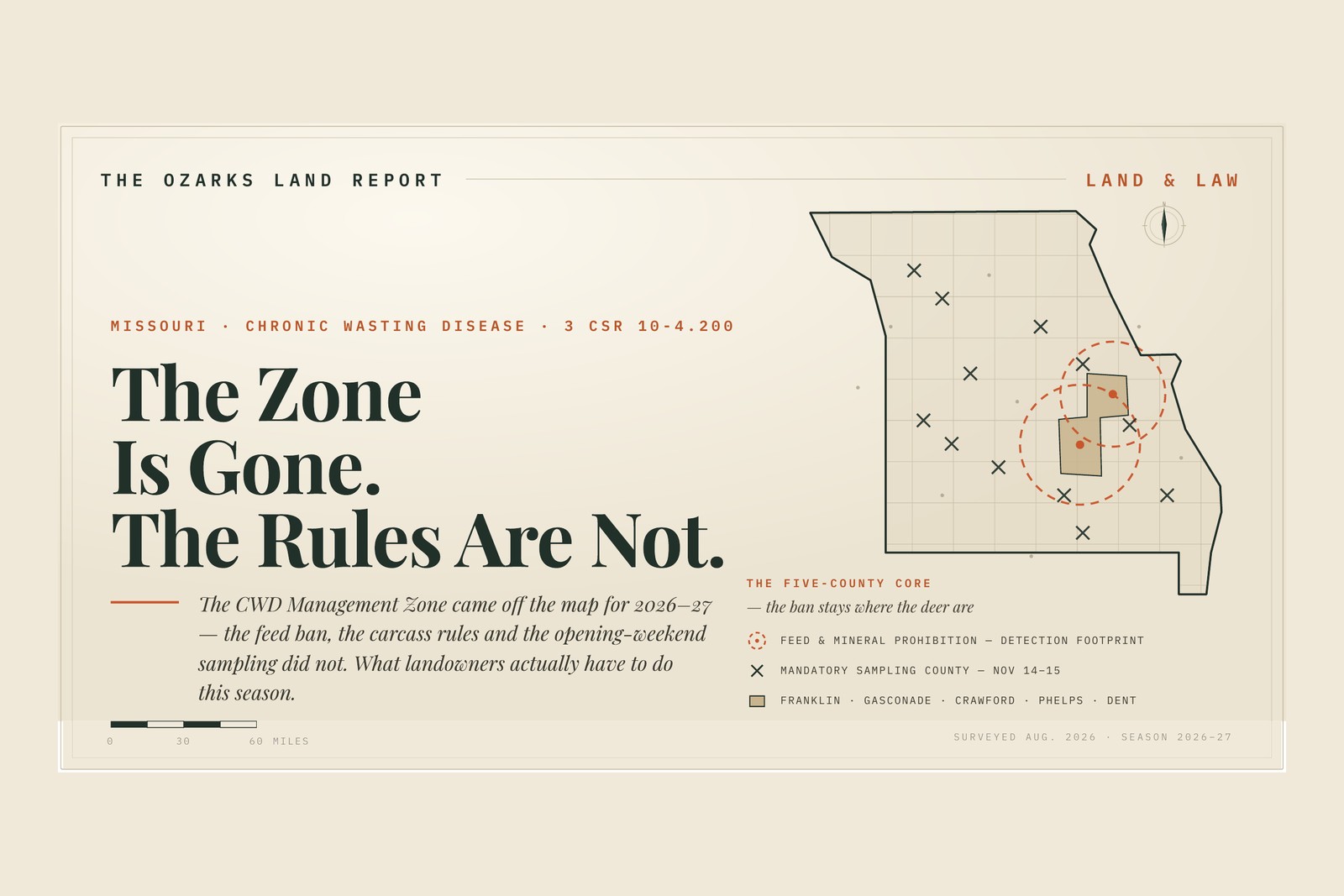
The Zone Is Gone but the Rules Are Not: Sampling Counties, the Feeding Ban, Carcass Transport, and Straight Answers for the Eastern Ozarks
Published by the Ozarks Land Report | Justin Head, Missouri attorney and land specialist, Whitetail Properties, eastern Missouri Ozarks · Last verified August 2, 2026 against the Missouri Department of Conservation’s published regulations and the 2026 Fall Deer & Turkey framework.
For more than a decade, Missouri deer hunters learned one geography: the CWD Management Zone. Beginning with the 2026–27 season, that zone no longer exists. The Missouri Department of Conservation (MDC) removed the designation, removed the CWD portion of firearms deer season, and removed the antler-point restriction in every county. What replaced the zone is not freedom from CWD rules. It is a set of separate rule footprints with separate triggers, and they do not match each other. A county can be off one list and firmly on another, and MDC’s own web pages are still catching up to the change, with old and new language sitting side by side. This article sorts it out, footprint by footprint, with specific answers for Franklin, Gasconade, Crawford, Phelps, and Dent counties and their neighbors.
Everything here was checked on August 2, 2026 against MDC’s current published regulations. This is educational information, not legal advice. The annual Fall Deer and Turkey Hunting Regulations and Information booklet is MDC’s official summary for the season you are hunting, and the Wildlife Code is the controlling legal authority. If MDC’s website and the booklet appear inconsistent, consult the Wildlife Code and call your county conservation agent before acting.
Is baiting deer still illegal in Missouri in 2026? Yes. Hunting deer or turkey with the aid of bait remains illegal statewide, and an area remains baited for 10 days after complete removal of the bait. Separately, the year-round prohibition on placing feed and minerals for deer remains in effect in the mapped CWD counties, including Franklin, Gasconade, Crawford, Phelps, Dent, and Washington.
| Rule | Where it applies | Key detail |
|---|---|---|
| Hunting with the aid of bait | Illegal statewide | Area stays baited for 10 days after complete removal |
| Placing feed and minerals to attract deer | Prohibited year-round in mapped CWD counties | Four narrow exceptions |
| Mandatory CWD sampling | 28 designated counties only | November 14 and 15, 2026, on the day of harvest |
| Telecheck and carcass disposal | Statewide | Telecheck before the deer leaves the county of harvest or by 10:00 p.m., whichever comes first |
The 60-Second Answer
- The CWD Management Zone is gone, but important CWD rules remain. For 2026–27, MDC removed the zone designation, the five-day CWD portion of firearms deer season, and the antler-point restriction in all counties. In a separate policy change, MDC paused its post-season targeted deer removals, will not conduct them this winter, and says it currently has no plans to resume them. The detection-based feed-and-mineral prohibition remains, while statewide baiting, Telecheck, transport, and carcass-disposal rules continue.
- Mandatory CWD sampling continues in 28 designated counties during opening weekend of the November firearms portion: November 14 and 15, 2026. Harvest a deer in one of those counties on either day and you must take the deer, or just the head, to a sampling station on the day of harvest. None of Franklin, Gasconade, Crawford, Phelps, or Dent is on the 2026 list. Nearby eastern and southern Ozarks counties on the 2026 list include Iron, Reynolds, Shannon, Carter, Oregon, and Ripley.
- The deer feeding and mineral ban did not go anywhere. Grain, salt products, minerals, and other consumable attractants remain prohibited year-round in counties within 10 miles of where CWD has been found, a footprint of more than 80 counties that includes all five of our counties plus Washington County next door. Corn for deer is still illegal here, every month of the year, with four narrow exceptions covered below.
- Carcass and Telecheck rules apply statewide. Telecheck your deer before it or any of its parts leave the county of harvest, or by 10:00 p.m. on the day of harvest, whichever comes first. Unused parts go in trash bound for a sanitary landfill or stay on the property where the deer was harvested.
What Actually Changed for 2026
The deer-rule amendments proposed in December 2025 and effective June 30, 2026, made four structural changes. First, the CWD Management Zone designation was eliminated; county-based CWD rules are now addressed separately through annual mandatory-sampling designations and the detection-based feed-and-mineral prohibition map. Second, the CWD portion of firearms deer season was removed after harvest data showed it was not meaningfully increasing harvest. Third, the antler-point restriction was removed statewide, partly because the young bucks the restriction protected travel long distances and can spread the disease. Fourth, the landowner acreage requirement for no-cost CWD Management Permits rose from five acres to 20 acres in a CWD core area.
A fifth change is policy rather than regulation, and it is the one hunters argued about most: the end, at least for now, of MDC’s post-season targeted deer removals. For years, agency staff worked with willing landowners after the close of deer season to remove additional deer within roughly two miles of confirmed CWD detections, using methods not available to ordinary hunters. In an open letter dated December 15, 2025, MDC Director Jason Sumners announced the department was pausing those efforts to work with hunters and landowners on a more sustainable path. In a follow-up letter in July 2026, Sumners went further: MDC will not conduct targeted removals this winter and currently has no plans to resume the approach. Hunter harvest during the regular seasons, supported by the department’s Hunter Harvest Initiative encouraging additional harvest where CWD is established, becomes the primary management tool. That shift is the thread that ties the 2026 changes together: fewer restrictions on hunters, and more reliance on them.
Just as important is what did not change. The year-round prohibition on placing feed and minerals for deer continues in the counties where it applied. The statewide ban on hunting deer or turkey over bait continues everywhere. The statewide carcass-disposal and Telecheck rules continue. If you absorbed one headline (“the zone is gone”) and concluded the rules went with it, that conclusion will earn you a conversation with a conservation agent.
The Zone Is Gone; Three Rule Footprints Remain
This is the concept that makes everything else make sense. The former CWD Management Zone bundled several county-based rules into one map. Beginning in 2026, hunters should separate three different rule footprints: an annually designated mandatory-sampling list, a detection-based feed-and-mineral prohibition map, and statewide baiting, Telecheck, transport, and carcass-disposal rules. They do not match.
- Footprint one: mandatory-sampling counties. Twenty-eight counties are designated for 2026. Under MDC’s new four-year sampling cycle, beginning in 2026, mandatory CWD sampling will be conducted in every Missouri county once every four years. The annual county list therefore changes from year to year, although the 2026 booklet does not identify the counties assigned to later years of the rotation. The 2026 designation applies only to deer harvested during opening weekend of the November firearms portion.
- Footprint two: feed-and-mineral prohibition counties. In counties within 10 miles of a CWD detection, placing grain, salt, minerals, and other consumable products to attract deer is prohibited year-round, subject to four exceptions. Detections do not un-happen, so this footprint expands as new counties are added. Confirm the current MDC map each season rather than relying on a prior-year designation.
- Footprint three: statewide rules. The prohibition on hunting deer or turkey with the aid of bait, the Telecheck requirements, and the carcass-transport and disposal rules apply in all 114 counties and depend on no county list at all.
The trap is treating the footprints as interchangeable. A county’s absence from the sampling list says nothing about corn, and eliminating the zone did not eliminate either set of rules. As of this writing, different pages on MDC’s own website describe pieces of the old and new systems side by side, which is exactly why the distinction is worth spelling out.
Mandatory Sampling: The 2026 Counties and How It Works
If you harvest a deer during opening weekend of the November firearms portion, November 14 or 15, 2026, in a designated county, you must take the deer, or just the head with at least six inches of neck attached, to a mandatory CWD sampling station on the day of harvest. Stations are open from 7:30 a.m. to 8:00 p.m.
The 2026 mandatory sampling counties are: Andrew, Atchison, Audrain, Benton, Buchanan, Callaway, Carter, Cedar, Dade, Greene, Holt, Iron, Lawrence, Lincoln, Monroe, Montgomery, Nodaway, Oregon, Pike, Polk, Ralls, Reynolds, Ripley, Shannon, St. Charles, St. Clair, Warren, and Wayne.
How to make the stop painless: field dress and Telecheck the deer before you arrive. The hunter who harvested the deer must be present, be ready to provide their Telecheck ID, and be able to point out the harvest location on a map or give the township, range, and section where the deer was taken. It is fine to remove the cape first if the deer is headed for a shoulder mount, and tell the station staff if a taxidermist is involved. Position the deer in the vehicle with the head and neck accessible. Note that freezer drop-off locations are closed during opening weekend, so plan on a staffed station. Sampling takes a few minutes, and hunters receive a card for free test results.
Outside of mandatory counties and dates, testing is voluntary and free throughout the deer season, September 15 through January 15, at select MDC offices, participating taxidermists and processors, and freezer drop-off locations. If you hunt Franklin, Gasconade, Crawford, Phelps, or Dent, voluntary testing is the only kind that applies to you in 2026, and it is worth doing.
The Feeding Ban: Where Corn Is Still Illegal
Here is the rule, unchanged in substance: grain, salt products, minerals, and other consumable products used to attract deer are prohibited year-round in counties within 10 miles of where CWD has been found. The feed-and-mineral prohibition map covers more than 80 counties, roughly three-quarters of the state, including Franklin, Gasconade, Crawford, Phelps, Dent, and Washington counties. Because a detection does not un-happen, the footprint expands as new counties are added. Under the current detection-based rule, a county that enters the footprint remains within it. Even so, confirm the current MDC map each season rather than relying solely on a prior-year designation.
The four exceptions: feed placed within 100 feet of any residence or occupied building; feed placed in a manner that excludes access by deer; feed and minerals used solely for normal agricultural, forest management, or wildlife food plot production practices; and feed placed as part of a feral hog or CWD management effort authorized by the Conservation Department. Your bird feeder by the house is fine. That exception makes the placement lawful under the CWD feed prohibition; it does not make hunting with the aid of that feed lawful. Your food plot is fine. Your corn pile on the back forty is not, in any month, whether or not anyone is hunting.
Mineral blocks deserve their own sentence. In feeding-ban counties, salt and mineral products placed to attract deer are prohibited along with grain. Mineral and salt blocks are prohibited on conservation areas everywhere in the state. And a mineral block that contains grain or other food additives is treated as bait wherever you are.
The statewide baiting rules ride on top of all of this. Hunting deer or turkey with the aid of bait is illegal in every Missouri county, and an area is considered baited for 10 days after complete removal of the bait. A hunter can be in violation if they take or attempt to take a deer where they know or reasonably should know the area is or has been baited, and it is illegal to place bait in a way that causes another hunter to violate the rule. What remains legal statewide: scents such as doe urine, apple, acorn, and persimmon, as long as they are not used on or with grain or other food; hunting over a harvested crop field, as long as nothing is added to it afterward; and manipulating standing crops, such as mowing or knocking them down, which is not considered baiting for deer and turkey.
Need an answer for a specific property? Request a free, no-obligation land valuation.
From the Field to the Processor: Telecheck, Transport, and Disposal
Missouri had already rescinded its county-by-county restrictions on transporting high-risk deer parts ahead of the 2025 season, replacing them with statewide carcass-disposal requirements. Those statewide Telecheck, transport, and disposal rules continue for 2026: easier to follow than the old system, but strictly timed.
- Void the permit immediately: tear-notch the month and day on a paper permit, or notch the permit electronically by following the prompts in the MO Hunting app. Keep the deer intact or field dressed until it is Telechecked.
- Telecheck on the clock. Report the deer through the Telecheck Harvest Reporting System before it is processed, before it or any of its parts leave the county of harvest, before it leaves Missouri, or by 10:00 p.m. on the day of harvest, whichever comes first. If using a paper permit, write the Telecheck confirmation number on it immediately. When using the MO Hunting app, Telecheck records the confirmation number electronically. Until the deer is Telechecked, only the hunter who took it may possess or transport it.
- After Telecheck, transport is open. Once checked, you may take the deer to a processor in any county. The confirmation number must stay with the carcass until the processor begins work, and deer left at a processor must be claimed by May 1 following the season.
- Label stored and gifted deer correctly. Stored deer must be labeled with the taker’s full name and address or Conservation Number, the date taken, and the Telecheck confirmation number. Gifted deer must be labeled with the taker’s full name and address, the date taken, and the Telecheck confirmation number.
- Donate through Share the Harvest carefully. A deer harvested in a county within 10 miles of a CWD detection—including all five counties covered here—must be tested for CWD before donation. An untested deer must go to a processor participating in the Share the Harvest CWD Testing Program with the head and a few inches of neck attached. If the deer was already tested, it may go to any Share the Harvest processor, but bring the sampler-provided barcode number.
- Dispose of the rest correctly. Carcass parts not kept or delivered to a taxidermist, processor, or tanner must go into trash that is dumped in a sanitary landfill, or stay on the property where the deer was harvested. It is illegal to put a deer carcass or its parts into any well, spring, brook, branch, creek, stream, pond, or lake.
- Bringing a deer or elk in from another state? Only certain parts may cross into Missouri: cut-and-wrapped or boned-out meat, quarters with no spine or head attached, cleaned hides, antlers on cleaned skull plates or skulls, upper canine teeth, and finished taxidermy. The head with cape and up to six inches of neck may enter only if it goes to a licensed Missouri taxidermist within 48 hours.
Our Five Counties at a Glance
For Franklin, Gasconade, Crawford, Phelps, and Dent counties in 2026–27, the picture is the same in all five. Feeding and minerals for deer: prohibited year-round, subject to the four exceptions. Mandatory sampling: not required, because none of the five is on the 2026 designated list, though free voluntary testing is available all season and encouraged. Baiting while hunting: illegal, as it is statewide, with the 10-day rule. Telecheck and carcass disposal: statewide rules apply. Antler-point restriction: removed. And if you hunt elsewhere in the eastern or southern Ozarks, check the mandatory-sampling list before opening weekend: Iron, Reynolds, Shannon, Carter, Oregon, and Ripley are all 2026 mandatory sampling counties, and a Saturday-morning buck in any of them must visit a sampling station before the day ends.
Frequently Asked Questions
Is the CWD Management Zone really gone?
Yes, as a designation. Beginning with the 2026-27 season there is no zone. The obligations that mattered continue as annual county lists for mandatory sampling and a detection-based footprint for the feeding ban, plus statewide carcass and Telecheck rules. The annual regulations booklet is where the current lists live.
Can I put out corn for deer in Franklin County, or Washington County, in 2026?
No. Both counties are within the feeding-ban footprint, and the prohibition applies year-round, hunting season or not. The exceptions are narrow: within 100 feet of a residence or occupied building, feed deer cannot access, normal agricultural and food plot practices, and department-authorized feral hog or CWD efforts.
Do I have to get my deer tested in 2026?
Only if you harvest it in one of the 28 designated counties on November 14 or 15, 2026. Then the deer, or its head, must reach a sampling station the same day. Everywhere else, and on every other date, testing is voluntary and free.
Can I drive my deer to a processor two counties away?
Yes, after you Telecheck it. The deer and its parts cannot leave the county of harvest until it is Telechecked, and it must be checked by 10:00 p.m. on the day of harvest regardless. After that, any processor in the state is fine, with the confirmation number accompanying the carcass.
What about salt licks and mineral blocks?
Prohibited in feeding-ban counties, prohibited on conservation areas statewide, and prohibited everywhere if the block contains grain or other food additives.
Did the antler-point restriction really go away?
Yes. For 2026-27 the four-point restriction has been removed in all counties.
Did MDC stop the sharpshooting and culling program?
MDC paused its post-season targeted removals in December 2025 and confirmed in July 2026 that it will not conduct them this winter and has no plans to resume the approach. The department describes the change as a shift to hunter harvest as the primary tool for managing the deer herd and CWD, not as an end to CWD management.
How many acres do I need for no-cost CWD Management Permits?
Beginning in 2026, a landowner must have at least 20 acres in a CWD core area to receive CWD Management Permits, up from the previous five acres. This matches the acreage requirement for no-cost landowner deer hunting permits.
Where is the official county list?
The 2026 Fall Deer and Turkey Hunting Regulations and Information booklet, available where permits are sold and at mdc.mo.gov, and the mandatory sampling page on MDC’s website. If a web page and the booklet appear inconsistent during this transition year, consult the Wildlife Code or call your county conservation agent before acting.
The Bottom Line
The 2026 changes genuinely simplified Missouri’s deer season: one fewer firearms portion, no antler-point restriction, and no CWD Management Zone. But the simplification headline hides the part that gets people in trouble, which is that the feeding ban and the carcass rules never blinked. Know which rule footprint applies where you are hunting, Telecheck before the deer leaves the county, keep the corn in the bin, and put your county agent’s number in your phone before September 15. If a recovery goes sideways or a deer crosses a line it should not have, our companion guide to tracking a wounded deer in Missouri covers the dogs, drones, firearms, and property-line rules in the same detail.
This guide was prepared and reviewed by a licensed Missouri attorney who regularly handles rural real-estate and property-access matters in the eastern Missouri Ozarks.
Sources & Authorities
- Missouri Department of Conservation, What’s New for 2026 (zone removal; CWD portion removal; antler-point restriction removal; feeding prohibition in counties within 10 miles of a detection).
- Missouri Department of Conservation, Mandatory CWD Sampling (2026 county list; opening-weekend requirement; station hours and procedures).
- Missouri Department of Conservation, Deer: Regulations (feeding prohibition and exceptions; baiting rules; Telecheck timing; carcass disposal; interstate carcass parts; feeding-ban county list including Franklin, Gasconade, Crawford, Phelps, Dent, and Washington).
- Missouri Department of Conservation, “MDC Announces Changes to Deer-Hunting Regulations” (Dec. 12, 2025) (initial Commission approval and proposed June 30, 2026 effective date), together with the 2026 Fall Deer & Turkey Hunting Regulations and Information booklet and current Wildlife Code.
- Open letters from MDC Director Jason Sumners on CWD: December 15, 2025 (pause of post-season targeted removals) and July 15, 2026 (no removals this winter; no plans to resume; hunter harvest as the primary tool), MDC newsroom.
- Missouri Department of Conservation, 2026 Fall Deer & Turkey Hunting Regulations and Information (PDF), including p. 7, “Four-Year Cycle for Mandatory Sampling”; general information, baiting regulations, CWD information, mandatory sampling stations, and after-the-harvest requirements.
- Missouri Wildlife Code, 3 CSR 10-4.135 (transportation), 3 CSR 10-4.140 (possession, storage, and processing), 3 CSR 10-4.150 (wildlife taken outside Missouri), 3 CSR 10-4.200 (CWD), 3 CSR 10-7.431 (deer general provisions and Telecheck), and 3 CSR 10-7.439 (CWD Management Permits).
This article is general educational information about Missouri law and regulation as of August 2, 2026. It is not legal advice and does not create an attorney-client relationship. County lists and dates change annually and MDC’s website is mid-transition as of this writing; always confirm current rules in the annual regulations booklet or with your county conservation agent before you act, and consult a licensed Missouri attorney about your specific situation.