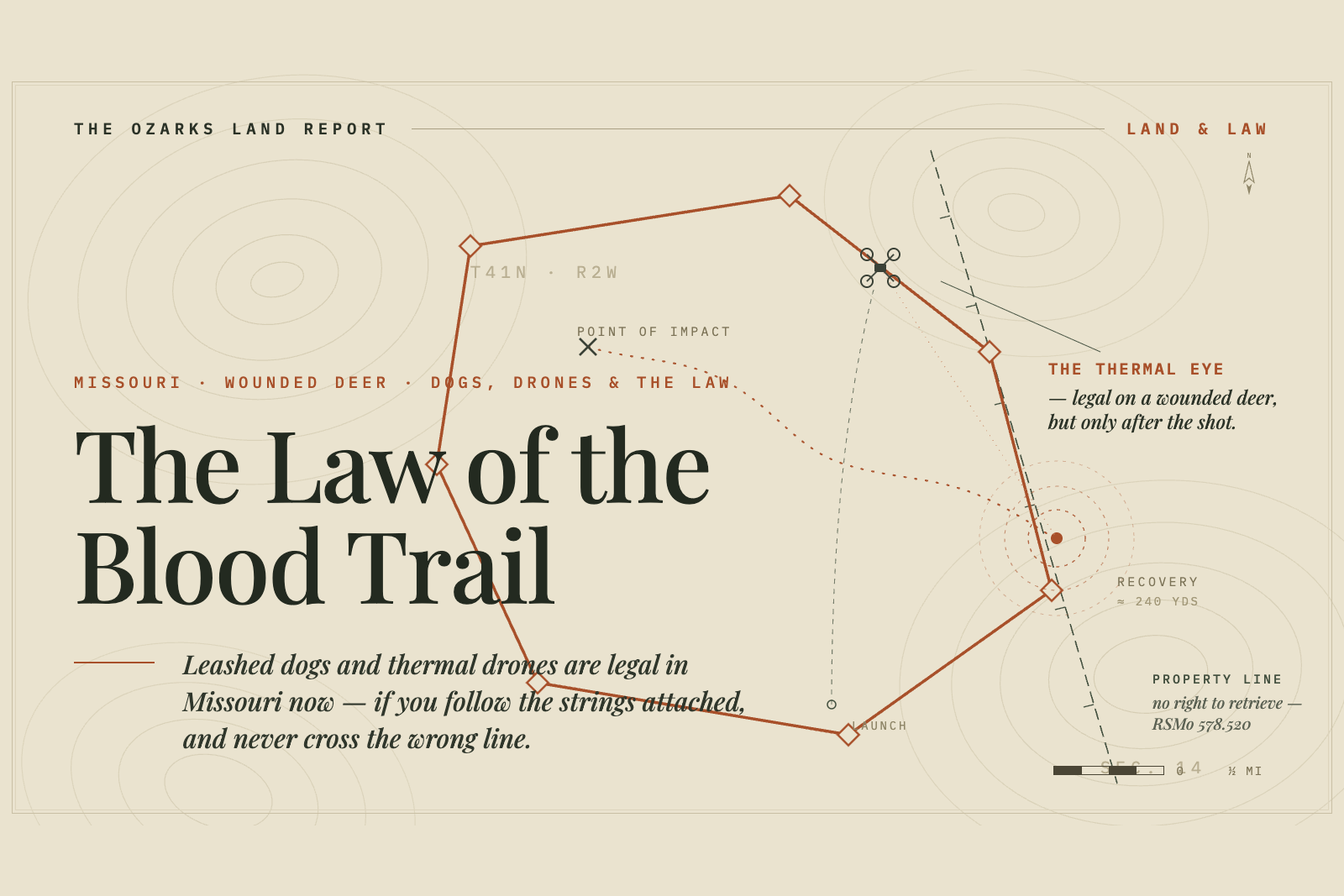
You made the shot, the deer bolted, and now the recovery is on. What you may lawfully do over the next few hours is governed by rule as much as by woodsmanship, and the fastest way to turn a good recovery into a bad day is to cross a property line or carry the wrong thing at the wrong time.
This guide lays out Missouri’s rules for recovering a wounded deer: leashed tracking dogs, drones, firearms while tracking, artificial light at night, and crossing onto a neighbor’s ground. It is built directly on the current Missouri Wildlife Code (3 CSR 10-7.410 and related rules), the Revised Statutes of Missouri, and Federal Aviation Administration rules, cited by section throughout so you can check every claim yourself. It is educational, not legal advice. Regulations change, so always confirm the current Missouri Wildlife Code and consult the annual Fall Deer and Turkey Hunting Regulations and Information booklet from the Missouri Department of Conservation (MDC) for the season you are hunting. The booklet is the official summary, and the Wildlife Code is the controlling legal authority.
The 60-second answer
- Tracking dogs are permitted. Missouri’s Wildlife Code permits leashed tracking dogs to be used to recover a wounded deer, subject to applicable property-access and area-specific restrictions, as long as the dog is leashed and under the direct control of a handler. 3 CSR 10-7.410(1)(F). You no longer have to call a conservation agent for permission first; that older requirement is gone.
- Drones are legal for locating and recovering a wounded deer after it has been shot, with permission from the landowner or the landowner’s authorized representative before launching from or landing on that property, and with no one afield possessing a firearm, bow, or other implement capable of taking wildlife while the drone is airborne (a concealable firearm carried for protection is the only exception, and it can’t be used on the deer). 3 CSR 10-7.410(1)(A)2.
- Carrying a firearm while tracking depends entirely on the situation. On foot during legal shooting hours and an open firearms portion, on ground you may lawfully enter: generally fine. During archery season you may not use a firearm to finish the deer (only a concealable firearm may be possessed under the exception, and it may not be used to take wildlife). While a tracking dog or drone is working, the weapons ban applies (concealable-firearm exception only). At night, using artificial light to locate a deer while possessing any implement capable of taking game is the spotlighting rule’s exact target, and legal shooting hours have ended anyway.
- You cannot cross onto a neighbor’s land to recover your deer without permission. Missouri has no “right to retrieve.” Retrieval without permission is a Class B misdemeanor (RSMo § 578.520), and on conviction the court shall notify the Conservation Commission and request revocation of your hunting, fishing, and trapping privileges for at least one year.
The big idea: “recovering” is not “hunting”
Almost all of Missouri’s recovery rules flow from one distinction: hunting a live animal versus recovering one you’ve already wounded.
You will read on MDC’s own website that dogs are prohibited when hunting deer. That’s true: you cannot run deer with dogs in Missouri. But the Wildlife Code carves out a separate, narrower activity: using a leashed dog to trail and recover a deer that has already been legally struck. Same with drones: you can’t use one to find a live buck to go kill, but you can use one to find the buck you already arrowed.
The Code even defines the line. Under 3 CSR 10-7.410(1)(F), a deer is “wounded” when “a properly licensed hunter has struck an animal with a projectile fired from a legal hunting method during the open season.” (The same definition governs the drone rule.) If that’s your situation, the recovery tools below are open to you. If it isn’t, using a dog or drone to locate or pursue an animal you have not legally wounded is unlawful hunting or pursuit and may constitute an unlawful take, which is a different and potentially much more serious problem.
Using a tracking dog to recover a wounded deer
Missouri is a tracking-dog-friendly state. Here’s what the law requires.
The dog must be leashed and under direct control
3 CSR 10-7.410(1)(F) authorizes “leashed dogs under the direct control of a dog handler” to track and recover wounded black bear, deer, elk, and turkey. A dog off the leash running your wounded deer is not legal recovery. It is the thing the “no dogs for deer” rule prohibits.
You don’t need a conservation agent’s blessing anymore
For years, Missouri hunters had to contact the local conservation agent and get case-by-case permission before putting a dog on a track. That requirement has been removed. Leashed-dog recovery is now a standing allowance in the Code. You’ll still see the old “call the agent first” advice on hunting forums and even some regulation-summary sites; it’s out of date. Calling your agent is still a smart courtesy in some situations, especially at night or when a neighbor’s land is involved.
The people working the track can’t carry a long gun or bow
This surprises people. The rule’s words: “Dog handlers assisting in the tracking and recovery of a wounded animal may not possess a firearm, bow, or crossbow, except for concealable firearms as defined in Chapter 571, RSMo,” and those concealable firearms “may not be used to take wildlife.” In plain terms: when the leashed dog is working, everyone helping with the track should go weapons-free. A concealable firearm may be possessed under the exception, but it may not be used to take wildlife. It is not a lawful dispatch method.
Helpers don’t need a hunting permit
The friend running the dog, or a professional tracker you call in, does not need a deer permit, provided they are not the person who wounded the deer — the rule exempts dog handlers “provided they are not the taker of the wounded animal.” The hunter who made the shot still carries the permit and the recovery duties. On conservation-department areas, even paid trackers are exempt from commercial-use permit requirements. 3 CSR 10-11.120(3).
Can you track at night?
Trailing itself isn’t locked to legal shooting hours: recovery can continue after dark, and a leashed dog is a normal, legal way to finish a track. On department areas, the Code says so expressly — leashed-dog recovery is authorized “during all hours” in areas open to hunting those species. 3 CSR 10-11.120(3). The catches are that (1) no one working the track may carry a firearm or bow (concealable-firearm exception only), and (2) you cannot legally shoot the deer after hours even if you find it alive.
If the dog finds the deer alive during legal shooting hours, any dispatch must independently comply with the rules: legal shooting hours, a method lawful for the season or portion then open, and lawful access to the ground the deer is standing on. Secure the dog, retrieve a lawful weapon, and finish the job cleanly. The tracking-party weapons ban and the dispatch are separate steps, not an excuse to blend them.
Using a drone to recover a wounded deer
Missouri’s wounded-game drone-recovery rule was filed February 23, 2024, became effective August 30, 2024, and was in force when the 2024 archery deer season opened on September 15. In short: Missouri permits drones to be used after a deer has been shot to locate and recover the wounded animal. Thermal changed night recovery, but the rules are tight, and there are two separate rulebooks — the state’s (MDC) and the federal government’s (FAA). You must satisfy both.
The Missouri (MDC) rules: 3 CSR 10-7.410(1)(A)2
- Recovery only, after the shot. A drone may be used after a deer has been shot to locate and recover it. You may not use one to scout or locate a live animal you intend to hunt. That is unlawful hunting or pursuit and may constitute an unlawful take, and the rule separately prohibits pursuing or taking any wildlife that has been harassed by or with the aid of a drone.
- Permission before launching or landing. Before launching a drone from, or landing it on, public or private property, the operator must first obtain permission from the landowner or the landowner’s authorized representative. This permission does not authorize anyone to enter the property on foot to locate or recover the deer; ground entry is a separate ask governed by RSMo § 578.520.
- No weapons afield while the drone is in flight. While the drone is airborne, no person afield, whether acting alone or as part of the group, may possess or control a firearm, bow, or other implement capable of killing or taking wildlife. The exception is a concealable firearm as defined in Chapter 571, RSMo, which may not be used to take wildlife. The practical consequence: if the drone locates a living deer, the aircraft must be on the ground before anyone lawfully takes a weapon in hand, and any dispatch must independently comply with legal shooting hours, the method authorized for the open season or portion, and property-access requirements.
- No harassing wildlife. The rule requires drones to be operated “in a manner that does not harass any wildlife.”
- Permit exemption for the pilot. The operator doesn’t need a hunting permit unless the operator is the person who wounded the animal.
- Department land is different. On areas owned or leased by the Missouri Department of Conservation, drone recovery requires prior authorization from a conservation agent; authorization is discretionary, and the agent may restrict the locations and times of the flight to minimize conflicts with resource-management activities or public use. 3 CSR 10-11.130(8).
- Thermal is allowed within these rules, which is what makes a drone so effective on a cold night.
The FAA rules (the part hunters forget)
MDC controls whether you may recover with the drone; the FAA controls the airspace. Both apply.
- Register the aircraft. A recreational drone weighing 0.55 pound (250 grams) or more must be registered with the FAA; a drone operated under Part 107 must be registered regardless of weight. 14 C.F.R. Part 48. A registered drone must be marked with its registration number and comply with applicable Remote ID requirements. 14 C.F.R. Part 89.
- Recreational vs. Part 107. A hunter recovering their own deer for enjoyment generally flies under the Recreational Flyer exception (49 U.S.C. § 44809), which requires passing the free TRUST test and carrying proof of it; current FAA guidance is Advisory Circular 91-57D (2025). The recreational exception applies only when the flight is conducted purely for recreational purposes. A paid recovery, a flight performed for a guiding business, or another operation serving a non-recreational purpose ordinarily must be conducted under Part 107, even when compensation is not the only purpose of the flight.
- Night flying. Night recovery is possible, but the requirements depend on how the flight is conducted. A Part 107 pilot flying at night must satisfy the FAA’s night-operation requirements, including anti-collision lighting visible for at least three statute miles. 14 C.F.R. § 107.29. A recreational pilot must follow the night-flight safety guidelines of an FAA-recognized community-based organization. In either case, visual line of sight must be maintained in the manner required by the applicable FAA rules. For a recreational flight, a visual observer must be physically co-located with and in direct communication with the operator. Watching only the thermal display does not satisfy the visual-line-of-sight requirement.
- Airspace and altitude. Generally remain at or below 400 feet above ground level and maintain visual line of sight. Controlled airspace requires FAA authorization, often available through LAANC. Do not operate over people or moving vehicles unless the operation satisfies the specific FAA requirements applicable to that flight. Check current airspace restrictions before launching.
- Flying over neighboring property. FAA airspace rules do not give a drone operator the right to launch from, land on, enter, or recover a deer from private property without permission. Low-altitude flights can also raise privacy, nuisance, or property-law concerns depending on how and where the drone is operated. Obtain permission whenever practical, avoid hovering over homes, people, or livestock, and remember that locating a deer from the air never authorizes entry onto the ground.
Carrying a firearm while tracking
“Can I carry a gun while I track?” has no single answer in Missouri; it depends on how and when. Run your situation through these five scenarios.
1. On foot, during legal shooting hours, during an open firearms portion, on property you may lawfully enter
Generally yes. The hunter must possess the required permit, and the firearm and ammunition must be legal for that particular firearms portion. If the wounded deer is found alive, it may be dispatched only during legal shooting hours and by a method authorized for that open portion. Legal hours for all deer seasons are one-half hour before sunrise to one-half hour after sunset. 3 CSR 10-7.431.
2. Archery season: no firearm to finish the deer
The archery-season rule, 3 CSR 10-7.432, is “use archery methods only; firearms may not be possessed except any person may carry concealable firearms, as defined in Chapter 571, RSMo, on or about his/her person while hunting,” and firearms carried under that exception “may not be used to take wildlife while archery hunting.” A deer wounded during the archery season may be dispatched only during legal shooting hours and with a method lawful during the archery season. The concealable firearm carried for personal protection is not a lawful dispatch method.
3. Tracking with a leashed dog: no long gun or bow
As above: those working the track may not possess a firearm, bow, or crossbow, except a concealable firearm that may not be used to take wildlife. 3 CSR 10-7.410(1)(F).
4. Drone in the air: the ban is even broader
While the drone is airborne, no person afield may possess any implement capable of taking wildlife; concealable firearm excepted and not usable on the deer. 3 CSR 10-7.410(1)(A)2.
5. At night: the spotlighting trap
Under 3 CSR 10-7.410(1)(B), no person may cast the rays of a spotlight, headlight, or other artificial light in any field, woodland, or forest to spot, locate, or attempt to take any game animal while possessing or controlling a firearm, bow, or other implement whereby game could be killed. That is the spotlighting rule, and a flashlight in one hand and a gun in the other while actively looking for your deer is exactly the conduct it prohibits. Legal shooting hours have also ended. Do not carry a hunting weapon while using artificial light to locate the deer.
The live-deer-at-night problem
Put scenarios 3 and 5 together and you get the question every serious tracker eventually asks: “My leashed dog has located my still-living deer, it’s after dark, and I’m not carrying a weapon. Now what?” The lawful answer is not to dispatch the deer after shooting hours. Back out, preserve the location as well as you can, and promptly contact the local conservation agent for guidance. Calling an agent does not itself authorize an otherwise unlawful method of take, but the agent can provide direction for the particular circumstances. Program your county agent’s number into your phone before the season.
Need an answer for a specific property? Request a free, no-obligation land valuation.
Crossing onto a neighbor’s property
This is the one that ends up in front of lawyers, so read it twice.
Missouri has no “right to retrieve.” Some states give hunters a limited statutory right to step across a boundary to pick up a downed animal. Missouri is not one of them. There is no “I can go get my deer because I shot it on my side.”
Stop at the property line
However tempting, do not step across a boundary without a “yes.” Under RSMo § 578.520, it is unlawful to fish, hunt, trap, or retrieve wildlife from private land you don’t own or possess without permission from the owner or lessee, and the statute reaches exactly the deer you legally shot that crossed the line before it died. Violation is a Class B misdemeanor, and on conviction the court shall notify the Conservation Commission and request revocation of the person’s hunting, fishing, and trapping privileges for at least one year from the date of conviction.
Note what § 578.520 does not require: posting. Unlike general criminal trespass (RSMo § 569.140, a Class B misdemeanor that applies to land only when it is fenced, otherwise enclosed, or posted against trespass, or notice is actually communicated), the retrieval statute has no fencing or posting prerequisite. Bare, unmarked timber is protected the same as a purple-painted fence line. Depending on the facts, both statutes can apply to the same walk across the boundary.
A conservation agent cannot give you permission to enter private land. Under RSMo § 578.520, permission must come from the owner or lessee of the property, or from someone authorized to grant access on that person’s behalf. This is a common and costly misunderstanding. Your agent can sometimes help make contact and is a great resource, but the legal permission must come from the landowner side.
How to do it right
- Stop at the line. Don’t step over without a “yes.”
- Find and ask the landowner. If you don’t know who owns the adjoining tract, the county assessor’s office, plat books, or online parcel maps will tell you. Knock, call, ask.
- Get the “yes,” ideally documented. A text message granting permission is worth a great deal if a question ever arises later.
- If you can’t reach them, call your conservation agent for guidance rather than freelancing it.
- Respect posted boundaries. Missouri’s purple-paint statute (RSMo § 569.145) makes properly placed purple marks the legal equivalent of a “No Trespassing” sign: vertical lines at least eight inches long, the bottom of each mark three to five feet off the ground, spaced no more than one hundred feet apart and readily visible. Alternatively, a post may be capped or marked in purple on at least its top two inches, with the bottom of the cap or mark between three feet and five feet six inches above the ground; marked posts must be no more than thirty-six feet apart and readily visible to a person approaching the property. Treat properly placed purple the way you’d treat a signed and locked gate.
The best fix happens before the season
If you hunt near a boundary — and in this part of the Ozarks, most of us do — go meet your neighbors now. A standing, mutual “call me and come get it” understanding between adjoining landowners solves this whole problem before a deer ever bleeds across the line. A five-minute conversation in August beats a Class B misdemeanor in November.
After the recovery
Void the permit and Telecheck the deer. The hunter who wounded and takes possession of the deer remains the taker and must use their permit. Under 3 CSR 10-7.431, the hunter must void the permit immediately by notching the month and date of harvest. Until Telechecked, the deer may be possessed and transported only by the taker. The deer must be reported through the Telecheck Harvest Reporting System by 10:00 p.m. on the day taken, and before processing, before transporting it outside the county of harvest, or before removing it from Missouri, whichever comes first. The Telecheck confirmation number must be recorded immediately on the deer-hunting permit, and until the deer is reported it must remain intact or as a field-dressed carcass.
Make a reasonable search. The Wildlife Code requires it in as many words: “Any person while hunting who kills or injures any wildlife shall make a reasonable search to retrieve the wildlife and take it into his/her possession; however, this does not authorize trespass.” 3 CSR 10-7.410(1)(O). The duty to search and the ban on trespass live in the same sentence. Missouri expects you to try hard and stay on the right side of the line while you do it.
CWD zones. If you’re in a Chronic Wasting Disease management county, watch the carcass-movement and mandatory-sampling rules; they can affect how and where you transport a recovered deer.
Frequently asked questions
Do I need to call a conservation agent before I use a tracking dog in Missouri?
No. The current Wildlife Code allows leashed-dog recovery without prior agent permission; that older requirement has been removed. Calling your agent is still wise for a live deer at night or a cross-boundary situation, and on MDC areas, drones, unlike dogs, do require prior agent authorization.
Can I use a thermal drone to find my deer at night?
Yes, for recovery of an animal you’ve already shot, with permission before launching from or landing on the property, no weapons afield while the drone flies, no harassment of wildlife, and full compliance with the applicable FAA rules: registration when required, Remote ID, TRUST or Part 107 qualifications, visual line of sight, airspace authorization when required, and the applicable night-flight lighting rules.
Can I carry my rifle while tracking a deer I shot with my bow?
No. During archery season you can’t use a firearm to finish a deer. Only a concealable firearm, as defined in Chapter 571, RSMo, may be possessed under the exception, and it may not be used to take wildlife. A deer wounded during the archery season may be dispatched only during legal shooting hours and with a method lawful during the archery season. And if you’re using a dog or drone to recover, the weapons restriction applies regardless of season.
My deer ran onto my neighbor’s land. Can I just hop the fence to grab it?
No. Missouri has no right-to-retrieve law. Get permission from the owner or lessee, or from a person authorized to grant access on that person’s behalf, before entering. You risk a Class B misdemeanor under RSMo § 578.520; on conviction the court shall notify the Conservation Commission and request revocation of your hunting, fishing, and trapping privileges for at least one year, and it doesn’t matter whether the land was posted.
Can I shoot a wounded deer I find after dark?
No. Legal shooting hours end one-half hour after sunset, and using artificial light to locate a deer while possessing any implement capable of taking game is the conduct the spotlighting rule prohibits. Track and recover, but don’t shoot after hours.
Does the person running the dog or drone need a deer permit?
Not if they aren’t the hunter who wounded the deer. Helpers and pilots are permit-exempt; the wounding hunter remains the taker and must use their permit. On department areas, even paid trackers and pilots are exempt from commercial-use permits. 3 CSR 10-11.120(3); 3 CSR 10-11.130(8).
The bottom line
Missouri gives you an excellent legal toolbox for recovering a wounded deer: leashed dogs, drones, thermal, and helpers who don’t need a permit. But the same Code that hands you those tools draws hard lines around weapons, hours, light, and especially property boundaries. The two mistakes that turn a recovery into a citation are almost always (1) having a firearm or bow in hand when the rules say you shouldn’t, and (2) stepping onto ground that isn’t yours without a “yes.” Know the rules before the season, know your neighbors, and keep your conservation agent’s number handy for the hard calls.
Recover every animal you can, and keep it legal.
Sources and authorities
- Missouri Wildlife Code, 3 CSR 10-7.410, Hunting Methods: (1)(A)2 (drone recovery), (1)(B) (artificial light), (1)(F) (leashed tracking dogs; definition of “wounded”), (1)(O) (reasonable search; no trespass). Amended: filed Feb. 23, 2024, effective Aug. 30, 2024.
- Missouri Wildlife Code, 3 CSR 10-7.431, Deer Hunting Seasons: General Provisions (legal hours; permit voiding; Telecheck).
- Missouri Wildlife Code, 3 CSR 10-7.432, Deer: Archery Hunting Season.
- Missouri Wildlife Code, 3 CSR 10-11.120(3), Pets and Hunting Dogs (recovery on department areas during all hours; commercial-permit exemption).
- Missouri Wildlife Code, 3 CSR 10-11.130(8), Vehicles, Bicycles, Horses, and Horseback Riding (drone recovery on department areas; agent authorization).
- Missouri Department of Conservation, 2026 Fall Deer and Turkey Hunting Regulations and Information; Tagging and Telecheck.
- RSMo § 578.520: unlawful fishing, hunting, trapping, or retrieval of wildlife on private land; mandatory revocation request on conviction.
- RSMo § 569.140: trespass in the first degree.
- RSMo § 569.145: purple-paint posting.
- 49 U.S.C. § 44809: exception for limited recreational operations of unmanned aircraft.
- 14 C.F.R. Parts 48, 89, and 107: FAA drone registration, Remote ID, and small-UAS operating rules (including § 107.29, night operations).
- FAA Advisory Circular 91-57D (2025): recreational operation of unmanned aircraft.
Buying or selling Ozarks ground where the boundary and access questions matter? Request a free, no-obligation valuation, or get in touch — we run the line, access, and neighbor questions down before they become problems.
This guide is general educational information about Missouri law and regulation as of July 2026. It is not legal advice and does not create an attorney-client relationship. Hunting regulations change; always confirm the current rules with the Missouri Department of Conservation and the FAA before you act, and consult a licensed Missouri attorney about your specific situation.