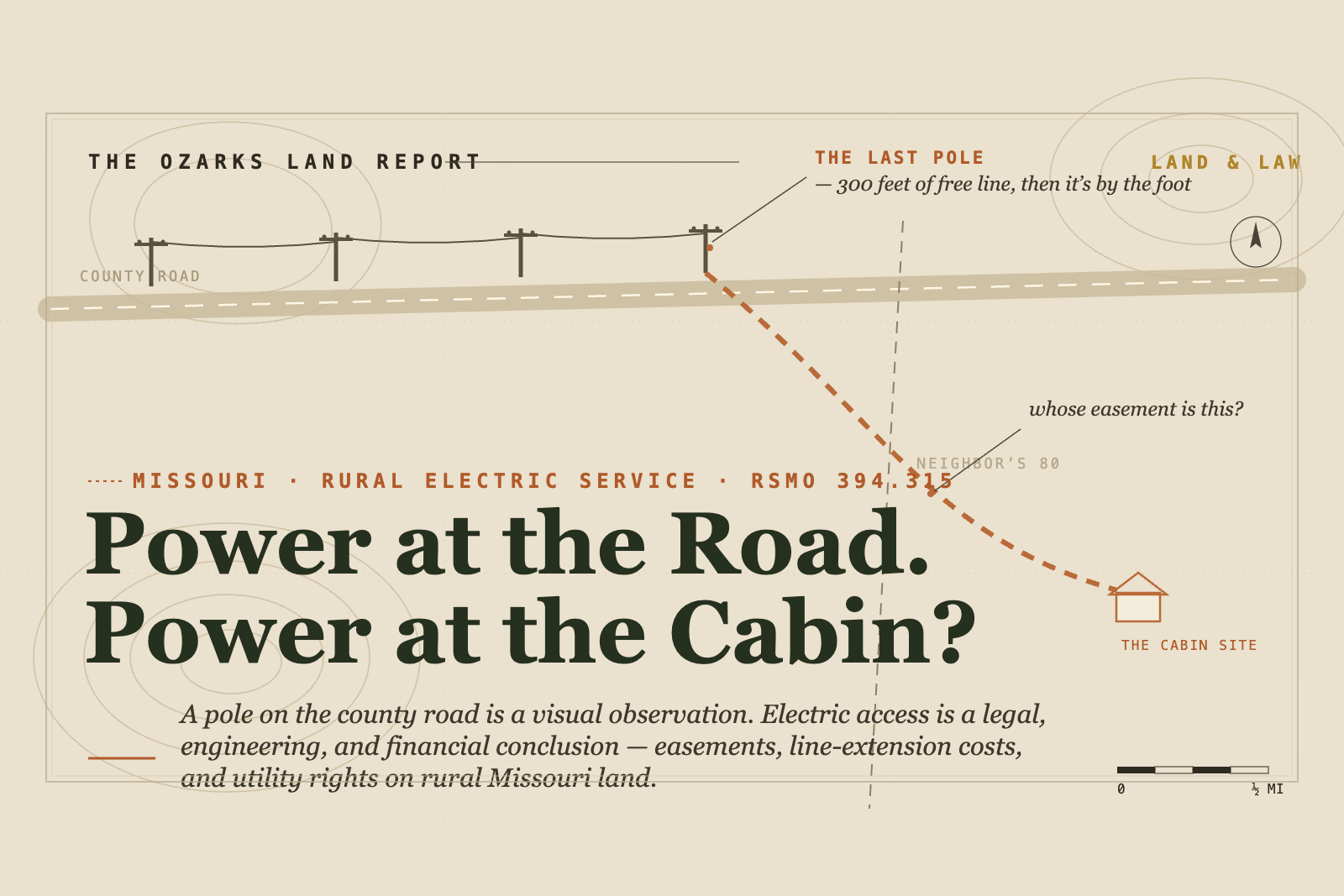
A buyer walks a rural property, sees a power line along the county road, and assumes electricity will be simple.
Sometimes it is.
Other times, the nearest usable power source is hundreds or thousands of feet away. The proposed route crosses a neighbor’s land. The existing road easement does not clearly include utilities. The cooperative requires a cleared right-of-way and an all-weather access road. The attractive cabin site is far more expensive to serve than the entrance. Or the line crossing the property gives the electric provider substantial access and vegetation-management rights that the buyer did not understand.
The presence of a pole or wire is only a visual observation. Electric access is a legal, engineering, and financial conclusion.
Before buying, selling, dividing, or improving rural Missouri land, an owner should answer at least six questions:
- Which electric provider has the right to serve the proposed structure?
- Where is the nearest usable service point?
- What route will the new line follow?
- Are utility easements already in place along the entire route?
- Who must clear, trench, construct, and maintain the route?
- What will the complete project cost — not merely the quoted price per foot?
Those questions are especially important for vacant land, hunting cabins, barns, RV sites, wells, remote homesites, and tracts being divided for future development.
Short answer: A nearby power line does not guarantee that a Missouri property can receive electric service. Before you buy — or price — rural ground, confirm six things:
- Utility provider — which electric co-op or utility actually serves that ground
- Existing easements — recorded rights for any lines already crossing the property
- Legal access — utilities generally build along legal access, not the shortest path
- Distance from the line — measured along the buildable route, not as the crow flies
- Line-extension cost — get the utility’s estimate in writing before closing
- Neighbor or road-crossing permission — a line that must cross someone else’s land needs an easement
A nearby power line does not guarantee service
A power line on or near a property does not necessarily establish that the proposed structure can connect to it. The electric provider must determine whether it serves that location, whether the existing infrastructure is suitable, where the meter and transformer should be placed, what route is feasible, and what additional construction will be required.
Missouri law also treats electric service largely on a structure-by-structure basis. Once a rural electric cooperative lawfully begins permanent service to a structure, it generally obtains the right to continue serving that structure. However, serving one structure on a tract does not automatically give the provider the right to serve every new structure later constructed on the same tract. See Section 394.315, RSMo.
That distinction can matter when:
- A farm already has electricity at the house, but the owner wants a second residence across the property.
- A large tract is being divided into several building sites.
- A barn, cabin, well, campground, or commercial operation will have its own meter.
- The closest visible line belongs to a provider other than the provider entitled to serve the proposed structure.
The correct first step is not estimating distance from a map. It is contacting the provider and having the proposed service evaluated.
Start with the utility’s engineering or staking department
Electric providers commonly use a staking engineer or similar employee to evaluate new construction. Intercounty Electric Cooperative — which serves portions of 10 Missouri counties, including Dent and Phelps counties — instructs applicants who need new electric-line construction to contact its engineering department well in advance, because unforeseen setbacks can delay the work.
A staking visit or engineering review may address:
- The proposed home, cabin, barn, or meter location.
- The nearest practical connection point.
- Overhead versus underground construction.
- Required poles, transformers, and other equipment.
- Terrain, timber, rock, roads, creeks, and drainage crossings.
- Right-of-way clearing.
- Trenching requirements.
- Easements across the applicant’s property.
- Easements needed from neighboring owners.
- Construction charges and deposits.
- Whether the proposed use qualifies as residential, seasonal, agricultural, commercial, or another service classification.
A seller or buyer should ask for the proposed route and estimated charges in writing whenever electric availability is material to the property’s value or intended use.
The electric route must be legally available
The shortest physical route is not always a legally available route.
Suppose the public road and power line are 500 feet from the property, but the tract reaches the road through a private lane across a neighbor’s land. The buyer may have the right to drive across that lane without having the right to install poles, underground cable, or other electric facilities within it. Some access easements expressly include utility installation. Others are limited to ingress and egress. (If this sounds familiar, it is the same lesson as legal access and shared-road maintenance: the paperwork controls, not the appearance.)
Before assuming electricity can follow an existing driveway, obtain and review:
- The deed creating the road or access easement.
- The recorded plat, if any.
- Separate utility easements.
- Easements held directly by the electric provider.
- The legal description and width of each easement.
- Restrictions on location, use, construction, and maintenance.
- Whether the rights benefit the property being served.
- Whether the rights extend to newly divided parcels or additional structures.
A statement that “the neighbor will not care” is not a substitute for a permanent, recordable easement acceptable to the provider.
A local example: Crawford Electric’s construction requirements
Crawford Electric Cooperative’s published line-extension policy (Administrative Policy 3.04A, February 2024) provides a useful example of what may be required before a rural electric line will be constructed. Crawford Electric currently states that it serves members in Crawford, Franklin, Washington, Gasconade, Jefferson, Dent, and Phelps counties.
An applicant requiring new construction must provide proof of ownership, a legal description, and a utility right-of-way easement. The applicant is responsible for obtaining any additional easements needed from other landowners, although the cooperative may assist. The applicant must also pay the cost of recording the easements.
Under the published policy, the applicant must also:
- Clear the initial right-of-way to the cooperative’s specifications.
- Complete required excavation or trenching.
- Provide and maintain an all-weather road to the service location.
- Make the road accessible year-round to cooperative vehicles and equipment.
- Restore disturbed property, including grading, backfilling, reseeding, and road repairs.
- Pay required fees, deposits, and overlength charges before construction begins.
Crawford Electric defines an all-weather road as one having an adequate base and surface to remain accessible by car under normal wet and dry conditions. A road requiring four-wheel drive does not qualify under the policy.
That requirement can be significant on remote recreational land. The buyer may be budgeting only for electric construction while overlooking the cost of building or improving a road capable of supporting utility trucks during wet conditions.
How wide is an electric easement or right-of-way?
There is no single width that answers every Missouri electric-line question. Several different concepts are often incorrectly treated as the same thing.
The recorded easement
This is the legal interest granted to the utility. Its location, width, purposes, and permitted activities depend on the language of the actual document.
The construction or clearing corridor
This is the area the provider requires to be cleared for installation and future operation.
The statutory vegetation-management area
Missouri law provides certain tree-trimming and vegetation-control rights, including default distances when no recorded easement exists.
Safety clearances
Buildings, pools, fences, grain bins, equipment, and other improvements may require additional clearances based on electrical-safety standards and the provider’s specifications.
Crawford Electric’s February 2024 published policy requires a 30-foot-wide, ground-to-sky right-of-way for an overhead line and a 10-foot-wide right-of-way for underground primary service. The requesting member clears the initial corridor, and the cooperative maintains it afterward. The complete service contract and recorded easement form ultimately control.
The 30-foot construction corridor should also not be confused with Missouri’s potentially broader statutory vegetation-management authority.
How far can an electric provider trim or remove trees?
Missouri law gives covered electric suppliers — including rural electric cooperatives, certain other cooperative electric suppliers, and specified municipally owned systems — authority to trim, remove, and control trees and other vegetation that threaten the safe and reliable operation of transmission or distribution lines.
Where a recorded easement exists, the provider may exercise the vegetation rights contained within the easement’s legal description and terms.
In the absence of a recorded easement, Missouri’s default vegetation-management area for lines energized at or below 34.5 kilovolts and located outside city limits extends 30 feet on each side of the line’s centerline. That is potentially a 60-foot-wide statutory area. Different distances apply inside cities and to higher-voltage lines. See Section 537.340, RSMo.
Missouri law also authorizes an electric supplier to trim, remove, or control vegetation outside those default distances when the work is necessary to maintain the continued safe and reliable operation of its electric lines.
This does not mean every rural distribution line automatically sits within a recorded 60-foot easement. The statute concerns authority to manage hazardous vegetation. It should not be treated as a universal easement description granting every possible construction, access, expansion, or exclusion right.
The statute separately allows a provider to trim or remove a sufficiently tall tree outside the stated area when the tree, if it fell, would threaten the integrity and safety of the line. Before removing a tree under that danger-tree provision, the supplier must generally give the owner or occupier at least 14 days’ notice, except when immediate removal is considered necessary or the work follows a major weather event or other emergency.
Intercounty Electric states that it uses side trimming, mowing, tree removal, herbicides, and other vegetation-management practices along its system. It also states that danger or hazard trees outside its rights-of-way may be cut, topped, or otherwise addressed when they threaten the electric system — and that cleanup and site restoration are the owner’s responsibility.
A landowner purchasing property with existing lines should investigate both the recorded easement and the provider’s operational policies before planting trees, constructing improvements, installing fences, or relying on the continued appearance of the existing corridor.
Who pays to extend electricity?
There is no universal Missouri price per foot. Cost depends on the provider, type of service, distance, load, terrain, route, clearing, trenching, equipment, and classification of the structure. Crawford Electric’s February 2024 published policy provides a helpful local illustration.
Qualifying permanent residence — overhead primary service
- Up to 300 feet: no line-construction charge.
- Beyond 300 feet: $5 per linear foot.
The policy defines a qualifying permanent residential structure to include at least 1,000 square feet of conditioned living space, a permanent foundation, an approved water system, an approved sanitary sewer system, and occupancy for at least nine months of the year. Smaller residences are evaluated individually and may incur additional charges.
Qualifying permanent residence — underground primary service
- Up to 350 feet: no line-construction charge.
- Beyond 350 feet: $5 per linear foot.
- The applicant must provide a trench meeting the cooperative’s specifications.
Cabins, barns, RV sites, wells, and other nonresidential service
Crawford Electric’s policy treats cabins, barns, sheds, garages, RV sites, campgrounds, wells, irrigation facilities, businesses, seasonal residences, and similar uses differently. For overhead primary service, the published schedule lists $1,500 for up to 300 feet and $10 per linear foot for anything beyond one span. Because the policy uses both a 300-foot measurement and a one-span measurement, an applicant should have Crawford Electric clarify in writing how the charge will be calculated for the proposed route. Underground primary service for these uses is listed at $10 per linear foot, with the applicant supplying a compliant trench.
Separate service-connect fees, deposits, meter-equipment charges, clearing expenses, trenching, roads, restoration, and other project costs may also apply.
These figures are examples from one provider’s February 2024 published policy. They are not permanent statewide prices. Crawford Electric’s policy states that service-connect fees are based on an annual cost analysis and that new cost schedules may be approved as needed. A buyer or seller should obtain a current written estimate directly from the serving provider.
“Free footage” does not mean the project is free
A utility policy may provide a certain amount of line construction without a footage charge for a qualifying residence. That does not necessarily eliminate:
- Membership fees.
- Deposits.
- Service-connect fees.
- Meter-loop expenses.
- Tree and brush removal.
- Stump removal.
- Rock excavation.
- Trenching.
- Road construction.
- Easement acquisition.
- Surveying or legal descriptions.
- Easement-recording charges.
- Property restoration.
- Electrician expenses beyond the utility’s service point.
- Changes required by the intended load or equipment.
The location of the service point also matters. A utility may extend its facilities to a meter pedestal or pole, while the owner remains responsible for the electrical system from that point to the house or other improvement.
The correct question is therefore not: “How much does the cooperative charge per foot?” It is: “What is the complete cost to deliver usable power to the place where I intend to build?”
Need an answer for a specific property? Request a free, no-obligation land valuation.
Overhead or underground?
Underground service is often attractive because it avoids visible poles and reduces some exposure to falling limbs. It may also require substantial trenching through rock, steep terrain, roads, creeks, or heavily wooded ground. Overhead construction may be less disruptive below ground but requires a cleared corridor and continuing vegetation management.
The decision should consider:
- Initial construction cost.
- Required trenching.
- Rock and excavation risk.
- Tree clearing.
- Appearance.
- Future access for repair.
- Road and creek crossings.
- Location of transformers and pedestals.
- Distance from the meter to the structure.
- Long-term plans for development or subdivision.
The provider, rather than the landowner alone, will ordinarily determine whether a proposed route and construction method satisfy its engineering requirements.
Can the cooperative force an easement across a neighbor?
Missouri rural electric cooperatives possess statutory authority to acquire rights-of-way and easements, construct lines along public thoroughfares subject to governmental requirements, and exercise eminent domain for electric transmission and distribution systems. See Section 394.080, RSMo.
That does not mean a buyer should assume the cooperative will condemn a neighbor’s land to complete a private line extension. Crawford Electric’s published policy places responsibility on the requesting member to obtain necessary easements from other landowners, even though the cooperative may assist.
Land advertised as having “electric nearby” may therefore face a major obstacle when the most practical route crosses land whose owner will not grant the required easement. This issue should be resolved before a buyer waives due diligence or spends substantial money designing a home or cabin around a particular location.
What rights does a utility easement give the provider?
The answer comes first from the easement itself. A typical electric easement may include rights to:
- Enter the property.
- Survey and locate facilities.
- Install poles, wires, anchors, transformers, pedestals, or underground cable.
- Inspect, operate, repair, replace, reconstruct, or remove facilities.
- Access the line with trucks and equipment.
- Trim or remove vegetation.
- Keep the corridor free from structures or obstructions.
- Serve the burdened property and, depending on the document, other properties.
- Install related communications or fiber facilities when legally authorized.
Crawford Electric’s policy describes its line-extension easement as a perpetual right to enter the property to place, replace, construct, reconstruct, operate, repair, and maintain power lines. Its actual easement form contains the controlling language.
For certain easements acquired after August 28, 2006, through condemnation or negotiations in place of condemnation, Missouri law limits the acquired rights to the particular use described in the conveyance or condemnation petition. An expanded use may require new negotiations, additional compensation, or another condemnation proceeding. A prevailing landowner in an expanded-use or trespass action may be awarded reasonable attorney fees, costs, and expenses. See Section 523.283, RSMo.
Missouri law also encourages rural electric cooperatives to use cooperative infrastructure to provide broadband service, but expressly states that the statute does not diminish property-owner rights. See Section 394.085, RSMo.
The practical lesson is straightforward: do not evaluate an electric easement merely by measuring its width. Read the rights granted within it.
Who pays to move an existing power line?
A landowner may want an existing pole or line relocated because it interferes with a building site, road, lake, commercial project, or subdivision plan. That can be expensive.
Crawford Electric’s published policy states that the individual or entity requesting a line conversion, removal, or relocation generally pays the total cost. The cooperative may reduce or waive the charge when it determines that the change also benefits the cooperative’s system.
A buyer should not assume that a poorly located line can be moved cheaply — or at the utility’s expense. The issue should be investigated before assigning value to a proposed building site or development layout.
Existing poles do not always mean existing service is usable
Rural properties sometimes contain old poles, abandoned meter loops, or lines that once served a house, mobile home, barn, or well. Those facilities may be idle, disconnected, obsolete, unsafe, or scheduled for removal.
Crawford Electric defines idle service to include infrastructure that has been disconnected, has not been maintained within its regular grid-maintenance cycle, or is no longer capable of delivering electricity. Its policy provides that service idle for two years or more may be retired, and that reactivation may require payment of construction costs, new right-of-way clearing, and an agreement to pay for reactivated service for at least 12 months.
An old meter base should therefore be investigated, not advertised as conclusive proof that active electric service is available.
Seller checklist before marketing rural land
A seller of vacant or partially improved rural property should consider completing the following before listing:
- Identify the provider likely to serve the proposed improvement.
- Locate the nearest poles, transformers, and existing meters.
- Contact the provider regarding the proposed use.
- Schedule a staking or engineering review when appropriate.
- Obtain a current line-extension estimate.
- Determine whether the estimate assumes a permanent residence, cabin, barn, RV site, well, or commercial use.
- Identify the proposed route.
- Pull and review recorded electric and utility easements.
- Confirm whether any route crosses neighboring property.
- Determine who must obtain and pay for new easements.
- Identify clearing, trenching, road, and restoration obligations.
- Investigate whether existing service is active or idle.
- Avoid advertising “electric on site” unless the statement accurately describes the service actually available.
Resolving these questions before marketing can prevent a buyer from discovering a major cost or access problem after the property is already under contract.
Buyer checklist before the due-diligence period expires
A buyer intending to build or improve rural land should confirm:
- The serving provider.
- The proposed structure and exact meter location.
- Whether the intended use qualifies for the quoted rate.
- The construction route.
- The total distance from usable infrastructure.
- Whether overhead or underground service is required or permitted.
- Easements across every affected tract.
- Initial clearing requirements.
- Trenching specifications.
- Access-road requirements.
- Estimated service-connect and construction charges.
- Responsibility for the owner-side electrical work.
- The effect of existing easements and power lines on future building sites.
- Whether any existing service is active and adequate.
- Whether the purchase contract allows termination if electric service, route, easements, or cost are unsatisfactory.
For undeveloped land, the electric investigation should occur before the buyer becomes committed to a building location or waives contractual protections.
The bottom line
Electricity is often described in rural listings with a few casual words: “Power nearby.” “Electric at the road.” “Utility poles on the property.” “Electric available.” Each statement may be accurate and still fail to answer the questions that matter.
A nearby line does not prove that a provider can serve the proposed structure from that line. A road does not necessarily include utility rights. A quoted per-foot price does not include every project expense. A utility corridor may carry broader access and vegetation-management rights than its appearance suggests. An old pole or meter does not prove that usable service remains active.
Before buying, selling, or improving rural Missouri land, treat electric service as three separate investigations: Can the provider legally reach the site? Can the provider technically serve the proposed use? Can the owner afford the complete project?
Until all three questions are answered, the property does not merely have an electric question. It has an unresolved land issue.
Buying or selling rural land where the power question is still open? Request a free, no-obligation valuation, or get in touch — we run the access, easement, and utility questions down before they become closing problems.
This article is general information about Missouri law and utility policies, not legal advice, and reading it doesn’t create an attorney-client relationship. Cooperative policies, construction requirements, and fee schedules can change; figures cited are from published policies current as of this writing. For a specific property, talk to the serving provider and a lawyer about the documents that actually apply.