Franklin · Gasconade · Crawford · Phelps · Dent Counties, Missouri
What changed federally on October 9, what did not, and what it means for deer season
Prefer a document? Download the print edition (PDF).
As of October 9, 2026, the ATF has stopped enforcing the federal approval and registration requirements for buying, selling or making a suppressor. From 1934 until this year, owning one meant a $200 tax stamp, a federal application and a wait that often ran months. The tax went to zero on January 1. A federal court ruled the registration scheme unconstitutional in August. On October 9 the ATF stopped enforcing it nationwide.
That is real news for hunters and landowners. Missouri law adds a wrinkle, though, and it is worth understanding before you buy a suppressor for deer season. Here is what changed, what did not, and how it plays out on Missouri ground.
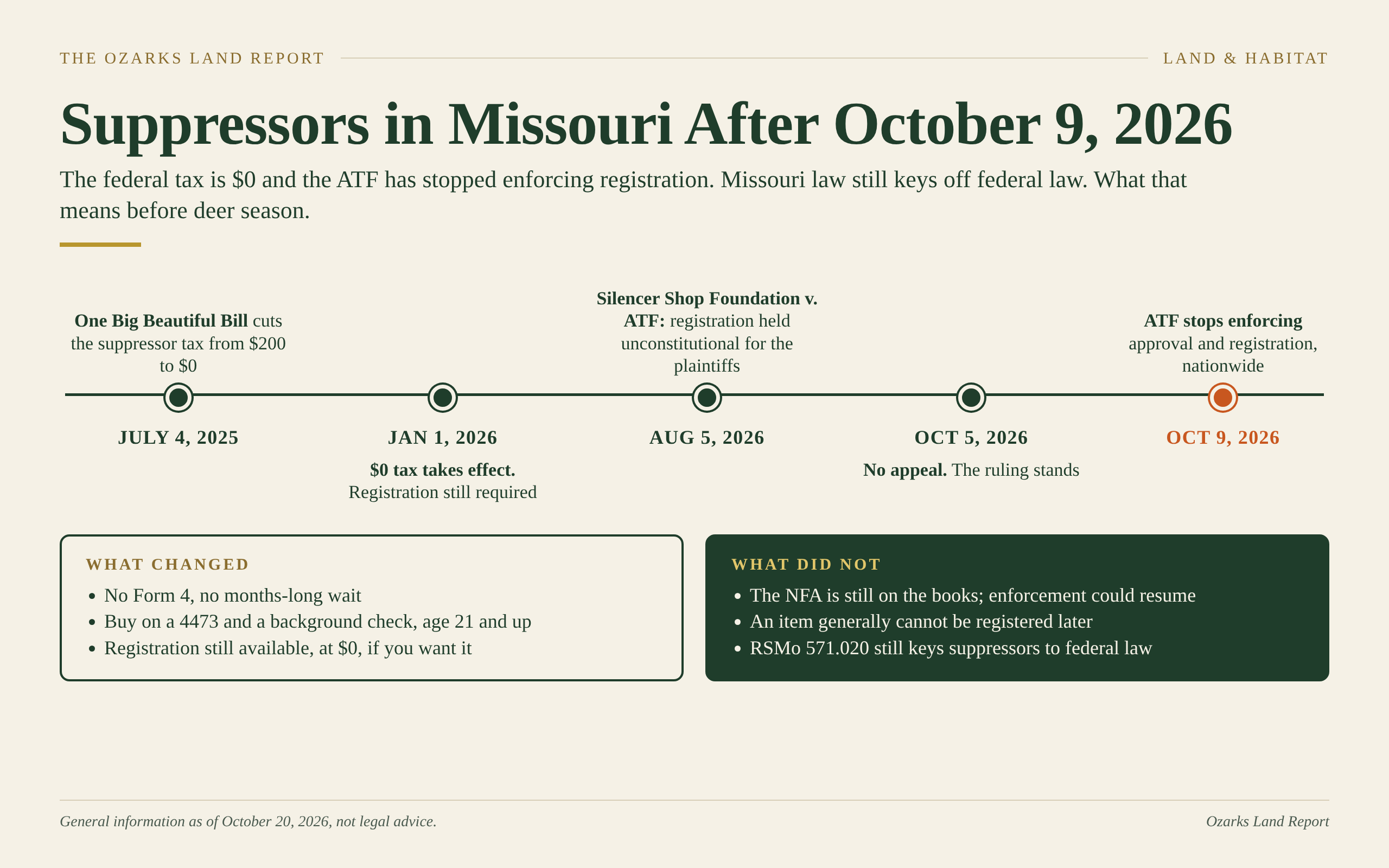
How we got here
| Date | What happened |
|---|---|
| July 4, 2025 | The One Big Beautiful Bill Act was signed. It cut the federal making and transfer tax on suppressors, short-barreled rifles and shotguns, and “any other weapons” from $200 (or $5 for a transfer of an “any other weapon”) to $0, effective January 1, 2026. Machine guns and destructive devices kept the $200 tax. |
| January 1, 2026 | The $0 tax took effect. The registration and approval process still applied. |
| August 5, 2026 | In Silencer Shop Foundation v. ATF, Judge James Wesley Hendrix of the Northern District of Texas held that, with the tax gone, the National Firearms Act’s registration and approval provisions for these items exceed Congress’s powers. He enjoined enforcement against the plaintiffs, their members and their customers, and declined to issue a nationwide injunction. The injunction took effect August 13. |
| October 5, 2026 | The deadline to appeal passed. The Justice Department did not appeal. |
| October 9, 2026 | ATF published an open letter and FAQ saying it will no longer enforce the approval, registration and marking provisions, and the NFA’s ban on carrying unregistered items across state lines, for suppressors, short-barreled rifles and shotguns, and “any other weapons,” for everyone, not just the parties. |
What changed
No Form 4, no months-long wait. You can buy a suppressor from a licensed dealer the way you buy a rifle: an ATF Form 4473 and a background check at the counter (one difference: you must be 21 to buy a suppressor from a dealer).
No Form 1 to build one. ATF will not enforce the prior-approval requirement for making a suppressor.
Registration is voluntary. ATF still accepts Form 4 and Form 1 filings, now at $0, and still maintains the registry for anyone who wants an item on it.
What did not change
The National Firearms Act is still on the books. ATF chose not to enforce these provisions. Congress did not repeal them. The ATF FAQ says plainly that a material change in legal or factual circumstances could cause enforcement to resume.
You cannot register later. ATF’s FAQ states that federal law does not generally permit registering an unregistered item after the fact. If enforcement resumes, an unregistered suppressor could become contraband unless the Attorney General declares an amnesty, which is discretionary.
Background checks and prohibited persons. The Gun Control Act still applies in full. Dealers still run the Form 4473 and NICS check, and anyone barred from owning a firearm is barred from owning a suppressor.
Machine guns and destructive devices are untouched.
State law still controls. ATF’s FAQ says its enforcement decision does not affect state laws, and that point matters most here in Missouri.
The Missouri wrinkle
Missouri does not ban suppressors. It criminalizes them only in one circumstance. Under Section 571.020.1(6)(c), RSMo, a person commits a class D felony by knowingly possessing, manufacturing, transporting, repairing or selling a firearm silencer “in violation of federal law.”
That raises an open question: whether an unregistered suppressor is possessed “in violation of federal law” when the registration statute is still on the books but the ATF has decided not to enforce it. I have not found a Missouri ruling on it. A bill that would have taken suppressors out of the Missouri statute, HB 1730, passed the House in April but did not clear the Senate, and Missouri’s own lawsuit against the ATF is pending in federal court in St. Louis alongside Brown v. ATF.
The practical point for a buyer is simple. ATF still accepts the Form 4 at no federal tax, so a Missouri buyer can still have the dealer file it and wait for approval before taking the suppressor home, or can buy on the 4473 and take it home, with the Missouri question above still open. ATF says an item generally cannot be registered after the fact, so that is a decision to make at the counter, and one worth a conversation with your dealer or a lawyer.
Hunting with a suppressor in Missouri
The Missouri Wildlife Code does not prohibit suppressors. The hunting-methods rule, 3 CSR 10-7.410, lists which firearms may be used and bans fully automatic firearms, but it says nothing about suppressors. A lawfully possessed suppressor on a legal deer rifle, shotgun or handgun is a legal method. A few practical points:
The usual method rules still apply. During the November and antlerless portions of firearms deer season, other wildlife may be hunted only with a .22 rimfire or smaller or a shotgun with shot no larger than No. 4, unless an exception applies. A suppressor does not change that.
Check the area rules on public land. Some conservation areas restrict firearms or single-projectile firearms entirely. Read the area’s rules before you go.
Quieter is not silent. A suppressor takes the sharp edge off the report and cuts recoil and muzzle blast, which helps follow-up shots and helps protect your hearing in a box blind. A centerfire rifle is still loud. Wear protection at the range.
Ammunition matters. Subsonic loads are quieter but lose energy fast. Use a load that will kill a deer cleanly at the distances you actually shoot.
Crossing state lines. If you hunt in Kansas, Arkansas or anywhere else, check that state’s law before you take a suppressor there. Some states tie legality to federal registration the way Missouri does.
What it means for landowners
For anyone who hunts, manages deer, or controls hogs and coyotes on their own place, the change makes suppressors far easier to own. If you are buying a farm with hunting in mind, it is one more tool that is now within easy reach. Just buy it the right way for Missouri.
If you have questions about hunting ground in Franklin, Gasconade, Crawford, Phelps or Dent County, or about how a property is set up for hunting, request a free land valuation or call 573.308.7376.
Sources
- ATF, Update to NFA Transfer Guidance and FAQ (October 9, 2026; last updated October 16, 2026)
- ATF, Open Letter to All Federal Firearms Licensees and the Public (October 9, 2026)
- Silencer Shop Foundation v. ATF, No. 6:25-CV-056-H (N.D. Tex. Aug. 5, 2026), Memorandum Opinion and Order, Dkt. 136
- Section 571.020, RSMo
- 26 U.S.C. § 5811 (current text and pre-2025 text)
- 3 CSR 10-7.410, Hunting Methods (Missouri Code of State Regulations)
- HB 1730 (2026), bill summary and action history, Missouri House and Senate
- Brown v. ATF, No. 4:25-cv-1162 (E.D. Mo.), docket checked October 20, 2026 (last entry October 7, 2026)
- Missouri ex rel. Hanaway v. ATF (E.D. Mo., filed September 8, 2026), consolidated with Brown and pending on the same docket
Notice. This article is general information about the law as of October 20, 2026, not legal advice for your situation. The federal picture in particular may change quickly. Reading it does not create an attorney-client relationship.
Justin Head is a Missouri licensed attorney, a Missouri licensed real estate salesperson, and a Land Specialist with Whitetail Properties serving Franklin, Gasconade, Crawford, Phelps and Dent Counties.