By Justin Head — Whitetail Properties Land Specialist & Attorney
A call I get a few times a year goes like this. “My grandfather passed away. The farm is still in his name. We want to sell it. Can you list it?”
The answer is usually yes, but not yet, and not until one specific question is answered: who has the legal authority to sign a deed for a dead man? Grandpa cannot sign. His children cannot sign just because they are his children. A listing agreement signed by the wrong person is unenforceable, and a deed signed by the wrong person will not be insured, so no title company will close it and no buyer with a lender can.
This article walks through how Missouri answers that question, in the order a title company will ask it. I am a Missouri attorney and a Whitetail Properties Land Specialist, and I have sat on both sides of this table. This is general information, not legal advice for your situation.
Start here: how was the farm titled on the day he died?
Everything turns on the deed that is on record at the county recorder’s office. Before you call anyone, pull the last recorded deed for the farm. The title company will do the same thing, and the answer sorts you into one of four paths.
Path 1: Grandpa owned it with someone who survived him. If the deed shows Grandpa and Grandma as husband and wife (tenancy by the entirety), or two people as joint tenants with right of survivorship, the farm already belongs to the survivor. The survivor can record a short affidavit of death, or simply recite Grandpa’s death in the new deed, and sign. No probate. If the survivor has since died as well, start this analysis over in the survivor’s name.
Path 2: Grandpa recorded a beneficiary deed before he died. Missouri allows a landowner to record a deed that names who gets the property at death (RSMo 461.025). It has to have been signed and recorded before death; one found in a desk drawer does nothing. If a beneficiary deed is on record, the named beneficiary takes the farm at death, records an affidavit of death, and can sign. No probate.
Path 3: Grandpa put the farm in a trust. If the recorded deed runs to “John Smith, Trustee of the Smith Family Trust,” the successor trustee named in the trust instrument signs. The same is true if Grandpa kept the farm in his own name but recorded a beneficiary deed naming the trustee of his trust as the beneficiary; at death the farm passes to the trust, the trustee records an affidavit of death, and the trustee signs. Either way, the title company will want a certification of trust under RSMo 456.10-1013, which states that the trust exists, who the current trustee is, and what powers the trustee has, so you do not have to hand over the whole trust document. No probate.
A warning on Path 3 that catches families every year: a trust only controls property that was actually deeded into it. If Grandpa signed a trust in 2015 but never recorded a deed moving the farm into the trust, the farm is not in the trust. It is in his name, and you are on Path 4.
Path 4: the deed is in Grandpa’s name alone, no survivor, no beneficiary deed, no trust. This is the “still in Grandpa’s name” problem, and it is the rest of this article.
Who owns the farm the day after he died?
Missouri’s answer is in RSMo 473.260. At death, a person’s real property “passes to the persons to whom it is devised by his last will, or, in the absence of such disposition, to the persons who succeed to his estate as his heirs.” So the heirs or the people named in the will own it immediately, in a sense. But the same sentence continues: that ownership “is subject to the possession of the executor or administrator” and to the claims and expenses of the estate.
That second half is why the heirs cannot simply sign a deed. Their title is real but clouded. A buyer’s title company needs a court record that establishes who the heirs are, that creditors have been dealt with, and that a person with authority is conveying. There are three ways to produce that record, and which one fits depends mostly on the calendar and the size of the estate.
Option A: open a probate estate and let the personal representative sell
This is the standard route when Grandpa died within the last year. Someone, usually the person named as executor in the will or a close heir if there is no will, applies to the probate division of the circuit court in Grandpa’s county for letters testamentary (with a will) or letters of administration (without one). The court issues the letters, and the person holding them is the personal representative, or PR.
The PR signs the listing agreement and the deed. Whether the PR needs a court order to sell depends on the type of administration:
Independent administration. If the will authorizes it, or every heir or devisee consents and the will does not forbid it, the letters will carry independent administration (RSMo 473.780). An independent PR may “sell, mortgage, or lease any real or personal property of the estate” without a separate court order (RSMo 473.810), unless the will restricts it. This is the fast lane.
Supervised administration. If the estate is supervised, the PR generally needs the court’s approval of the sale (RSMo 473.460 to 473.513), and the contract will carry a contingency for it. Slower, but routine.
Power of sale in the will. If the will expressly gives the executor the power to sell real estate, the executor “may proceed under such power” (RSMo 473.457). Good estate planning puts this clause in every will that passes land.
What the title company will ask for: letters certified within the last few months, a certified death certificate, the will if there is one, the court order if the sale is supervised, and, at closing, a personal representative’s deed. The PR signs as “Jane Smith, Personal Representative of the Estate of John Smith, deceased.”
Option B: the estate is small enough for an affidavit
If the whole estate, after liens and debts, is worth $40,000 or less, Missouri allows a small estate affidavit instead of full administration (RSMo 473.097). The statute does reach real property: the distributees “may establish their right to succeed to the real estate of the decedent by filing a copy of the foregoing affidavit and certificate of the clerk in the office of the recorder of deeds” where the land sits. Thirty days must pass after death, a bond is usually required, though the court can waive it, and creditor notice is published when the estate exceeds $15,000.
Two details matter here. First, the affidavit has to recite either that Grandpa left no will or that his will was presented for probate within the deadline in RSMo 473.050 (more on that deadline below), so this route does not rescue a will that was never filed. Inside the year, filing the will along with the affidavit counts as presenting it (RSMo 473.050.2). Second, the one-year clock that closes full administration does not close this door; the statute says the affidavit may be filed “notwithstanding” those limitation periods.
In my counties, a farm worth $40,000 or less is a rare thing. This option mostly applies to a few acres or a fractional interest. Before you rely on it, ask the title company whether it will insure a sale on that affidavit; some will, some want more.
A cousin of this option, refusal of letters under RSMo 473.090, is available to a surviving spouse or unmarried minor children when the estate does not exceed what the law sets aside as exempt property and allowances. It can carry real estate, the certified order is recorded in place of a deed, and it too is available at any time regardless of the one-year clock. It is narrow, and it is not available to grandchildren.
Option C: more than a year has passed, so you determine heirship
Here is the deadline most families do not know about. Under RSMo 473.050, no letters of administration can be issued unless the application is made “within one year from the date of death of the decedent,” and a will not presented for probate within that year “is forever barred from admission to probate in this state.”
Read that twice. If Grandpa died three years ago and nobody opened an estate, nobody can open one now, and the will he signed cannot be admitted. The farm passes to his heirs at law under Missouri’s intestacy rules as if the will did not exist. If the will left the farm to one grandchild and the intestacy rules split it among five, that is a $400,000 lesson in why the one-year clock matters.
The clock can be shorter. If anyone opened an estate and the clerk published notice of letters, the will has to be presented within six months of the first publication, not one year (RSMo 473.050.3). A will found in month eight is a legal nullity, and the statute makes no exception for a will the family did not know existed. If a cousin opened an estate for the bank accounts and nobody filed the will, call a lawyer the same day.
What the one-year clock does not close is Option B. The small estate affidavit and refusal of letters both survive the one-year mark; it is full administration and the will that die with it.
The tool for everything else is a petition to determine heirship under RSMo 473.663. If “no administration has been commenced on the estate of such decedent in this state within one year after the date of decedent’s death,” and no will was presented in time, an heir, or someone claiming through an heir, petitions the probate court, notice goes out to everyone who might claim, and the court enters a decree naming the heirs and their shares. The decree “is conclusive evidence of the facts determined in such decree as against all parties to the proceedings,” and the petitioner records a certified copy in every county where the land sits. By then the one-year bar on claims against the estate has already run (RSMo 473.444); only liens of record, like a deed of trust, are left to pay at closing.
Once the decree is recorded, the heirs named in it hold title of record and can sign the deed, every one of them. Which brings up the last problem.
Every heir has to sign
When title passes to heirs rather than through a PR, the farm belongs to all of them as tenants in common, and every one of them signs the listing agreement and the deed, along with each heir’s spouse where Missouri marital rights require it. Four siblings and nine grandchildren scattered across six states is a signature problem, and it only takes one holdout, one minor, or one heir who cannot be found to stop a closing.
If the family cannot agree, Missouri’s partition statute (RSMo chapter 528) lets one co-owner force a sale through the court. I wrote about that in Can One Heir Force the Sale of a Family Farm in Missouri? It works, and it is expensive, slow, and hard on families. A probate estate with a single PR holding the pen is almost always cleaner, which is one more reason to open one inside the first year.
Can you list it before the paperwork is done?
Yes, with care. A listing agreement is a contract, and it needs a party with authority on the seller’s side. Once letters are issued, the PR can sign the listing and we can market the farm while the estate proceeds; the sale contract simply carries the contingencies the estate requires (court approval, if supervised). If you are on the heirship route, we can prepare the listing and the photography while the petition is pending, but the contract waits for the decree.
What I will not do is list a farm on a signature from someone who does not yet have authority. It does not help you. The first thing a buyer’s title company does is pull the deed, and the first thing it asks is the question at the top of this article.
Which document lets someone sign the deed
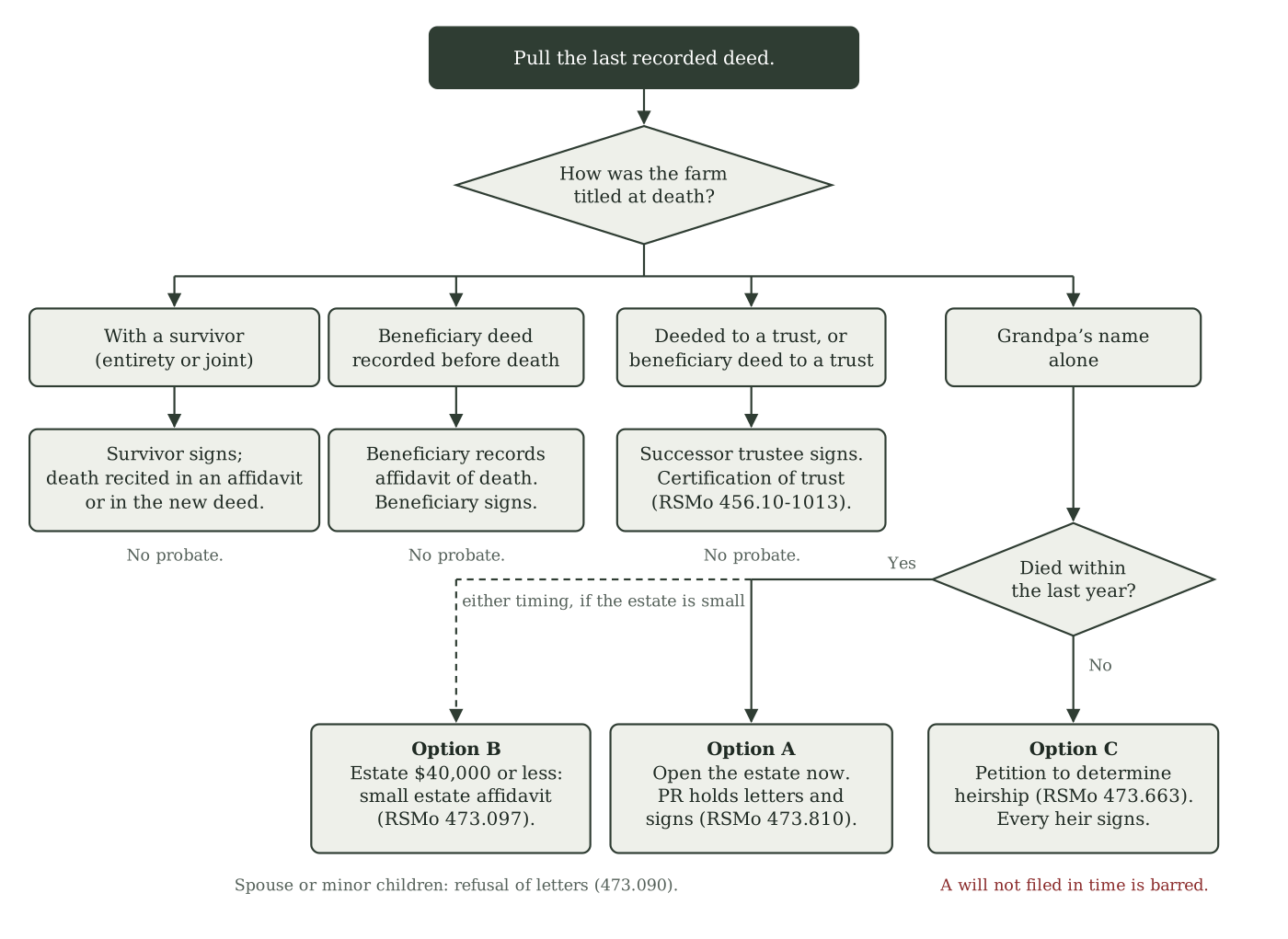
The six-month will deadline applies whenever an estate was opened and notice of letters was published (RSMo 473.050.3).
The practical checklist
- Pull the last recorded deed. Who is on it, and how do they hold title?
- Check the recorder’s index for a beneficiary deed or a deed to a trust recorded before death.
- Note the date of death. Inside one year: open the estate now. Past one year: determination of heirship, unless the estate is small enough for Option B.
- Find out whether anyone has already opened an estate. If notice of letters was published, the will deadline is six months from that publication, not one year.
- Find the will, if any, and read it for a power of sale and for independent administration.
- Get ten certified death certificates. Every institution wants an original.
- Order a title commitment early. The title company’s requirements page is the real to-do list.
- Talk to a CPA before closing. Inherited land takes a stepped-up basis to date-of-death value, which can wipe out most of the capital gain on a sale soon after death. I covered that in Selling Inherited Land in Missouri: The Title and Tax Rules That Actually Apply.
What it means for you
A farm in a dead man’s name is not stuck. It is waiting on one document: letters, a recorded affidavit, a certification of trust, or an heirship decree. Which one depends on how the deed reads and how long it has been. Figure that out first, and the sale is ordinary. Skip it, and the sale is a lawsuit.
If you are facing this, I am glad to look at the deed and the dates with you and tell you which path you are on. There is no charge for that conversation. Start here: What’s My Farm Worth?, or read how we sell land in the Missouri Ozarks for the rest of the process.
Frequently asked questions
Can the children sign a deed for a farm still in their deceased father’s name?
Not just because they are his children. Someone has to hold legal authority of record: a personal representative with letters, a beneficiary or trustee under a recorded instrument, or heirs named in a recorded heirship decree or small estate affidavit. Until then a title company will not insure the deed.
How long do you have to open a probate estate in Missouri?
One year from the date of death (RSMo 473.050). After that, no letters of administration can be issued and a will that was never presented is barred. If an estate was opened and notice of letters published, a will must be presented within six months of first publication.
What happens to the farm if nobody opened an estate within a year?
Full administration is closed. The farm passes to the heirs at law under Missouri intestacy rules, and the usual path to marketable title is a petition to determine heirship under RSMo 473.663, after which every heir signs the deed. A small estate affidavit under RSMo 473.097 remains available if the whole estate is $40,000 or less.
Can you list a farm while the probate estate is still open?
Yes. Once letters are issued, the personal representative can sign the listing agreement and the farm can be marketed. The sale contract carries whatever contingency the estate requires, such as court approval in a supervised administration.
Related from the Ozarks Land Report
- Selling Inherited Land in Missouri: The Title and Tax Rules That Actually Apply Here
- Can One Heir Force the Sale of a Family Farm in Missouri?
- Is the Double-Wide Real Estate? Manufactured Homes, Titles, and Affixation in Missouri
Know the Terms
- Letters: The probate court’s written grant of authority to a personal representative (letters testamentary with a will, letters of administration without one).
- Personal representative (PR): The person holding letters, who administers the estate and signs for it.
- Beneficiary deed: A deed, recorded before death, that names who takes the land at the owner’s death without probate (RSMo 461.025).
- Certification of trust: A short sworn statement of a trust’s existence, current trustee, and powers that a title company accepts in place of the trust instrument (RSMo 456.10-1013).
- Determination of heirship: A probate decree, available after one year with no administration, that names the heirs and their shares and is recorded in the land records (RSMo 473.663).
Authority
Devolution of real property at death: RSMo 473.260.
Time limits on wills and letters: RSMo 473.050.
Personal representative’s sale powers: RSMo 473.457, 473.460 to 473.513, 473.780, 473.810.
Small estates and refusal of letters: RSMo 473.090, 473.097.
Determination of heirship: RSMo 473.663; claims bar, RSMo 473.444.
Nonprobate transfers: RSMo 461.025 (beneficiary deeds); RSMo 456.10-1013 (certification of trust).
Justin Head is a Missouri-licensed attorney and a Land Specialist with Whitetail Properties Real Estate, LLC, serving Franklin, Gasconade, Crawford, Phelps, and Dent counties. This article is general information about Missouri law and is not legal advice; the facts of your estate control, and you should consult an attorney about them.