Franklin · Gasconade · Crawford · Phelps · Dent Counties, Missouri
General educational information about Missouri law as of September 2026. Not legal advice about any specific road, tract, or dispute, and it does not create an attorney-client relationship. Road status turns on the county records and the history of use of a specific road. Talk with a Missouri attorney before acting.
Prefer a document? Download the print edition (PDF).
Short Answer
A Missouri public county road ends by formal vacation or by abandonment through nonuse, subject to the exceptions below. It can be vacated on a petition under section 228.110, RSMo, or it is deemed abandoned by five continuous years of nonuse by the public under section 228.190.1. The second happens by operation of law. No proceeding is required and nothing is necessarily recorded to show it, which is exactly what makes it hard to rely on. Two exceptions matter. For an abandonment occurring after January 1, 1990, a road that has drawn county aid road trust fund allocations for at least five years is conclusively public under section 228.190.2 and the nonuse exit closes. An abandonment already complete before 1990 is not undone by later funding. And a road dedicated on paper but never built cannot be abandoned by nonuse at all. Overgrowth is not abandonment, and neither is the county’s failure to maintain the road.
Missouri road abandonment law is one of the questions I get most often as a land specialist and one of the few I have argued at the appellate level. What follows is the law as the Missouri courts have stated it, with every case and statute linked so you can read it yourself.
It usually starts the same way. A buyer walks a new farm and finds a roadbed. Two shallow ruts running off toward the back line, grown up in cedar and blackberry, maybe a cut bank where somebody once moved dirt. It does not appear on the deed. The title commitment carries the standard exception for public roads and nothing more specific. The seller says it has not been used since the family bought the place.
Then the neighbor shows up and says it is a county road.
Sometimes the neighbor is wrong. Sometimes the neighbor is right, the road is still a public road, and the gate that just went up across it is a problem.
One disclosure before we go further. I argued Burris v. Mercer County at the Missouri Court of Appeals, Western District, for the landowners who lost. Three judges thought we had it right. Eight did not. The opinion that came out of that loss is now one of the cases Missouri courts cite when they explain how a public road gets abandoned. This article states the law as it stands, not as I argued it.
How does a road become public in the first place?
Before anything can be abandoned, it has to be public. Missouri courts describe three routes: under section 228.190, by prescription, or by implied or common law dedication. Karashin v. Haggard Hauling & Rigging, Inc., 653 S.W.2d 203, 205 (Mo. banc 1983); Przybylski v. Barbosa, 289 S.W.3d 641, 644 (Mo. App. W.D. 2009). A recorded subdivision plat adds a fourth, statutory dedication, which is discussed with the platted-street rule below.
By statute. Section 228.190.1 deems a road legally established if a county commission ordered it and the public then used it as a public highway for ten years or more. The same subsection separately deems a road legally established when the public has used it continuously for ten years and public money or labor has been expended on it for that same period. Note what that second path requires. Use alone is not enough. There has to be public money or labor in the ground. And a commission order alone is not enough either. In Przybylski, a county court had entered a 1978 order establishing a dedicated strip as a road, but the strip was never built or used. The court held that an order not accompanied by ten years of public use does not establish a public road under the statute. 289 S.W.3d at 645.
By prescription. Long use by the public can ripen into a public road. The use must be continuous, uninterrupted, visible and adverse for ten years. Whittom v. Alexander-Richardson Partnership, 851 S.W.2d 504, 508 (Mo. banc 1993). Because the law does not favor prescriptive easements, the claimant must prove the elements by clear and convincing evidence. Shapiro Bros., Inc. v. Jones-Festus Properties, L.L.C., 205 S.W.3d 270, 274 (Mo. App. E.D. 2006). Whether the use was adverse or permissive is usually the fight, and the burden on that element is not where most landowners assume it is. Once the claimant shows open, continuous, visible and uninterrupted use for ten years, the law presumes the use was adverse and the burden shifts to the landowner to prove it was permissive. Two 2024 Southern District decisions from the Ozarks applied exactly that rule against owners who gated long-used roads. In Porton v. Box, a Taney County owner bought a tract in 2020 and blocked a road the public had used for nearly thirty years to reach a subdivision; the absentee seller had never given anyone permission and never knew the road was being used, and that was the point. Thirty years of open use raised the presumption of adversity, and the owners could not rebut it with evidence of permission. Porton v. Box, No. SD37755 (Mo. App. S.D. June 26, 2024). In Romano v. Adams, a Christian County owner gated the unpaved end of Canyon Road at Lindenlure on the Finley River, where the public had been reaching the river since at least the 1940s. The court affirmed both a public prescriptive easement and a common law dedication. Romano v. Adams, No. SD37377 (Mo. App. S.D. June 4, 2024). Understand what this means in practice. Prescriptive rights may exist before any judgment and may not appear in the recorded documents or the title commitment. The owner does not get to settle that question alone. Neither does the neighbor. Mere use of a convenient cutoff, standing alone, does not show that the use was adverse or as of right. Shapiro, 205 S.W.3d at 275, quoting Mackey v. Weakley, 439 S.W.2d 219, 226 (Mo. App. E.D. 1969).
By dedication. An owner can dedicate land to public use. Common law dedication requires proof that the owner, by unequivocal action, intended to dedicate the land to public use, that the public accepted it, and that the public is using it. Whittom, 851 S.W.2d at 507-08. Intent is the foundation, but it can be shown by conduct rather than words, and because the doctrine rests on estoppel, an owner whose actions evince an intention to dedicate can be barred from taking the land back once the public has acted on them. Id. at 508. In Romano the court found intent in the owners’ decades of inaction in the face of extensive public use. Statutory dedication is different. When a plat is made, acknowledged, certified and recorded under the plat act, the plat itself is a sufficient conveyance to vest the fee of the parcels named or intended for public use in the city, town or village, in trust for those uses and no other; where the town is unincorporated, the fee vests in the county in like trust. Section 445.070.2 and .3, RSMo. Which kind of dedication you are dealing with matters, for reasons that come up below.
How does a public road stop being public?
There is a familiar two-part answer, and it is the right starting point as long as you know where it runs out.
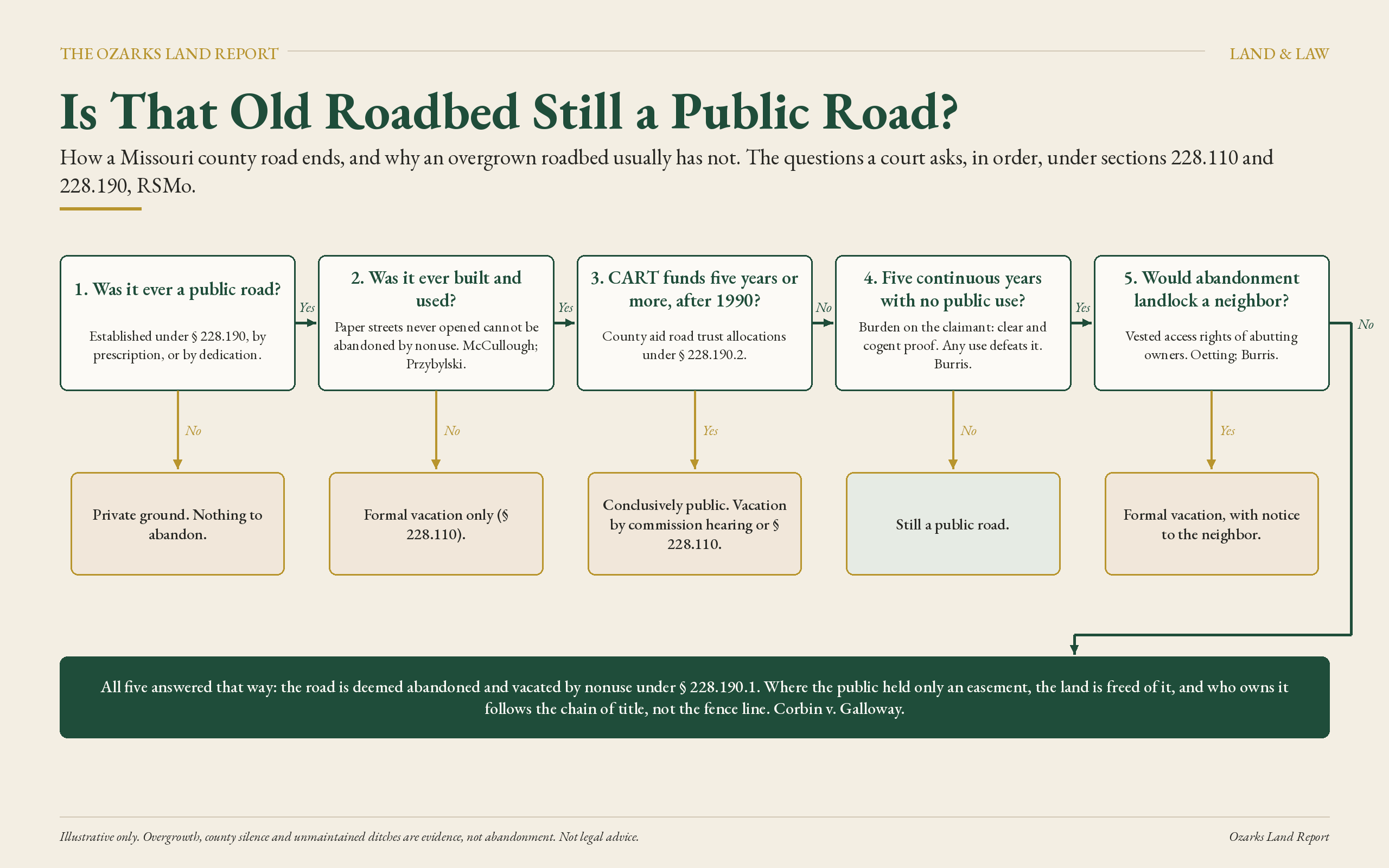
Formal vacation. Section 228.110 lets any twelve residents of the township or townships the road runs through apply to vacate it as useless and its repair an unreasonable burden on the district. (When Corbin v. Galloway was decided in 1964 the statute said twelve freeholders; it now says residents.) The petition is read publicly on the first day of the term and continued to the next term. Notice of the filing and of the road sought to be vacated must be posted in not less than three public places at least twenty days before the first day of the next term, and served personally on every person residing in the district whose land the road crosses or touches. If twelve residents file a written remonstrance, the commission weighs it before deciding. Charter counties have a separate procedure under subsection 4, added in 2007.
It is a real process with real notice requirements, and it works. A commission’s decision to grant or deny a vacation petition is subject to judicial review under section 228.120, and because the statute does not require the commission to hold a hearing, the circuit court reviews the decision as a non-contested case under section 536.150: it hears the evidence itself and decides whether the denial was unlawful, unreasonable, arbitrary or capricious. Ard v. Shannon County Commission, 424 S.W.3d 468, 472-73 (Mo. App. S.D. 2014); Cooper v. Henry County Commission, 529 S.W.3d 343, 346 (Mo. App. W.D. 2017). In Ard the road ran in the bed of Grassy Creek, washed out with every flood, and was used mostly for poaching and dumping; a county commissioner testified he would not close any road for any reason. The circuit court vacated the section and the court of appeals affirmed, holding that useless means practically useless, not absolutely useless, and that a categorical refusal to consider vacation is the definition of arbitrary. 424 S.W.3d at 479-81. Cooper reached the same result three years later where commissioners had been told at an association meeting not to vacate any more roads. 529 S.W.3d at 348, 350. If you own both sides of a road that serves no one, the petition is the tool, and a commission that will not listen can be made to. A person challenging a vacation order must also establish standing. When five Dunklin County residents sued in 2018 to undo a 2014 order vacating a county road, the court dismissed the case because residency alone gave them no standing to challenge it. Foster v. Dunklin County, No. SD37204 (Mo. App. S.D. Feb. 17, 2022).
Nonuse. Section 228.190.1 closes with the sentence that does more work than the rest of the statute combined: “nonuse by the public for five years continuously of any public road shall be deemed an abandonment and vacation of the same.” The period has not always been five years. The statute the courts applied in 1911 and 1915 required ten.
Burris put the two together in the sentence courts have quoted since: a public road can be abandoned in one of two ways, through either a formal vacation accomplished by filing a petition under section 228.110, or nonuse by the public for five years continuously under section 228.190. Burris v. Mercer County, 252 S.W.3d 199, 202 (Mo. App. W.D. 2008).
Two things sit outside that frame. Section 228.190.2 carves out an express exception for roads that have drawn county aid money, discussed below. And streets inside municipal limits run on a different set of statutes, where the machinery depends on the city’s classification. In Rice v. Huff the court applied section 88.673 to a fourth-class city and held that vacating a street there is a purely legislative function belonging to the board of aldermen, exercisable only by formal ordinance and not by resolution or motion. 22 S.W.3d 774 (Mo. App. W.D. 2000). If your roadbed is inside a city, you are in a different chapter of the statutes, and which provisions apply depends on the city’s classification.
What does five years of nonuse actually take?
Here is where Burris earns its keep, because the opinion is the best field guide in the Missouri reports to how this fight actually goes.
The facts are ordinary Missouri facts. Three men bought a Mercer County tract in March 2003 to farm and hunt. A road ran across the north end of their ground toward the Grand River, graveled to the point where it left a field, and past that it once crossed a bridge. The bridge went out in the 1950s and was never replaced. Everything past the field grew up in timber and brush.
Two neighbors to the west were landlocked. One had bought in 1994 and had been driving a four-wheeler across the overgrown roadbed to reach his ground and hunt on it, until 2004, when the new owners put a gate across the entrance. The other neighbor, who had bought in late 2003, asked the county commission to reopen the road. The commission told him he would need a petition in order for the county to expend funds to open it. He also testified that he was told that if he spent the money himself, no petition would be needed. Those are two different propositions and the record contains both. What is not in dispute is what he did next. He hired a man with a dozer, who cleared roughly three hundred yards, sixty to a hundred trees, a corridor forty to fifty feet wide, before a neighbor heard the machine and came over.
What followed was a declaratory judgment action, an intervention, a trespass cross-claim, a two-day trial in May 2006, and an appellate opinion in April 2008. From the filing of the petition in January 2005 to the denial of rehearing in May 2008, the file ran more than three years.
The court affirmed that the road had not been abandoned. Five things in the opinion are worth a landowner’s attention.
The burden sits on the person claiming abandonment, and it is a hard one. “One asserting abandonment of a public road must carry the burden of showing such abandonment by clear and cogent proof.” 252 S.W.3d at 201, quoting Faustlin v. Mathis, 99 S.W.3d 546, 550 (Mo. App. S.D. 2003). Missouri courts start from a presumption against losing a public road. The court of appeals adopted the rule in 1915, quoting an Indiana decision: vacations of highways are not favored, and the presumption will always be in favor of their continuance. Oetting v. Pollock, 189 Mo. App. 263, 175 S.W. 222, 224 (1915).
The county not maintaining it does not do the work. This is the most common mistake landowners make. They assume that if the county has not graded a road in thirty years, has no record of spending a dollar on it, and does not carry it on any maintenance list, the road must be gone. Burris says otherwise: whether the road was maintained is relevant but not determinative of whether the road was used by the public. Public money or labor matters to one of the statutory routes for establishing a road. Abandonment, the court said, is exclusively determined by use. 252 S.W.3d at 203. Maintenance is evidence. It is not the test. The test is use.
Trees and brush do not do the work either. In Burris a parade of witnesses testified to the size and number of the trees standing in the roadbed, and it did not carry the day. Trees in a roadway do not necessarily mean the road has been abandoned, particularly where there is evidence the public has used it. 252 S.W.3d at 204. Heavy growth may suggest that nobody has driven a truck through in a long while. It does not establish that nobody has walked, ridden, or taken a four-wheeler. The court also rejected tree-diameter evidence as proof of the age of the growth without testimony about the species and its growth rate. Id. at 206. If the timber is your proof, bring a forester.
Sporadic use is still use. The abandonment has to be complete and continuous across the full five years. Use that is infrequent, intermittent or rare still defeats it. The Burris majority put it as bluntly as it can be put: if even one member of the public does not concur in the abandonment and uses the road, it is not abandoned. 252 S.W.3d at 204.
Abandonment cannot be used to landlock a neighbor. This limitation gets overlooked and it decides cases. Missouri has said since 1911 that the only limitation on the abandonment of an established public road is that it must not be done to the injury of the vested rights of abutting owners or persons similarly situated. Oetting, 175 S.W. at 224, quoting Johnson v. Rasmus, 237 Mo. 586, 141 S.W. 590, 591 (1911).
Oetting is worth knowing on its own facts. A Wright County road had been bypassed in 1884 when the main route from Hartville to Mansfield was relocated. For fifteen or twenty years the public had not traveled it to any extent and no public money had been spent on it. In 1912 the adjoining owner built fences across it in two places. The trial court held the road abandoned by nonuser and denied relief. The court of appeals reversed and ordered the fences taken down on two independent grounds. First, because vacating the road would leave the plaintiff with no connection to any public road, it could not be vacated except by a proceeding brought for that purpose, in which he could appear and assert his rights, and until that happened the road had to be left open. Second, the evidence did not show the clear and entire abandonment by the public that the statute requires, because the plaintiff and the children attending the schoolhouse on the road still used it, climbing the fences to do so. 175 S.W. at 223-24.
That is why Burris produced the split it did. The majority relied on the protection of abutting owners’ vested access rights, reasoning that where the neighbors’ property would become landlocked and no formal vacation proceeding had been brought, abandonment by nonuse was not available unless those neighbors had acquiesced in losing their access. 252 S.W.3d at 201-02. The dissent answered that the majority overstates the holding of Oetting, which on the dissent’s reading confirms that abandonment by nonuse can occur even in those circumstances. Id. at 210-11. Both judges were reading real parts of the same opinion, which had given two grounds for one result. If your neighbor’s only access runs over the road you want declared abandoned, expect that argument.
Put it together and the practical rule emerges. Proving a Missouri public road abandoned by nonuse means proving a negative, for five straight years, against a presumption, with witnesses, in front of a judge whose credibility findings will be very difficult to disturb on appeal. Where the history of use is genuinely disputed, that is not a question a title opinion resolves. It gets resolved with testimony.
What about a street that was platted but never built?
Different rule, and it governs a great many old Ozarks subdivisions.
Where land was voluntarily conveyed in trust for the purpose of establishing streets as they should be needed, and dedicated and platted for that purpose, it can be abandoned only by an act as deliberate as the one by which it was acquired, which in Herman meant a proceeding under section 228.110. State ex rel. State Highway Commission v. Herman, 405 S.W.2d 904, 908 (Mo. 1966); see also Winschel v. County of St. Louis, 352 S.W.2d 652 (Mo. 1961).
In 2010 the Missouri Supreme Court explained the principle in one line. Herman and the cases it relied on recognize the self-evident proposition that the public cannot abandon a public road that never was built or otherwise established. McCullough v. Doss, 318 S.W.3d 676, 679 (Mo. banc 2010).
The same opinion narrowed how far that limitation reaches. Some later decisions had read it to exempt any road acquired by voluntary conveyance from the nonuse provision entirely. The Supreme Court disagreed and held that those decisions misinterpret the nonuse provision of section 228.190.1 and, on that point, no longer should be followed. Id. The plain language of the nonuse provision applies to any public road, and the Court has never required proof of the manner in which the road was established. Id.
Przybylski shows the never-built rule at work in a subdivision. A 1978 plat in Andrew County dedicated a strip to the county for a road; the county built the road over all of it except the piece along one lot, which was never graded, graveled or used. The lot owners fenced it, landscaped it, and after thirty-one years sued to quiet title, arguing the strip had been abandoned by nonuse in 1983 and adversely possessed for the decade after. The petition was dismissed. Land dedicated in trust for a road and never established as one is not subject to abandonment by nonuse, so the adverse possession clock never started. The court noted the owners had never filed a section 228.110 petition and, having chosen not to, had no other avenue. 289 S.W.3d at 645-46.
The line that comes out of it is workable. A road dedicated on paper and never built is not subject to abandonment by nonuse; vacate it or live with it. A road that was actually built and used, however the county came by it, is subject to the five-year rule, unless section 228.190.2 takes it out or an abutting owner’s access stands in the way.
Does county aid road money change the answer?
It can, and this is the subsection nobody reads. It is also newer than most people assume: subsection 2 was added in 2006, and subsection 3 in 2007.
From and after January 1, 1990, any road identified as a county road for which the county receives allocations of county aid road trust funds from or through the Department of Transportation for a period of at least five years is conclusively deemed a public county road, without further proof of its status. Section 228.190.2 then adds that no such road shall be abandoned or vacated except by the county commission declaring it vacated after a public hearing, or through the section 228.110 process. That is an express exception. For a road that meets the five-year CART qualification, the automatic nonuse rule in subsection 1 is not the exit.
McCullough supplies the timing rule. A prerequisite to the application of section 228.190.2 is that the alleged abandonment must have occurred after 1990, so even if the county received CART funds for the road, it could still be abandoned as long as the abandonment occurred before 1990. 318 S.W.3d at 679. In that case the plaintiffs proved the road had been abandoned prior to 1990, and the defendants’ CART argument failed on that ground. The old road there had been left stranded when the state built Highway 39 in 1954 and 1955, and the public quit using it when the new highway opened.
How far subsection 2 can go has been questioned and not yet answered. In Brehm v. Bacon Township, a Vernon County landowner argued that the subsection is unconstitutional as applied to him, because it conclusively presumes a road is public regardless of prior ownership or abandonment once the county has drawn CART funds for five years. The Missouri Supreme Court did not reach that question. An earlier quiet title judgment had vested the disputed strip in the conservation commission and left him only permission to use the road, so he could not show the legally protectable interest that standing to challenge a statute requires. 426 S.W.3d 1, 5-7 (Mo. banc 2014). The Court did say, in passing, that due process considerations could be implicated if the state’s only claim to a road were that it had privately listed the road as public for five years without notice to the owner. Id. at 4-5. That question is still open. The road in Brehm had been on the county’s CART inventory since at least 1992 and had drawn payments for roughly twenty-two years.
Brehm also shows where the record lives. The Department of Conservation proved the CART history with an affidavit from a senior planning technician at the Missouri Department of Transportation, who testified that the road had been on Vernon County’s CART inventory since 1992 or earlier. 426 S.W.3d at 5. That is not an accident of the case. Under article IV, section 30(a) of the Missouri Constitution, half of each county’s CART allocation is apportioned on the ratio its county road mileage bears to the county road mileage of the state, as determined by the last available report of the highways and transportation commission. The county road mileage on file with MoDOT is the basis for the money, which is why the inventory and allocation records are the evidence of whether a road meets subsection 2’s requirement of at least five years of allocations.
The practical consequence for a buyer is concrete. The question to put to the county is not only whether the road is on the maintenance list today. It is whether the road has ever been carried on the county’s CART inventory, and for which years.
Subsection 3, added after the Burris trial, is also worth knowing. In litigation over whether a public road exists, an exact location does not have to be proven. Once the road is determined to exist, the judge may order a survey and charge the cost to the party who asserted the road was public.
Whose use counts as public use?
Section 228.190 speaks of nonuse “by the public.” Nobody disputes the words. The question is what they mean when the only person still using an overgrown roadbed is the neighbor whose farm it serves.
The Burris majority treated that neighbor’s use as public use, and it was not inventing the rule. Oetting had said in 1915 that when a right to use a road as a public highway has become vested in the public, it inures to the benefit of all the public, and the right cannot be surrendered or abandoned unless all of the public concur. Quoting older authority, the same opinion held that to vacate a road by nonuser there must be a clear and entire abandonment by the public for the statutory period, that courts cannot inquire whether the road was used much or little, and that if it is used at all the road will not be deemed vacated. The fact that a road is rarely, if ever, used by persons other than the adjoining owners makes it nonetheless a public highway, because the law does not fix the number of persons who must travel a road to determine its existence. 175 S.W. at 224.
The Burris dissent went to Black’s Law Dictionary and argued that “public” does not mean all the people, nor most of the people, but so many of them as contradistinguishes them from a few, and that one adjoining landowner riding to his hunting spot is not the public. 252 S.W.3d at 214-15.
McCullough addressed a related but distinct question two years later. The defendants there argued the road could not have been abandoned because the plaintiffs were themselves members of the public and admitted using it. The Court rejected that: the plaintiffs’ use of the road does not constitute use by the public for purposes of an abandonment claim under section 228.190.1. 318 S.W.3d at 680, citing Kleeman v. Kingsley, 167 S.W.3d 198, 205 (Mo. App. S.D. 2005), where a public road was held abandoned even though the plaintiffs used the disputed land for their cattle operations.
The distinction is about the character of the use, not about who filed suit. The McCullough plaintiffs had stored farm equipment on the disputed ground since 1955 and used it as if it were their own. The Burris neighbor was traveling over someone else’s ground to reach separate property of his own, which is what people do on a road. Burris answers the question on its facts: one traveler using the road as a road was enough.
McCullough is also useful on what a gate does. Obstruction of a public road is unlawful, but the baseline for an abandonment analysis remains whether the public continued to use the road. 318 S.W.3d at 680. The Court quoted an older case for the proposition that evidence of access entirely blocked and cut off for ten years, and submitted to by the public, may be taken as evidence of abandonment. McCullough, 318 S.W.3d at 680. The ten-year figure comes from that older case and does not change the five-year statutory period. Where members of the public sought access and were turned away, the landowner’s efforts to obstruct become relevant against the landowner. In McCullough the plaintiffs had prevented no one, which is part of why they prevailed.
Can you acquire the old roadbed by adverse possession?
Not while it is still a public road. The statute of limitations applicable to adverse possession does not run against public lands, so title to public property cannot be claimed by adverse possession. Section 516.090; Rice v. Huff, 22 S.W.3d 774, 781 (Mo. App. W.D. 2000). The clock begins to run only once the land loses its protected public status, which is to say once the road has actually been vacated or abandoned, not on the date some later judgment gets around to saying so. Rice, 22 S.W.3d at 781; Przybylski, 289 S.W.3d at 644, 646.
That is the answer to the most common version of the question I get, which is some form of “we have been mowing it and farming across it for thirty years, so isn’t it ours by now?” Not while it remains public. Once it is no longer public, the ordinary ten-year clock can start, and McCullough is an example of the sequence: the plaintiffs proved the road abandoned before 1990, claimed to the center of the old road by their deed, and took the rest by adverse possession. It does not follow that every abandoned roadbed is open ground for a possession claim. Whether anyone can acquire it, and who already owns it, are separate questions with their own answers.
Who owns the dirt once the road is gone?
For a street in a fourth-class city, the statute answers it directly. Under section 88.673, when a street is vacated it reverts to the owners of the adjacent lots in proportion as it was taken from them. Rice v. Huff, 22 S.W.3d 774.
For a county road, the answer comes from the common law, and it turns on where the right-of-way came from rather than on who happens to adjoin it now. The Kansas City Court of Appeals stated the rule in 1964 in a case about an old road between two Bates County farms: it is the firmly established rule in this state that if a public road or highway is taken wholly from one man’s property and such public road is vacated, the land in fee reverts to the original owner, or his grantees or successors in title, freed from the public use or easement. Owners of other land abutting on the right-of-way who personally or through their chain of title never had any estate in it obtain nothing by the reverter. Corbin v. Galloway, 382 S.W.2d 827, 831 (Mo. App. 1964), citing three decisions of the Missouri Supreme Court. Three points follow from that.
First, where the public held only an easement, the underlying fee stayed in private ownership. When the easement ends, the fee is simply freed of it, and nothing passes from the county, because the county never held the fee. The Missouri Supreme Court stated the rule in 1945: the fee, subject to the easement, remains in those who owned the land when it was dedicated to public use and in their successors in title, and if the street is ever vacated and its public use abandoned, those owners or their grantees hold it freed of the burden. American Steel & Wire Co. v. City of St. Louis, 354 Mo. 692, 699-700, 190 S.W.2d 919 (1945). The same opinion states the companion rule for deeds: absent an express reservation, a conveyance of land bounded on a public road carries the fee to the center of the road. Id. at 699. A county that took the roadbed in fee, by deed or by a recorded plat under section 445.070, is a different case.
Second, the result follows the chain of title, not the fence. In Corbin the old Papinsville Road had been laid out with a quarter mile taken from one farm’s side of the line and a quarter mile from the other. When the neighbor cleared the roadbed and fenced down the middle of it, the court held the plaintiff entitled to eject him from the part that had come from the plaintiff’s side. Which portion of a roadbed is yours depends on what your predecessors gave, and the ancient plats, county road records and the legal descriptions in the chain are where that answer lives. A description that runs to the center of the road, or to its edge, or that excepts the road entirely, means something different in each case. Where the road was created by prescription rather than by grant, the roadbed was never separated from the adjoining fee in the first place and the deeds on each side usually tell you where the line is.
Third, a platted subdivision street is different again. Under section 445.070 the recorded plat vests the fee of the street in the city or the county, in trust for street purposes and no other. Outside the fourth-class city rule above, what happens to that fee when a platted street is vacated depends on the applicable statute, the plat and the vacation documents, and it is a question for an attorney with those documents in hand.
Corbin decided one more thing worth knowing. The defendant there argued that no reversion could occur until the county court had formally closed the road under section 228.110. The court disagreed: abandonment of a public road, as distinct from a platted street, may be proved in ordinary litigation between the parties by showing nonuse by the public for five years continuously, without any prior county order. 382 S.W.2d at 830-31. That cuts both ways, and Ben Brower Property Co. v. Evella, LLC, 554 S.W.3d 504 (Mo. App. S.D. 2018), shows the other edge. In a quiet title fight between St. Clair County neighbors over a strip that carried an old road, the losing side tried to raise the road’s public status for the first time in the middle of trial. The court held that whether a road is a public road that has not been vacated or abandoned is an affirmative defense the defendant must plead and prove, and it added that because the county was not a party, the judgment awarding the road to one neighbor did not bind the county at all. 554 S.W.3d at 508-09 & n.6. A judgment between two neighbors settles the question between them. If you want it settled against the county, the county has to be in the case, and in a township-organization county the township that maintains the road may need to be there too. In Burris the trial court declined to order the county to open the road for exactly that reason: the road lay in Washington Township and the township had not been sued. 252 S.W.3d at 208.
The practical order is the same order a careful buyer follows anyway. Start with the records: the deeds and the legal descriptions in the chain, the recorded plat, any vacation order or commission minutes, the county’s road inventory, and the title commitment. Those records may resolve it. Litigation is what is left when competing claims survive the paperwork, and the time to price that possibility in is before closing.
What to do instead
Most of the misery in these disputes is self-inflicted, and it is avoidable.
These fights tend to start the same way. Two neighbors each work out the legal question on their own, out in the timber, and each comes away certain. Then one announces his ruling with a lock, a gate, or a dozer, and the other answers in kind. Missouri gives that decision to the county commission, to the city where the road is a municipal street, and to a court when the claim is contested. It does not give it to either neighbor standing at the fence, and these are neighbors, with equipment and long memories, a long way from anybody with authority to settle it.
Before you close. Ask the county commission and the road department, in writing, three things: whether the road is on the county’s road inventory, whether it has ever been carried on the county’s CART mileage reported to MoDOT and for which years, and whether the commission or a township board has any record of maintaining it. Pull the old county maps and the assessor’s maps, then read them skeptically. County officials in Burris testified that roads stay drawn on assessor’s maps for decades after the last vehicle, and the court did not treat the maps as proof either way. Walk the roadbed and photograph it. If a neighbor is using it, find out for how long and under what claim, and whether the neighbor has other access, because a neighbor’s lack of other access was one of the grounds the Burris majority relied on. Have your title company or your attorney look for a recorded vacation order, and remember that the absence of one is not the absence of a road.
Before you hang a gate. Obstructing a public road is unlawful. If you are not certain of the road’s status, a gate is not a way to find out. It is a way to become a defendant. The owners in Porton gated a road a month after buying. The owners in Romano gated a road the public had been using since the 1940s. Both spent years in litigation and both lost.
Before you run a dozer. This is the lesson the Burris record teaches at somebody else’s expense. When the commission tells you a petition is required, the conservative course is to file the petition, whoever is paying for the work. Clearing a disputed roadbed with heavy equipment converts a question about a road into a question about who owes whom for sixty to a hundred trees, and it puts you in front of a judge with the worse set of facts.
If the road serves no one. File the section 228.110 petition. Ard and Cooper are the proof that a road which is practically useless and a burden to repair can be vacated over a commission’s objection, and that a commission which refuses to consider any vacation is acting arbitrarily. Bring the photographs, the maintenance history, the alternative route, and the evidence of who actually uses it and for what.
If what you actually need is access. A landlocked owner in Missouri has a separate statutory path, a private road of strict necessity under sections 228.341 to 228.374. Different claim, different elements, and the relief is an easement, not fee title. Do not confuse it with a public road fight. In Burris the neighbors were landlocked, which is exactly why the temperature ran so high.
The short version
An old roadbed is not an abandoned road. Overgrowth is not abandonment, the county’s silence is not abandonment, and neither one substitutes for the proof the statute requires. A public county road ends by formal vacation under section 228.110 or by five continuous years of nonuse by the public under section 228.190.1, and whoever claims that second one carries the burden by clear and cogent proof against a presumption that the road survives. Abandonment by nonuse is unavailable in some circumstances. For an abandonment occurring after January 1, 1990, a road that has drawn county aid road trust funds for at least five years is conclusively public under section 228.190.2, which leaves formal vacation as the route: the county commission declaring it vacated after a public hearing, or the section 228.110 process. A road platted but never built cannot be abandoned by nonuse at all. And abandonment may not be used to cut off an abutting owner’s access. When the road does end and the public held only an easement, the underlying land is freed of it, and who owns that land follows the chain of title, not the fence line.
That is a high bar. I know, because I argued that it had been cleared, and eight judges told me it had not.
Common questions
The county has not graded the road in thirty years. Is it abandoned?
No. Under Burris, maintenance is relevant but not determinative. Abandonment is determined by public use, and even infrequent use by one member of the public defeats it. Ask instead who has walked, ridden, or driven it, and when.
The road is on the assessor’s map. Does that make it public?
Not by itself. County officials in Burris testified that roads stay on assessor’s maps for decades after the last vehicle. The map is a lead, not a conclusion. The county’s road inventory and its CART history are the records that matter.
Can I gate an old county road on my own land?
Obstructing a public road is unlawful, and if the road’s status is uncertain a gate is how you become a defendant. The owners in Porton and Romano both gated long-used roads and both lost. If the road serves no one, the section 228.110 petition is the tool.
Who owns the roadbed once the road is gone?
Where the public held only an easement, the fee was always in private hands and is simply freed of the easement. It goes to the owner of the land the right-of-way came from, or that owner’s successors, not automatically to whoever adjoins it. Corbin v. Galloway.
Can I get the old roadbed by adverse possession?
Not while it is a public road. Section 516.090 stops the clock on public land. It starts only after the road is actually vacated or abandoned.
Road questions sit next to two of their cousins. If the problem is that the tract has no legal access at all, our piece on landlocked land in Missouri covers the private road of strict necessity. If the road is private and the fight is over who maintains it, see road maintenance agreements in Missouri. And if the question is where the line runs rather than what the road is, start with Missouri fence law.
If an old road, a gate, or a neighbor’s access claim is in the way of a sale or a purchase in Franklin, Gasconade, Crawford, Phelps, or Dent County and you want a straight read on what it means for value, title, and timing, that is squarely what we do. Request a free land valuation or call, and bring the county records if you have them.
Scope. This article addresses Missouri county roads under Chapter 228, RSMo. Streets inside city limits are governed by other statutes that depend on the city’s classification, and platted subdivision streets carry their own rules under section 445.070.
Currency. This article reflects Missouri law as of September 14, 2026. Subsection 2 of section 228.190 was added in 2006 and subsection 3 in 2007. The constitutional question raised in Brehm v. Bacon Township remains undecided.
Sources. Mo. Const. art. IV, § 30(a) (apportionment of county aid road trust funds); Mo. Rev. Stat. § 228.190 (roads legally established, when; deemed abandoned, when; roads deemed public county roads, when) (subsection 2 added by S.B. 932, 2006; subsection 3 added by S.B. 22, 2007); Mo. Rev. Stat. § 228.110 (roads may be vacated, how); Mo. Rev. Stat. § 228.120 (record of proceedings; judicial review); Mo. Rev. Stat. § 88.673 (board may open and vacate streets); Mo. Rev. Stat. § 445.070 (recorded plat as conveyance of public parcels in trust); Mo. Rev. Stat. § 516.090 (statute of limitations does not extend to public lands); Mo. Rev. Stat. §§ 228.341 to 228.374 (private roads; § 228.340 was repealed in 1991); Burris v. Mercer County, 252 S.W.3d 199 (Mo. App. W.D. 2008); McCullough v. Doss, 318 S.W.3d 676 (Mo. banc 2010); Brehm v. Bacon Twp., 426 S.W.3d 1 (Mo. banc 2014); Przybylski v. Barbosa, 289 S.W.3d 641 (Mo. App. W.D. 2009); Ard v. Shannon County Commission, 424 S.W.3d 468 (Mo. App. S.D. 2014); Cooper v. Henry County Commission, 529 S.W.3d 343 (Mo. App. W.D. 2017); Ben Brower Property Co. v. Evella, LLC, 554 S.W.3d 504 (Mo. App. S.D. 2018); Romano v. Adams, No. SD37377 (Mo. App. S.D. June 4, 2024); Porton v. Box, No. SD37755 (Mo. App. S.D. June 26, 2024); American Steel & Wire Co. v. City of St. Louis, 354 Mo. 692, 190 S.W.2d 919 (1945); Foster v. Dunklin County, No. SD37204 (Mo. App. S.D. Feb. 17, 2022); Mackey v. Weakley, 439 S.W.2d 219 (Mo. App. E.D. 1969); Corbin v. Galloway, 382 S.W.2d 827 (Mo. App. 1964); State ex rel. State Highway Commission v. Herman, 405 S.W.2d 904 (Mo. 1966); Winschel v. County of St. Louis, 352 S.W.2d 652 (Mo. 1961); Oetting v. Pollock, 189 Mo. App. 263, 175 S.W. 222 (1915); Johnson v. Rasmus, 237 Mo. 586, 141 S.W. 590 (1911); Rice v. Huff, 22 S.W.3d 774 (Mo. App. W.D. 2000); Kleeman v. Kingsley, 167 S.W.3d 198 (Mo. App. S.D. 2005); Faustlin v. Mathis, 99 S.W.3d 546 (Mo. App. S.D. 2003); Karashin v. Haggard Hauling & Rigging, Inc., 653 S.W.2d 203 (Mo. banc 1983); Whittom v. Alexander-Richardson Partnership, 851 S.W.2d 504 (Mo. banc 1993); Shapiro Bros., Inc. v. Jones-Festus Properties, L.L.C., 205 S.W.3d 270 (Mo. App. E.D. 2006).
Notice. This article is general information about Missouri law and is not legal advice. It does not create an attorney-client relationship. Road status questions are fact-specific and turn on county records and the history of use of a particular road. Talk with a Missouri attorney about your property before acting.
Justin Head is a Missouri-licensed attorney with Hansen, Stierberger, Downard, Schroeder & Head LLC in Union, Missouri, and a Missouri-licensed real estate salesperson and Land Specialist with Whitetail Properties serving Franklin, Gasconade, Crawford, Phelps, and Dent Counties. This article is published in that dual capacity.