The No-BS Guide to What Bare Land Is Actually Selling for Per
Acre
By Justin Head | Ozarks
Land Report | Updated October 2026 · Data through September 30, 2026. Updated monthly as new closings post.
Buying or selling land in Dent County? Start with our Dent County farms and land page.
Here’s the number, right up front, because that’s the whole point of
this report:
What
is bare land worth per acre in Dent County, Missouri?
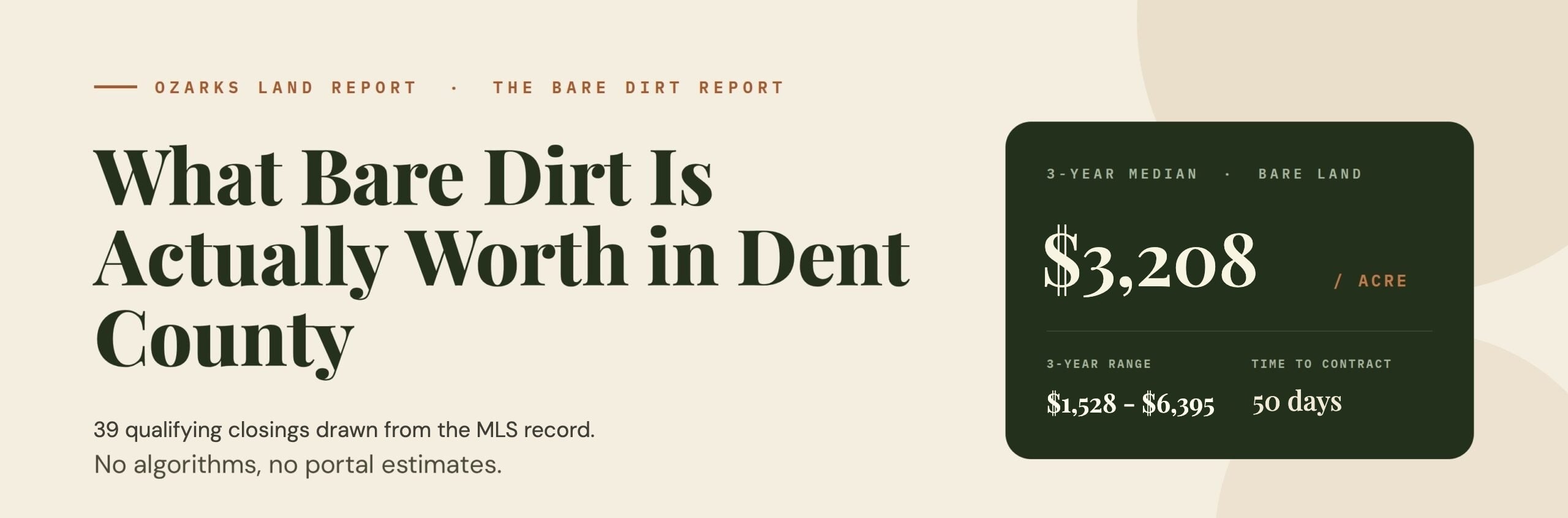
- Three-year median (August 2023-September 2026): $3,208 per acre across 39 qualifying closings (call it $3,200).
- 2026 year-to-date median: $3,277 per acre across 7 qualifying closings through September 30, 2026, approximately 591 acres and $1.67 million in volume
- Zone medians: $2,443-$3,277 per acre, depending on
where in the county the ground sits - Full dataset: 39 qualifying closed sales from August 1, 2023 through September 30, 2026, totaling approximately 3,418 acres and $10.6 million in volume
These figures describe qualifying transactions reported in MARIS
under the report’s stated screening method. They are not a census of
every transfer of land in the county.
Across the 39 qualifying transactions under the screen described below, sale prices ranged from approximately $1,500 to $6,400 per acre.
No algorithm. No portal estimate. Just closed transactions drawn from
the MLS record.
If you’d rather have an estimate than real data, Zillow is thataway.
If you want to know what your ground would actually bring, and where
this market has been heading, keep reading.
Prefer a copy for your files or your coffee table? Download the full report as a PDF.
Why AI often gets your
land’s value wrong
I hear it almost weekly now. A seller calls me and says, “Well,
ChatGPT says my farm is worth $7,500 an acre.” Or Zillow says. Or
Perplexity says. And they’re often wrong, sometimes by a lot. Here’s
why, and it’s not because the machines are dumb. It’s because the data
they’re fed is contaminated in three specific ways:
1. They often can’t reliably separate the dirt from the
improvements. Say an 80-acre farm with a $260,000 house and a
$40,000 shop sells for $600,000. A simple price-per-acre calculation
records that sale as $7,500 per acre. It wasn’t. The dirt in that sale
was worth maybe $300,000, about $3,750 an acre. The rest was lumber,
concrete, and copper wire. Closed-sale records do not reliably allocate
the purchase price between the land and the improvements, and public
portals generally do not provide a dependable land-only allocation. An
automated answer built from those records can therefore overstate
bare-land value. In a county like this one, where most of what changes
hands is a farmstead rather than a bare tract, that single problem is
enough to throw a valuation off by half.
2. Missouri has no statewide requirement that real estate
sale prices be publicly disclosed. That leaves public valuation
tools with incomplete price data, especially for rural land. Asking
prices are not closed values, and an automated tool may remember the
wish instead of the result.
3. An algorithm has never walked your farm. It
doesn’t know your east 40 was select-cut five years ago. It doesn’t know
the “road frontage” is a shared gravel easement with no maintenance
agreement. It doesn’t know whether electric is at the corner or $40,000
away. On bare land, those things can materially change value. I’ve
written about most of them, including utilities,
road
agreements, and creeks
and water rights, because they’re where land value actually
lives.
This report applies the same objective screen to every transaction:
Farm or Land & Lots, at least 30 acres, and zero reported bedrooms
and bathrooms. A blank bedroom or bathroom field is treated as zero. For
purposes of this analysis, those transactions are referred to as
“bare-land” or “bare-dirt” sales. The screen substantially reduces
residential influence, but it cannot guarantee that every tract was
completely free of buildings or other improvements. Same filter, same
method as my quarterly Ozarks land market reports. I pull these by hand
because I want the real answers for my clients.
What
three years of dirt say: a market that climbed, then paused
Line up all 39 closings by year and the story jumps off the page:
| Year | Sales | Median $/acre | Weighted $/acre | Range |
|---|---|---|---|---|
| 2023 (Aug-Dec, partial) | 4 | $2,253 | $2,025 | $1,528 – $2,818 |
| 2024 | 12 | $2,966 | $3,413 | $2,645 – $4,313 |
| 2025 | 16 | $3,622 | $3,519 | $2,000 – $5,928 |
| 2026 (through September, partial) | 7 | $3,277 | $2,825 | $1,856 – $6,395 |
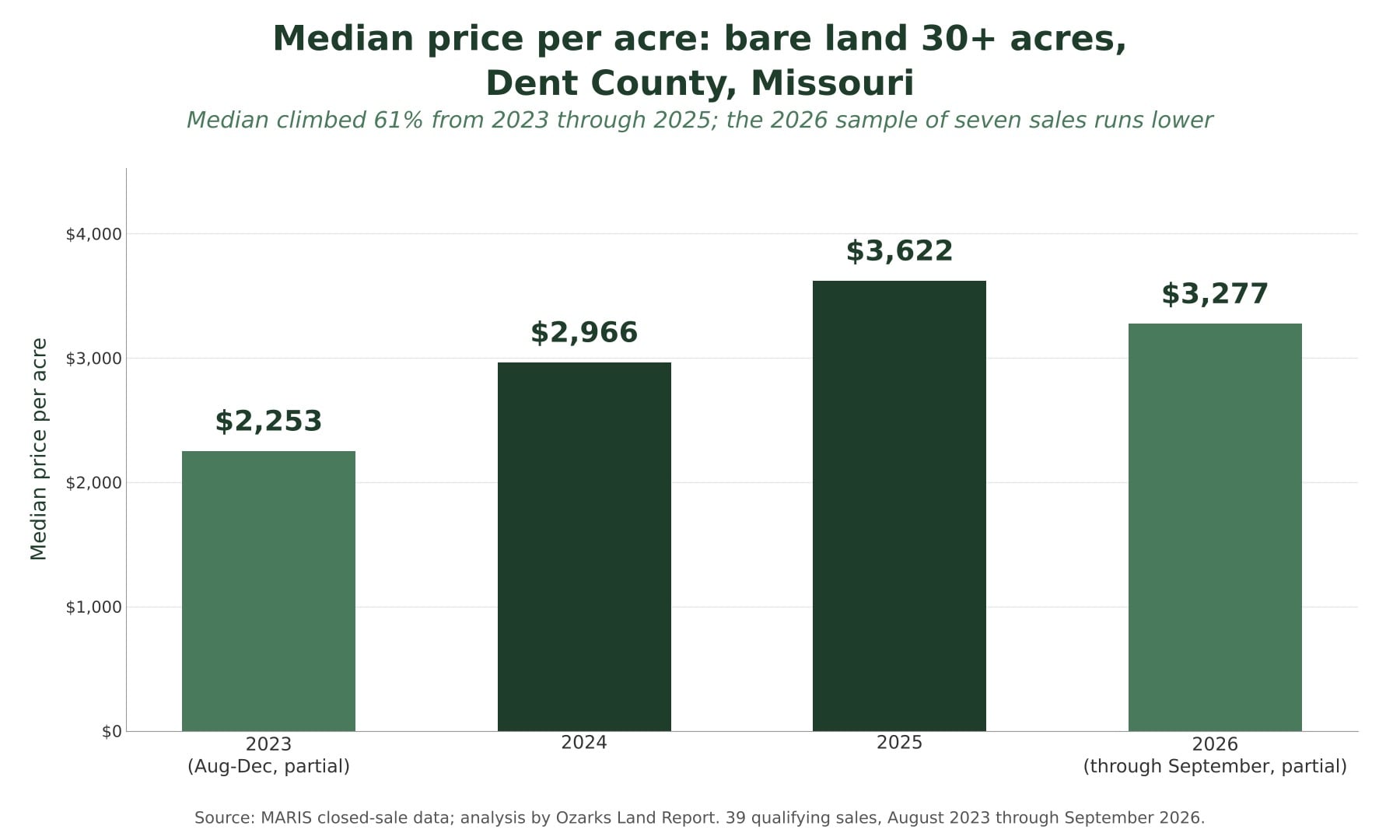
Median price per acre for bare 30+ acre tracts in Dent County:
$2,253 (2023, partial year), $2,966 (2024), $3,622 (2025), $3,277 (2026 through September). The median climbed about 61% from the partial 2023 period
through 2025.
The median increased about 32% from the partial 2023 period to 2024,
then another 22% into 2025, for a gain of roughly 61% across that
stretch. That is the real story in this county: bare dirt in Dent County
repriced steadily for two straight years, and it repriced from a low
base.
The 2026 sample runs lower, at a median of $3,277 per acre, about 10% below the 2025 median. Seven closings is not a trend. Most of the year’s
acreage sits in a few of its larger tracts, and those closed toward the
bottom of the year’s per-acre range, which is why the acreage-weighted
average for 2026 falls below the year’s median. Because the year is partial and the sample contains only seven qualifying sales, these
figures do not establish either a market floor or a market turn.
Owners who purchased comparable bare ground before 2024 may already
have benefited from the market’s repricing. If you’ve been sitting on a
2022 opinion of your land’s value, it’s stale in the other
direction.
The three price zones of
Dent County
“What’s an acre worth in Dent County?” is really three questions,
though not to the degree you might expect. The following zones summarize
the complete August 2023-September 2026 dataset.
| Zone | What it is | Sales | Median $/acre | Range |
|---|---|---|---|---|
| Salem core (the county-seat trade area, Highways 32, 72, and 19) |
Mixed timber, pasture, and small farms within reach of town; the most closings and the highest upper-end result in the dataset | 29 | $3,208 | $2,000 – $6,395 |
| Outlying timber market (Boss, Bunker, Jadwin, and the Licking side) |
Timber and recreational ground along the county’s south and east edges; the highest zone median in the dataset, on five closings |
5 | $3,277 | $1,528 – $4,961 |
| North corridor (Edgar Springs, Lake Spring, Lenox, and the Rolla side) |
Larger farms and timber tracts on the north and northwest side, closer to I-44; the lowest zone median in the dataset |
5 | $2,443 | $2,031 – $4,313 |
Here is a result worth saying plainly rather than dressing up: the
three zone medians fall within about $830 per acre of one another, and
twenty-nine of the thirty-nine closings sit in a single zone. Two of
these zones contain five sales each, which is enough to report and not
enough to lean on.
What that means for a seller is straightforward. In this dataset,
sub-county location did not separate prices as clearly as tract-level
differences did. The widest spread in the dataset, from $2,000 to $6,395 per acre, sits inside the Salem trade area alone. The aggregated data do
not isolate the effect of any one factor.
Two footnotes, because transparency is the product here: (1)
Zones are assigned by MLS market area, then community and ground type
within it. (2) Some north-corridor and outlying ground carries a Rolla
or Licking mailing address and is assigned to an adjacent MLS market
area, but the ground itself is in Dent County. The post office is
elsewhere; the dirt is not.
What tract size does to
price per acre
The following tiers summarize the complete August 2023-September 2026
dataset:
| Tract size | Sales | Median $/acre | Range |
|---|---|---|---|
| 30-50 acres | 20 | $3,546 | $1,856 – $6,395 |
| 50-80 acres | 7 | $2,890 | $2,645 – $4,000 |
| 80-120 acres | 3 | $2,822 | $2,534 – $4,000 |
| 120+ acres | 9 | $3,200 | $1,528 – $4,313 |
Small tracts did bring the most per acre in this dataset, but not in
a straight line. The 30-50 acre tier produced the highest median and the
80-120 acre tier the lowest, while the 120+ acre tier came in second
highest of the four. These are simple groupings rather than controlled
comparisons, and the 80-120 acre tier contains only three sales. The
results show that acreage alone did not determine price per acre;
location, access, usability, and ground quality also matter.
The 2026 market at a glance
Seven qualifying bare-land transactions closed through September 2026, representing approximately 591 acres and $1.67 million in total sales volume.
The median sale price was $3,277 per acre, while the acreage-weighted average was $2,825 per acre. Individual closings ran from approximately $1,900 to $6,400 per acre. The seven sales spread across all three zones, four in the Salem core, two in the outlying timber market, and one in the north corridor, and five of the seven went under contract within 30 days.
How fast does bare
land sell in Dent County?
| Time to contract (final listing) | Sales |
|---|---|
| 7 days or less | 3 |
| 8-14 days | 6 |
| 15-30 days | 5 |
| 31-60 days | 5 |
| 61-179 days | 11 |
| 180 days or more | 6 |
Across the 36 closings with a recorded marketing period, the median time to contract was 50 days, and 19 of the 36 went under contract within 60 days. Nine went under contract within two weeks, while eleven took between two months and six months.
At the other extreme, six sales required 180 days or more, the
longest more than a year and a half. Marketing time can reflect price,
access, property condition, seasonality, relisting strategy, and other
tract-specific factors. The data show a wide range of exposure times,
but they do not establish why any particular property took longer to
sell.
One opinion from the field, clearly labeled as such: in my experience
walking this ground, price is the single biggest lever on marketing
time.
How this report was built
This analysis covers 39 closed MLS transactions from August 1, 2023 through September 30, 2026. Qualifying transactions were limited to
properties classified in the MLS as Farm or Land & Lots, containing
at least 30 acres, and reporting zero bedrooms and zero bathrooms, with
a blank bedroom or bathroom field treated as zero. Duplicate records
were removed, and the statistics were calculated using the acreage and
closed-sale information reported in the source records.
For purposes of this report, a “qualifying bare-land transaction” is
a closed MLS sale classified as Farm or Land & Lots, containing at
least 30 acres, and reporting zero bedrooms and zero bathrooms in the
MLS record.
This screening method is intended to reduce the influence of
residential improvements, but it does not establish that every included
tract was completely free of improvements. Some properties may contain
fencing, utilities, wells, driveways, ponds, outbuildings, cabins, or
other improvements that were not reflected in the MLS bedroom and
bathroom fields. MLS information may be incomplete or entered
inconsistently. Information is deemed reliable but not guaranteed.
A few more details, in the interest of full transparency. All 39 transactions are located in Dent County; three of them are assigned to
adjacent MLS market areas. Zones are assigned by MLS market area, then
community and ground type within it. Time to contract reflects each
property’s final listing period. Three of the 39 closings show no marketing period in the MLS record. They are included in every price
statistic, but a property that was never marketed cannot be said to have
gone under contract in zero days, so the time-to-contract figures cover the other 36. This report is therefore limited to what was reported in
MARIS. A transfer that was never entered in the MLS does not appear here
at all, and one that was entered only after the fact does. Using cumulative days across relistings instead, the median increases from 50 to 78 days, and nine sales rather than six required 180 days or more. The pattern holds either way you count it.
The annual, zone, tract-size, and time-to-contract tables report only
aggregated market statistics. No property addresses, MLS numbers,
photographs, listing remarks, agents or brokerages are identified.
Based on information from Mid America Regional Information
Systems, Inc. for the period August 1, 2023 through September 30, 2026. Information deemed reliable but not guaranteed.
So what’s your land
worth?
Somewhere in those tables. Where you land inside your zone comes down
to the things no algorithm can see: open versus timbered, how it was cut
and when, legal access versus handshake access, utilities at the road or
a quarter mile away, water, neighbors, and how the property hunts or
grazes. In a county where zone medians sit within $830 per acre of one
another, those property-specific factors are not a rounding error. They
are the whole spread. And they’re walked, not calculated.
I’ll give you the real number, and I’ll show you the comparable sales
and methodology behind it, the same way this report shows you the
market’s actual ranges and trends. No charge, no pressure, and if the
honest answer is “hold it and let it grow,” that’s the answer you’ll
get. Start here: What’s my land
worth?
Frequently asked questions
What is an acre of land worth in Dent County, Missouri in
2026? Based on the 39 qualifying MLS closings through September 30, 2026, involving tracts classified as Farm or Land & Lots, containing
at least 30 acres, and reporting zero bedrooms and zero bathrooms in the
MLS record, bare land in Dent County shows a median of $3,208 per acre, with individual closings ranging from approximately $1,500 to $6,400 per acre. In the seven qualifying closings that posted in 2026, the median was $3,277 per acre. Smaller tracts with good access near Salem bring
the top of the range, while large timber tracts on the county’s edges
generally fall in the lower half. These figures describe qualifying
transactions reported in MARIS under the report’s stated screening
method. They are not a census of every transfer of land in the
county.
Are Dent County land prices still going up? Through
2025, yes, and substantially: the median rose about 32% from the partial
2023 period to 2024 and another 22% into 2025, roughly 61% across that
stretch. The seven qualifying closings that posted in 2026 had a median of $3,277 per acre, about 10% below the 2025 median. That sample is too
small to establish a trend, and most of its acreage sits in a few larger
tracts that closed toward the bottom of the year’s per-acre range. There
is not enough 2026 data yet to say the market turned.
Why can Zillow be wrong about my land’s value?
Zillow itself states that vacant land is not eligible for a Zestimate. A
portal page may still display asking-price, tax, prior-sale, or
user-submitted information, and for rural land those records may not
reliably separate land value from houses and other improvements.
Missouri also has no statewide requirement that real estate sale prices
be publicly disclosed. A closed-sale analysis built on a stated,
consistent screen, shown along with its methodology and its limits, is
therefore more useful than a portal estimate.
Why did ChatGPT or Perplexity give me a different
number? AI tools may summarize public listing and portal data
that do not reliably separate improvements from land or asking prices
from actual closings. They’ve also never seen your timber, your access,
or your utilities. Use them to learn concepts, not to price a specific
farm in a state without comprehensive public sale-price reporting.
What makes one Dent County farm worth $2,000 an acre and another $6,400? Less than you’d think about which end of the
county it sits on, and more about the tract itself. The three zone
medians in this dataset fall within about $830 per acre of one another,
and the widest spread, from $2,000 to $6,395 per acre, is inside the Salem trade area alone. Access, utilities, timber condition, openness,
and overall usability decide most of it, and tract size plays in as
well: the 30-50 acre tier produced the highest median in the dataset.
The dataset’s median time to contract was 50 days, but individual marketing periods ranged from under a week to more than a year and a
half.
How long does it take to sell bare land in Dent
County? Across the 36 qualifying closings with a recorded marketing period, the median time to contract was 50 days, and 19 of the 36 went under contract within 60 days. Nine went under contract within two weeks, and six required 180 days or more. Counted on cumulative days across re-listings instead, the median moves from 50 to 78 days.
Marketing time can reflect price, access, property condition,
seasonality, relisting strategy, and other tract-specific factors, and
the data do not establish why any particular property took longer to
sell.
How do I find out what my specific land is worth?
Get a valuation from someone who has both the closed-sale data and boots
that have walked ground in this county. I provide that as a free,
no-obligation breakdown, with the comparable sales shown, not
hidden.
Buying or selling land here? Visit our Dent County farms and land page.
Explore the Complete Bare Dirt Report Series
See closed-sale land-price data for all five counties served by Ozarks Land Report:
Franklin County | Gasconade County | Crawford County | Phelps County | Dent County | Five-County Land Values Dashboard